
EN
What are you looking for?
The selection of a suitable cleaning mechanism is the most important decision in the performance of a dust collection system in industrial applications. An Air Filter system is only as effective as its cleaning cycle and two types dominate the market: Pulse Jet Baghouse and Reverse Air System. Knowing how each cleans filter bags, the cost and the conditions can make the difference between a 99.9% collection efficiency, and an expensive compliance failure.
In Senotay we design Dust Collection Systems for the industry. This in-depth comparison guide gives plant engineers, procurement managers and facility operators the data they need to make an informed decision about which technology to use.
A Pulse Jet Baghouse is a filter bag house that cleans bags with short, high pressure pulses of compressed air, normally between 90 and 100 PSI and 100 to 150 milliseconds in duration. The pulses flow against the direction of the airflow to remove the dust cake that has built up on the outside of the bags and drop into a hopper below.
Key operational facts:
Operates online (cleaning occurs while the system runs — no shutdown needed)
Pulse frequency: typically every 5 to 60 seconds per row of bags
Compressed air consumption: 0.5 to 3.0 SCFM per bag depending on design
Can handle inlet dust loads of 20+ grains per dry standard cubic foot (gr/DSCF)
Bag life: approximately 3 to 5 years under normal conditions
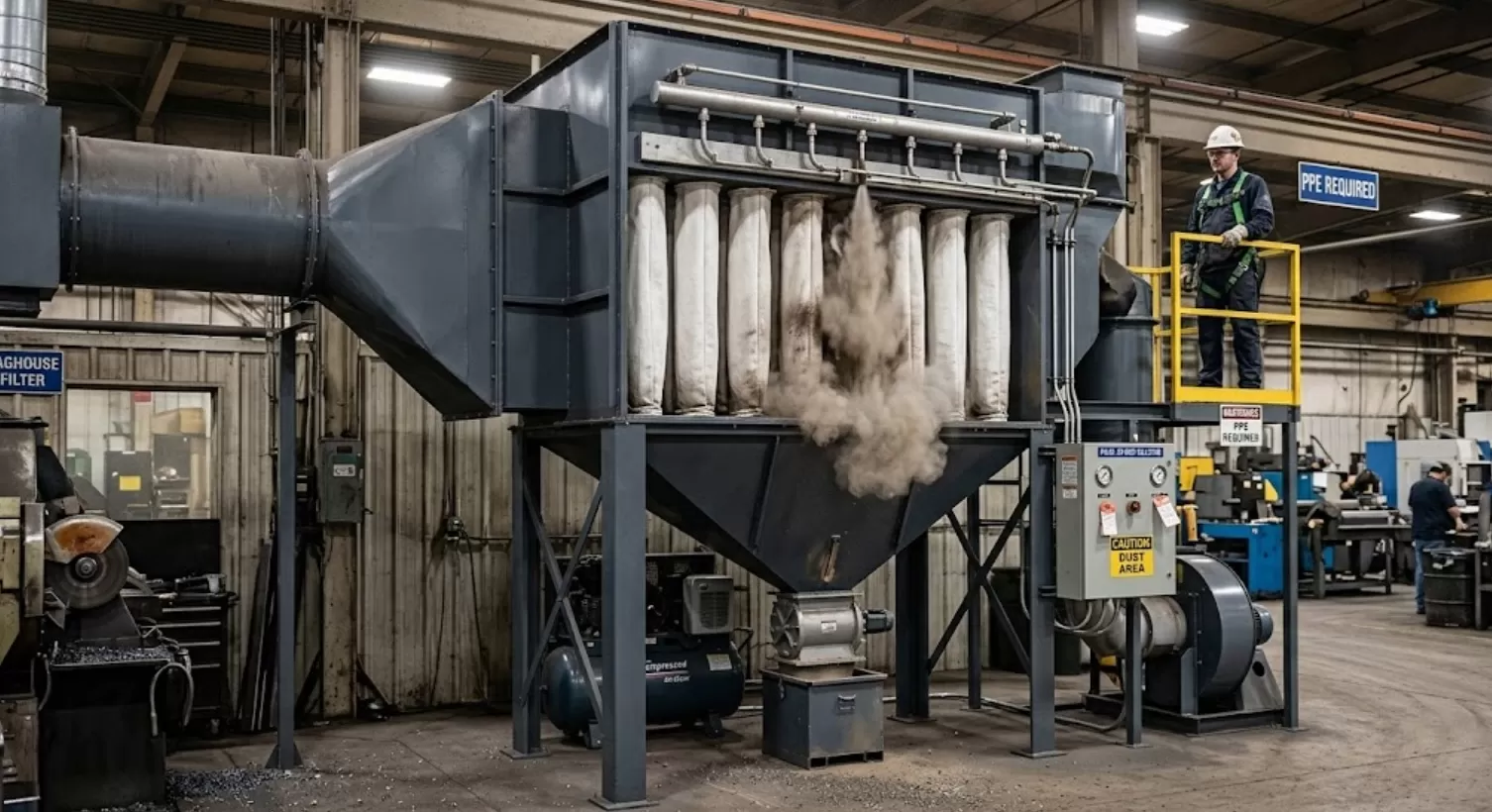
A reverse air system is a filter bag cleaner that can reverse the flow of air through its structure. One or both chambers are shut off and clean air is slowly blown back through the bags which collapse a bit and release the dust cake.
Key operational facts:
Requires compartmentalization — one section offline at a time (offline cleaning)
Airflow reversal pressure: typically 0.5 to 2.0 inches of water column (WC)
Gentle cleaning action — suited for fragile woven bags
Typical cleaning cycle per compartment: 30 to 90 seconds
Bag life: 5 to 10+ years due to lower mechanical stress
The table below highlights the core performance differences between both technologies across key operational parameters:
The U.S. Environmental Protection Agency (EPA) emission factors guide indicates that the efficiency of the pulse jet fabric filter for particles greater than 1 micron is between 99% and 99.9%. A cement plant in Ohio, processing 85,000 CFM of dusty gas, had an outlet emission level of less than 0.01 gr/DSCF with a 99.95% dust removal efficiency, achieved by a pulse jet system recommended by Senotay.
The Filtration Society industry benchmark showed that for power generation applications, replacing filters was reduced by 22% when the pulse intervals were optimized between 10 and 30 seconds in a 2023 study. This directly equates to cost savings ranging from $14,000 to $60,000 per year for mid-to-large facilities.
Reverse air baghouses work best with fine powders that tend to clump together like alumina or titanium dioxide. At a chemical plant in Germany, 6-compartment reverse air cleaning systems were used and the following results were recorded: Average cleaning efficiency of 97,3% over 18 months monitoring period. Only one bag replacement was needed in 8 years, more than twice the life span of similar pulse jet installations.
During process upsets, however, the same plant experienced an efficiency of only 91% when it temporarily operated under high load conditions (more than 6 gr/DSCF inlet loads), demonstrating the sensitivity of the technology to high dust load conditions.
Senotay's engineering team has evaluated hundreds of installations globally. Here is a curated suitability guide for common industrial applications:
Cleaning Efficiency is more than catching particles, it has a direct impact on total cost of ownership (TCO). Here are some approximate estimates of what it will cost if the installation is an industrial plant of 50,000 CFM:
Maintenance labor, compressed air and bag replacement costs for pulse jet baghouse filters are $180,000 to $320,000 for a 10-year operating life.
There is also a Reverse Air System, which costs $140,000 to $260,000 over 10 years (lower energy usage, lower initial investment but more bag changes).
Break-even point: For low-dust-loads this means that the higher capital cost of the Reverse Air systems is recovered in 4 to 6 years.
Where dust load exceeds 10 gr/DSCF, an estimated 35% of downtime is prevented over 10 years with a Pulse Jet system.
Senotay is an expert in precision engineered industrial filtration solutions for optimum cleaning with reduced downtime. Senotay has 20+ years' experience with filtration in 40+ countries and offers:
Real time intelligent pulse timing optimization — Senotay's intelligent controllers optimize pulse timing according to differential pressure, thereby extending bag life by up to 30%.
Hybrid system design — In complex applications, Senotay engineers hybrid systems with high loading capacity and gentle cleaning mechanics of reverse air
Predictive maintenance integration — Bag condition is monitored by sensors and the system warns the operator before the bags lose efficiency, thanks to IoT technology.
200+ bag materials matched to temperature, chemistry and particle characteristics are available in Senotay's filter media library, providing material selection support.
Before recommending a system, Senotay's engineering consultation service starts with a comprehensive particle size distribution measurement (PSD), moisture content, temperature, and inlet grain loading measurement. The clients of Senotay have achieved a typical 18% increase in cleaning efficiency with this data-driven solution compared to generic off-the-shelf solutions.
Pulse Jet Baghouses are especially effective at cleaning for high dust loads (above 5 gr/DSCF) with a collection rate of 99.9%. Reverse Air Systems are highly efficient (95-98%) for fine particulate application systems where the dust load is not a major concern, and offer greatly reduced mechanical bag stress.
Yes. This is one of the greatest benefits of the Pulse Jet Baghouse that it can clean while the system is in operation instead of shutting it down to clean the bags. Cleaning in a Reverse Air System is done by compartmentalizing the area during off-line operation.
The pressure of compressed air. Research indicates that when the PP is below 80 PSI, the efficiency will be reduced by 5-15% due to incomplete removal of the dust cake. The pulse pressure in a Senotay system is calibrated at 90 – 100 PSI for uniformity of performance.
The reverse air filter systems with woven bags are usually limited to 350°F.The pulse jet baghouse can be used to process 500°F when equipped with temperature resistant felted filter bags (glass fiber or PTFE). Senotay also provides a high-temp bag media for the system types when used in extreme temperature applications.
Senotay performs a comprehensive application audit for airflow volume (CFM), inlet dust load (gr/DSCF), particle characteristics, temperature, regulatory emission limit and available footprint. This data allows Senotay to recommend and tailor the best system, avoiding trial and error and ensuring compliance from the start. For a free consultation, check out senotay.com.
Senotay Pulse Jet Baghouse systems pay for themselves in as little as 2.5 to 4 years on most industrial installations due to the following benefits: Less downtime, lower frequency of bag replacement, and better compliance with regulations, which can mean an estimated $50,000+ in fine liability reduction for each compliance event.