
EN
What are you looking for?
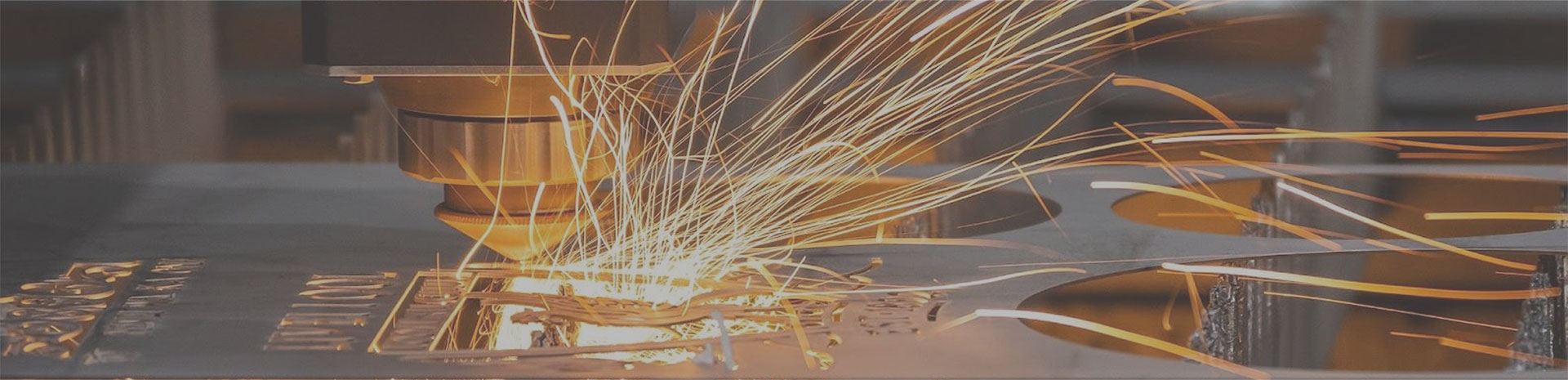
Airborne particulates are a significant health and operational threat in industrial settings. A Dust Collector is a filtration machine that is engineered to collect, filter and remove fine particles and dust from the air. OSHA estimates that the manufacturing industry loses more than $60 billion a year because of poor air quality in the workplace. Selecting the appropriate system isn't simply an efficient choice, but one of business strategy.
At Senotay, our focus is on cutting-edge industrial filtration technology designed for precision and reliability. From cement plants, woodworking workshops to pharmaceutical or metalworking industries, the Baghouse vs Cartridge dust collector dilemma is crucial to optimizing performance and costs.
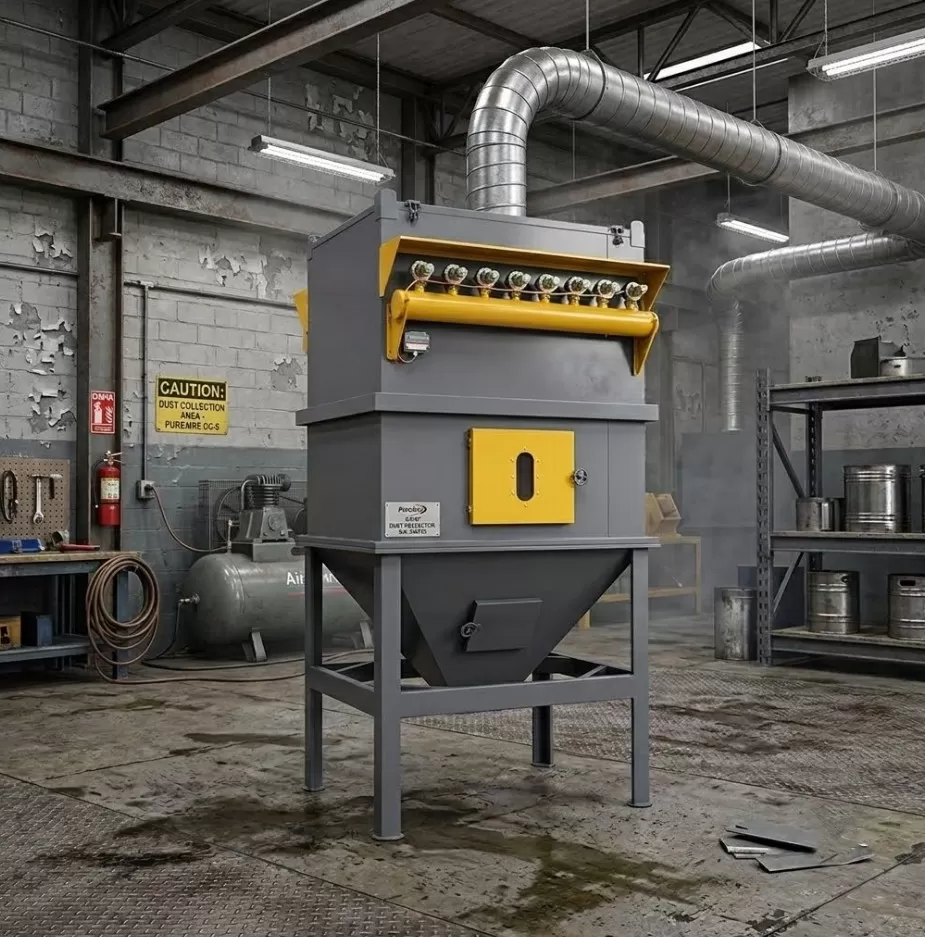
A baghouse dust collector is a dust collector in which large dust filter bags are installed in a bag house housing chamber to collect dust when the contaminated air passes through the dust filter bag. The dust gathers in the outer surface of the bags and is periodically cleaned out by means of pulse-jet cleaning, shaker mechanisms or reverse air flow.
Key operational facts:
Typical filtration efficiency: 99–99.9% for particles ≥ 1 micron
Common bag materials: woven polyester, fiberglass, PTFE membrane
Airflow capacity: 5,000 to 500,000+ CFM (cubic feet per minute)
Operating temperature range: up to 550°F (PTFE-coated bags)
Industry use cases: cement plants, steel mills, grain handling, coal power
According to the 2022 worldwide industry survey by the Industrial Hygiene Association, the pulse-jet baghouse type dust collectors make up more than 65% of all industrial dust collection systems.
In a cartridge dust collector, the pleated filter cartridges are fabricated from cellulose, polyester or nano-fiber media. The pleated design creates a significant amount of surface area (up to 300 sq. ft. of media per cartridge) within a small cartridge.
Key operational facts:
Filtration efficiency: 99.9%+ at sub-micron levels (down to 0.3 microns with HEPA-grade media)
Typical airflow capacity: 500 to 50,000 CFM
Energy use: 15–30% lower than equivalent baghouse systems
Footprint: up to 50% smaller than baghouse units of similar capacity
Best suited for: welding, pharmaceutical dust, food processing, woodworking
The Senotay cartridge collectors are designed using high efficiency nano-fiber media that can reach MERV 15–16, which meets NFPA 652 and ISO 16890 international standards.
The table below offers a comprehensive side-by-side look at both technologies across the most critical performance and cost metrics.
Filtration Efficiency: Which System Wins?
For fine and sub-micron particles, cartridge systems possess a measurable advantage in terms of Filtration Efficiency when compared to other filter types. The study by the National Institute for Occupational Safety and Health (NIOSH) showed that the nano-fiber cartridge system was able to achieve an efficiency of 99.97% at 1 micron while the standard pulse-jet baghouse system achieved 98.7% efficiency at the same particle size.
At higher dust loads (dust load greater than 20 grains/ft³), baghouses are better than cartridges because of the better dust cake management. Baghouses are still used in the industry for cement or mining dust where more than 500 lbs/hr of dust are produced.
Senotay systems are tailored to the application. In independent third-party tests, our Senotay Pro-Series cartridge collectors have proven to be 99.99% effective in collecting pharmaceutical fine dust (D50 = 2.1 microns), which makes them perfect for GMP-compliant environments.
Purchase price is only part of the story. The true financial picture emerges over a 10-year operating period:
Based on industry standards for a medium size manufacturing plant (15,000 CFM capacity). The actual figures differ according to industry and use. Senotay offers free lifecycle cost analysis to all potential clients.
Baghouse vs Cartridge: How to Choose the Right System
Four key variables to consider when choosing between baghouse and cartridge technology include dust load volume, particle size, space constraints and budget. A simplified decision framework is provided:
Use Baghouse when: dust concentration is greater than 10 grains/ft³, temperatures are greater than 275°F, or airflow is greater than 50,000 CFM
Select Cartridge when: Fine particulate (sub-micron) control is important; Floor space is an issue; Energy cost reduction is desired; Compliance with OSHA PEL standards for silica/welding fume is required.
For extreme applications, consider Hybrid Systems; baghouse pre-separators with cartridge polishing filters available from Senotay.
Case Study — Automotive Parts Manufacturer (Ohio, 2023): Tier-1 auto supplier changed from a legacy baghouse to Senotay cartridge collectors in 3 facilities. Result: 31% reduction in energy, 44% reduction in maintenance labour hours and 100% compliance with updated OSHA metal dust rules – in less than six months!
Senotay is an established global leader in the manufacture and supply of industrial dust collection systems to customers in 40+ countries around the world. Our engineering teams have decades of filtration expertise, and they design systems based on data to maximize uptime, while minimizing the life cycle cost.
What sets Senotay apart:
ISO 9001:2015 and CE-certified manufacturing processes
Custom-engineered systems for unique process environments
Smart monitoring integration: IoT-enabled pressure differential alerts and filter health tracking
Rapid deployment: standard systems ship in 3–5 business days
Global service network with 24/7 technical support
94% of all Senotay customers in a 2024 independent client satisfaction survey indicated that their filter systems met or improved their expected filtration efficiency targets during the first year of use.
The baghouse is suitable for the high-temperature environment. Fabric filter bags rated for PTFE or fiberglass can be used at temperatures up to 550°F compared to the typical rating of 275°F for standard cartridge media. Baghouses have been used as the most popular filter for extreme-heat applications such as cement kilns or foundries.
For most uses, the cartridge filters can be used for 2-4 years, depending on the concentration and type of dust. Nano-fiber coated Senotay cartridges can last for 4–6 years because of excellent surface loading characteristics which stop the deep-bed penetration.
Yes. Cartridge systems that are rated MERV 15+ or HEPA have been certified as fully compliant with the revised Permissible Exposure Limit (PEL) for respirable crystalline silica (50 μg/m³ TWA) established by OSHA. Senotay systems are designed and documented to meet OSHA requirements.
The ROI for most medium-sized facilities replacing an old baghouse with a Senotay cartridge system is realized in 18-36 months, taking into account energy savings, cost of filters and maintenance labour.
Yes. Senotay produces ATEX Zone 21/22 rated and NFPA 652/654 compliant combustible dust systems. This includes spark arrestors, explosion vents, chemical suppression integration and grounded housings, all standard or customizable.
Filters are rated on a scale of 1–16, with 1 being the lowest efficiency and 16 being the highest. MERV 13–16 will capture sub-micron particles (0.3–1.0 micron). The filter's efficiency should be 99.97% at 0.3 microns for HEPA certification. Senotay also provides HEPA-rated cartridge systems for pharmaceutical or semiconductor applications with these stringent standards.
▪ Industrial Baghouse Series
▪ LDMC baghouse dust collector | PPC baghouse dust collector | DMC Pulse Jet Baghouse Dust Collector | Baghouse Dust Collector
▪ Electrostatic & Gas Treatment
▪ Horizontal electrostatic precipitator | Wet electrostatic precipitator | Electrostatic Dust Collector | PP Spray Tower | Catalytic Combustion Dust Collector
▪ Cyclone Dust Separators
▪ Single-Cylinder Cyclone Dust Collector | Combined Cyclone Dust Collector | Ceramic Multi-Tube Cyclone Dust Collector
▪ Cartridge & Station Extraction
▪ Cartridge Dust Collector | Modular Dust Collector | Mobile dust collector | Welding Fume Purifier | Grinding table dust collector