
EN
What are you looking for?
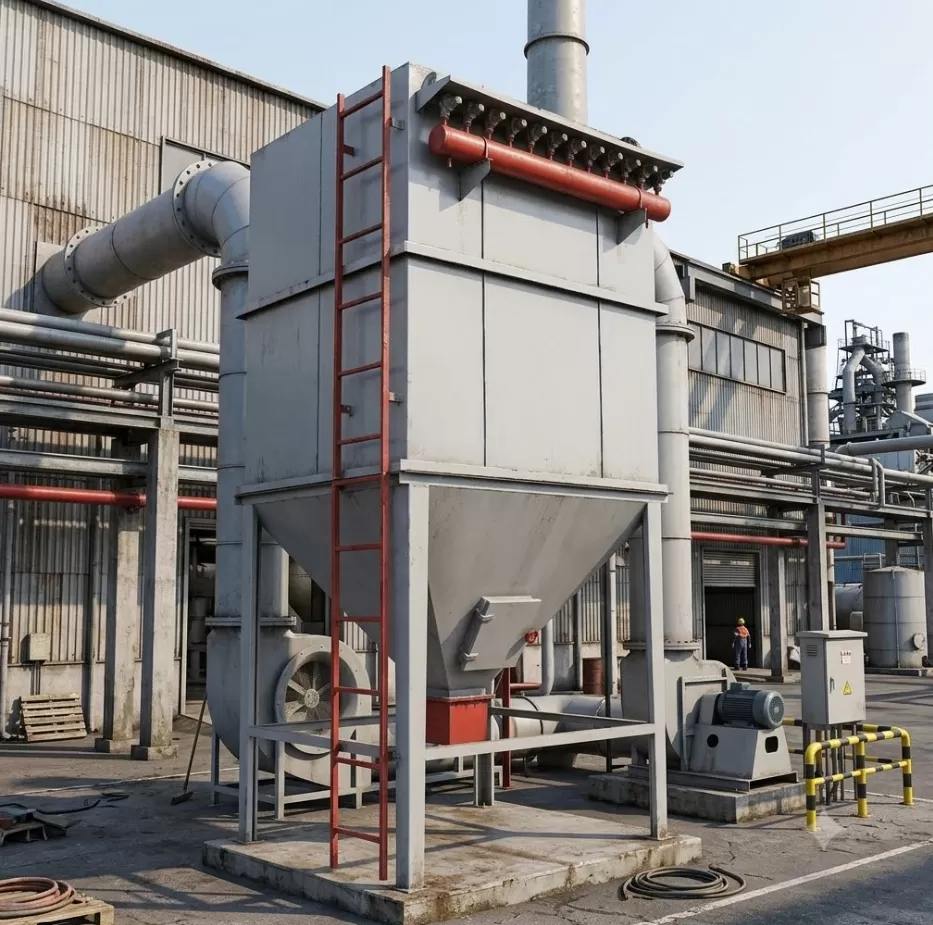
An industrial Baghouse Dust Collector, also known as a fabric filter or "bag filter," is a dry type dust collector that uses fabric filter bags to remove fine dust and particulate matter from exhaust air flows in industrial processes. While the contaminated air is passing through the bag material, particles are trapped on the surface of the bag and cleaned air is emitted from the outlet. Over time, a layer of accumulated dust (called the "dust cake") actually improves filtration efficiency by trapping even finer particles.
If there is any doubt about whether China is an option for an industrial dust control equipment sourcing manager in 2024-2025, then they should only question who is the supplier and what verified price point. Asia-Pacific dust collection equipment market reached a value of USD 2.1 billion (MarketsandMarkets, 2023) while the Chinese manufacturers contributed around 38% of the total dust collection equipment export volume from global manufacturers. That concentration gives them real pricing advantages, which no other manufacturing geography can offer, at comparable technical specifications.
Senotay is a certified mid-range Chinese manufacturer, providing systems with full material traceability, ISO certified quality infrastructure and after sales support that regulated industries demand, but at a significantly lower price than Western OEMs.
The number one complaint of buyers in this market is the 10x difference in price, for what are supposed to be 'the same specification'.In Germany or Southeast Asia a customer asking for the quotes for a baghouse with a pulse-jet filter might receive a quote between $3,800 and $38,000 with the same specification baghouses. It's important to know what causes those differences if you want to place a purchase order.
All figures are FOB port pricing (pre-freight, pre-duty), based on ISO-certified manufacturer data.
Note: Chinese pricing cited above reflects systems from ISO-certified manufacturers with verifiable quality control infrastructure — not lowest-tier commodity suppliers. Bottom-end quotes below $3,800 typically represent uncertified systems with 3 mm mild steel housings and no after-sales support.
The wide price range in the Chinese baghouse market is not arbitrary. Four engineering and operational factors determine whether a system quotes at $4,000 or $40,000:
This is the major cost contributor. Systems under 5,000 m³/h can be used in light industrial applications, small workshops. For heavy duty cement, steel or power generation installations 50,000–100,000+ m³/h capacity may be required. The higher the level of air flow, the larger the housing, the more filter bags and the heavier the structural steel — and all of these costs scale up.
A budget system is usually a fabricated system made of 3 mm mild steel. In the foundry, cement plants, chemical processing, etc. where working at high temperature or in abrasive conditions, 5–6 mm boiler grade steel (Q345R) or stainless steel (304 or 316L). The specification change alone increases the fabrication cost by $800 – $4,500 per system, depending on system volume.
Simple on/off timer-based pulse controllers are priced at $180-$350/unit. The cost of PLC based systems with remote monitoring and differential pressure control is $1,200-$3,800. This performance advantage is significant - on-demand cleaning systems can save 30–40% on filter bag life and 25–35% on compressed air consumption, making the initial investment worthwhile through the potential of long-term savings.
Continuous third-party audits are a real burden on the operational side, and are required for both ISO 9001 and ISO 14001 as well as ISO 45001. Budget-tier suppliers don't bother with the certification because they know they don't have to deal with all these audits. Documentation gaps at the supplier level represents compliance exposure to far exceed the price difference for buyers in regulated industries such as Pharmaceutical, Food Processing, and export-to-EU industries.
Doing sourcing purely based on unit price is a common method for underestimating total cost of ownership (TCO). The cost of filter bag replacement, compressed air use, unplanned downtime, and system life span are costs that are orders of magnitude greater than the cost of the initial system purchase over a 5-10 year period of operation.
Key insight: A system with a 30–40% longer bag life and 25–35% lower compressed air usage pays back the higher acquisition cost within 18–36 months in most industrial applications. The performance gap between certified mid-range and budget-tier systems is not marginal.
A cement plant located in Southeast Asia in 2022 ordered a Senotay PPC offline pulse baghouse system with an airflow capacity of 45,000 m³/h. Two key outcomes after 24 months of operation:
A filtration efficiency of 99% or higher was maintained during the operating period.
Replacing the filters every 4 years as opposed to the industry average of 2 years for similar systems.
A 28% reduction in compressed air consumption, compared to the plant's previous system.
The total cost for 24-month maintenance was reduced by 34% compared to the previous 24-month maintenance cost for the similar capacity system.
The plant successfully completed two regulatory audits with no remediation works required, as it achieved ISO 9001 documentation package.
It is the essence of the Senotay value proposition: certified mid-range pricing and measurable system performance over the system's entire life cycle, which cannot be matched by budget-tier systems.
No ISO certification or self-declaration — third-party audited certifications can be checked; self-declaration cannot
Specifications that are not qualified with a steel grade are fundamentally different in performance between 3mm mild steel and 5–6mm Q345R.
No Differential pressure controller available — Systems with no DP control cannot adjust cleaning cycles to actual operating conditions
After-sales support terms (filter sourcing, availability of spare parts and remote technical support) have a real economic impact within a 10–20 year system life.
Price below $3,800 in combination with systems that claim more than 50,000 m³/h — this price-specification combination does not apply to ISO approved components and boilerplate steel.
The key problem area for any international buyer who is ordering from China is the middle ground of lowest-price suppliers who offer no documentation, no certification and limited post-sale support, versus OEM suppliers from the West, who provide full documentation, but with a 60–70% price premium that is hard to justify for many applications.
Senotay takes this head on. The systems are competitively priced within the certified mid-range of the Chinese market (meaningfully lower than western OEM prices), and offer the level of material traceability, quality documentation and after-sales infrastructure required for regulated industries. PPC offline pulse, LDMC and DMC configurations provide airflow capacities from small workshop applications up to heavy industrial applications, above 100,000m3/h.
When project budgets can't afford the price of a Western OEM but suppliers must provide ISO certification for compliance, Senotay has a defined place in the market.
▪ Industrial Baghouse Series
▪ LDMC baghouse dust collector | PPC baghouse dust collector | DMC Pulse Jet Baghouse Dust Collector | Baghouse Dust Collector
▪ Electrostatic & Gas Treatment
▪ Horizontal electrostatic precipitator | Wet electrostatic precipitator | Electrostatic Dust Collector | PP Spray Tower | Catalytic Combustion Dust Collector
▪ Cyclone Dust Separators
▪ Single-Cylinder Cyclone Dust Collector | Combined Cyclone Dust Collector | Ceramic Multi-Tube Cyclone Dust Collector
▪ Cartridge & Station Extraction
▪ Cartridge Dust Collector | Modular Dust Collector | Mobile dust collector | Welding Fume Purifier | Grinding table dust collector
The price of a FOB from a manufacturer in China that is ISO certified is $3,800 for small systems such as pulse-jet systems with a capacity of between 1,000 and 5,000 m³/h, and $120,000+ for heavy duty industrial configurations above 100,000 m³/h. Those systems in the most common size range (5,000-20,000 m³/h) usually price from $8,500 to $18,000 FOB Chinese port. This is a 60 - 70% discount from comparable Western OEM prices ex-duty & freight.
Due to the different kinds of dust, temperature, moisture, etc., the filter bag life varies. Bags from certified systems can normally last 3 to 5 years, as long as there is no abrasive environment and good maintenance practices are followed. Basic timer controller systems in the budget range will have an average service life of 1-2 years. PLCbased on-demand pulse cleaning provides a bag life that is 30-40% longer than that of timer-based pulse cleaning.
Q3: What filtration efficiency can I expect from an industrial baghouse?
Fine and medium sized dry particles are removed 99% or more efficiently by certified industrial baghouse systems. During operation the dust cake formed on filter bags gradually increases the efficiency, which retains sub-micron particles. The efficiency of 95-97% can be acceptable for standard and budget systems, but not acceptable in pharmaceutical, food processing or emission controlled environments.
As a minimum, buyers should ask for ISO 9001 (quality management), ISO 14001 (environmental management), and ISO 45001 (occupational health and safety) certifications. The CE certification is also required for systems sold to Europe. These certifications have to be audited by third parties and are not self-declared, but can be checked independently by the certifying bodies.
The TCO doesn't begin and end with the up-front price. Costs to consider in the ongoing operation include: the cost of replacing the filter bags (1-5 year cycles depending on the quality of the system), the cost of compressed air used for pulse cleaning, maintenance labor costs, the cost of replacement filter parts (pulse valves, solenoids, diaphragm kits, timer boards), and possible regulatory compliance costs if the system doesn't perform as expected. A certified mid-range system, which provides a 30-40% longer bag life and 25-35% less compressed air consumption, can usually pay for itself in premium over a budget system in 18-36 months.
Q6: Can a baghouse handle high-temperature applications?
Yes, if they are properly specified. For applications at high temperature, Q345R boiler-grade steel (5–6 mm) or stainless steel (304L/316L) housing construction is required and filter bag materials, which use the same filter media used in the previous method, can be used at high temperatures, up to 220°C or more in some cases. The standard systems are not recommended for process streams with high-temperature requirements because they use polyester filters.Polyester filters are not suitable for high-temperature process streams so standard systems with 3 mm mild steel housings are not recommended.
A typical pulse-jet baghouse performs cleaning of filter bags while the system is online and functioning, by sending high-pressure pulses of compressed air at individual bags. Off-line pulse (compartmentalized) baghouse separates each compartment for cleaning during operation – allowing for more comprehensive cleaning and filter life. These pulse models are generally set up offline and are usually used when the dust load is high (cement, steel, mining etc.).