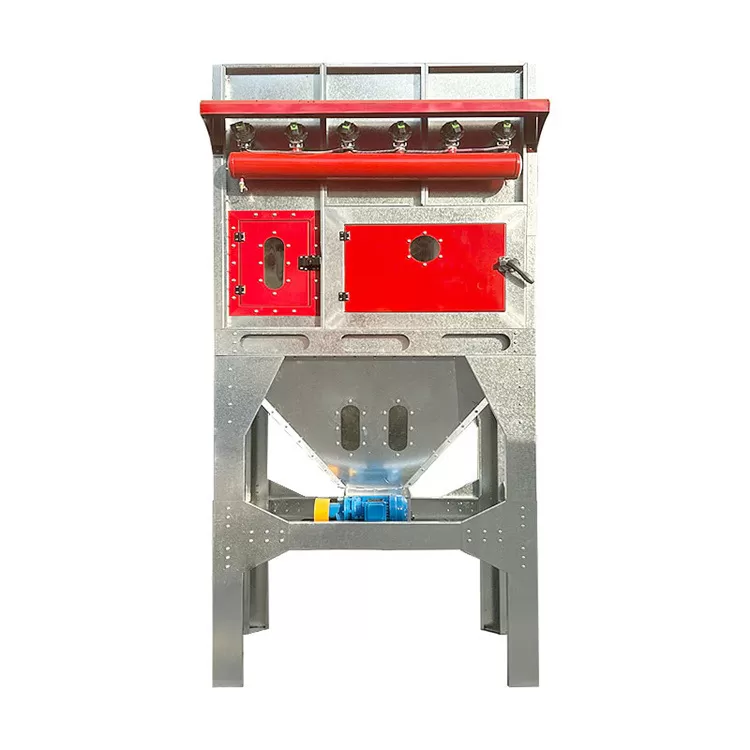
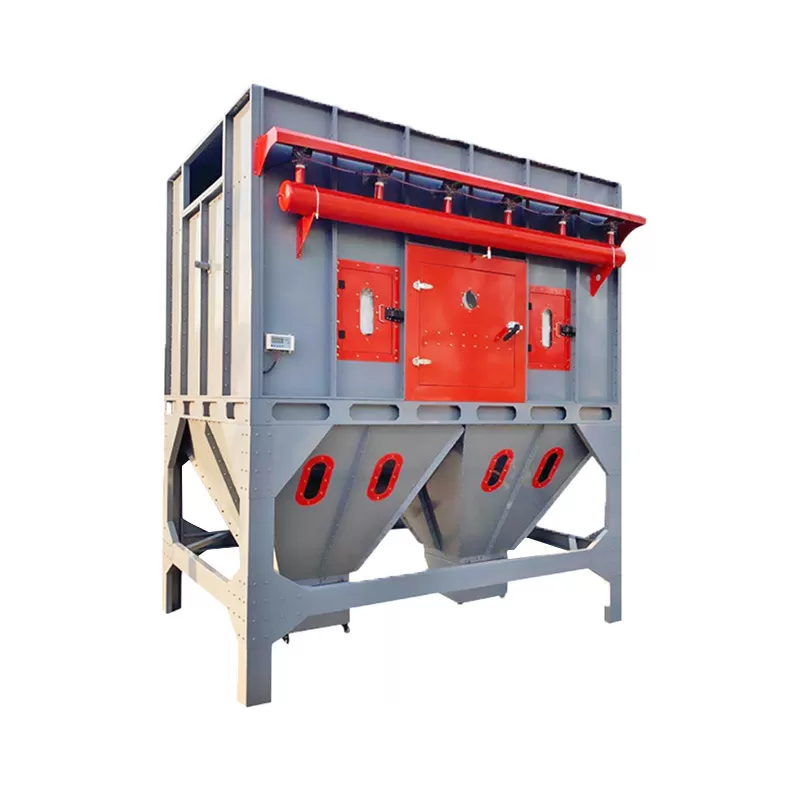
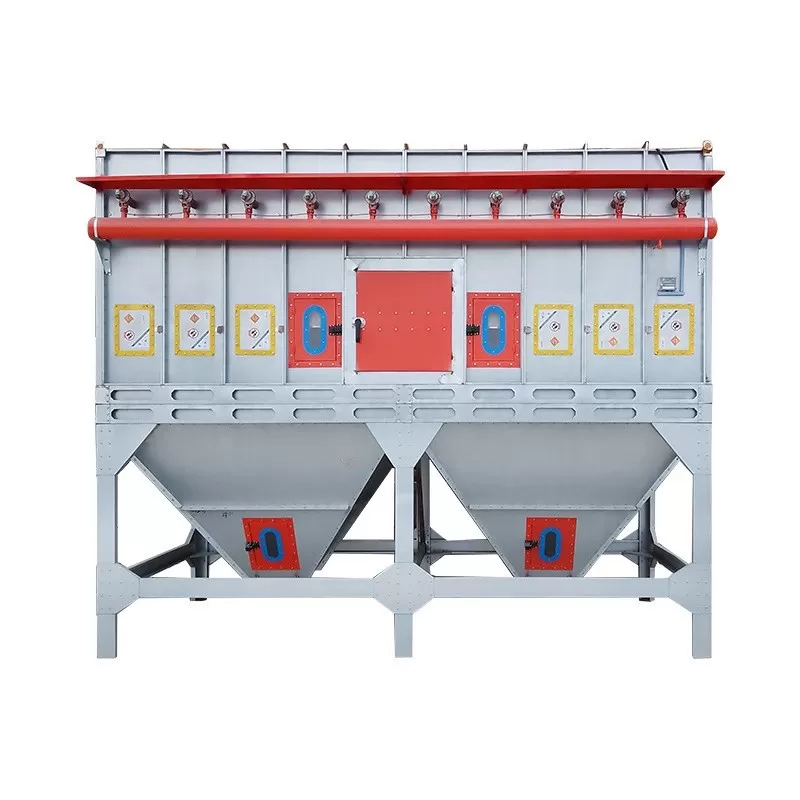
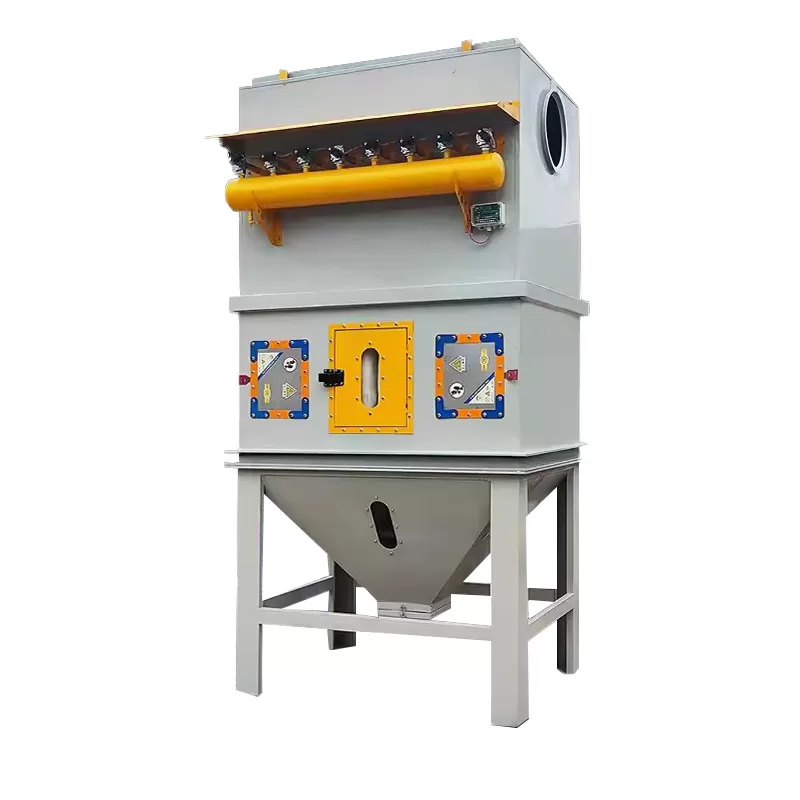
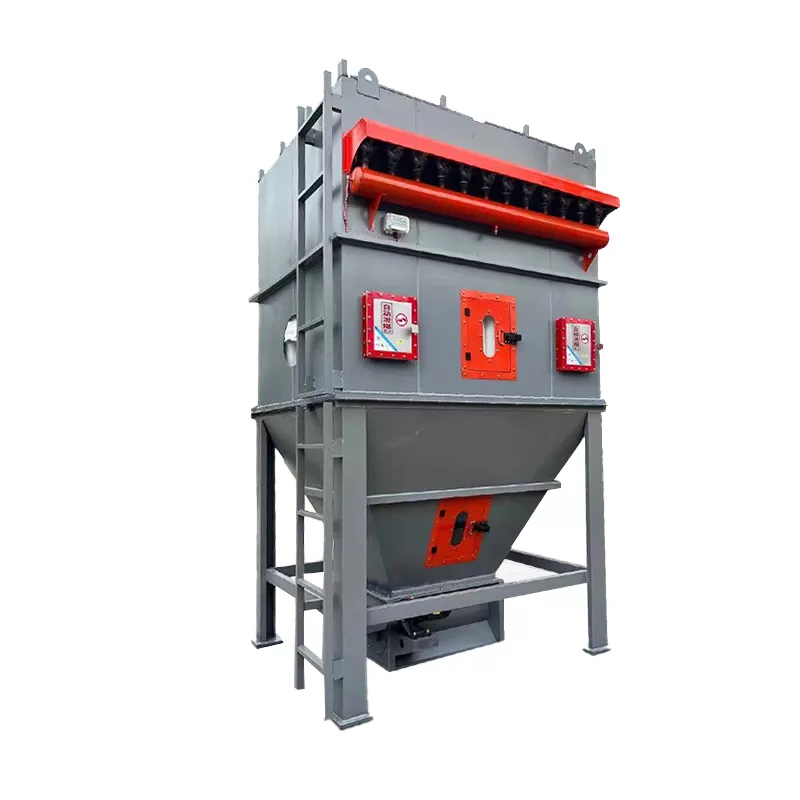
LDMC dust collector for large process-air systems
The LDMC range combines long filter bags, low-pressure pulse cleaning and compartment-based operation. Compare all ten listed configurations below, followed by dimensional, material and operating references for the selected design.
Long-bag filtration
The published LDMC range combines large filter areas with a long-bag arrangement. Check the required installation height and bag-removal space as well as floor area.
Low-pressure pulse cleaning
A pulse-cleaning system releases collected dust from the bag surface. Confirm compressed-air demand and the cleaning sequence for the selected model.
Compartment-based operation
Offline cleaning isolates a compartment while other sections filter. Available filtration capacity during cleaning must be included in the design; this is not a promise of zero downtime.
LDMC model selection and published specifications
Compare the LDMC range by filter area, air volume, bag quantity and valve count. Air volume is stated in 10⁴ m³/h. Catalog values support initial selection; outlet performance, media and test conditions are confirmed for each project.
LDMC model specifications — airflow, filter area, bags and valves| Model | Filter Area (m²) | Air Volume (10⁴ m³/h) | Filter Bag Qty (pcs) | Solenoid Valves (pcs) | Leakage Rate (%) | Emission (mg/m³) |
|---|
| LDMC-1920 | 1,920 | 9.6–11.52 | 640 | 40 | <3 | ≤50 |
| LDMC-2400 | 2,400 | 11.52–13.82 | 800 | 50 | <3 | ≤50 |
| LDMC-2880 | 2,880 | 13.82–16.59 | 960 | 60 | <3 | ≤50 |
| LDMC-3840 | 3,840 | 18.43–22.12 | 1,280 | 80 | <3 | ≤50 |
| LDMC-4800 | 4,800 | 23.04–27.65 | 1,600 | 100 | <3 | ≤50 |
| LDMC-5760 | 5,760 | 27.65–33.18 | 1,920 | 120 | <3 | ≤50 |
| LDMC-6720 | 6,720 | 32.26–38.71 | 2,240 | 140 | <3 | ≤50 |
| LDMC-1920×2 | 3,840 | 18.43–22.12 | 1,280 | 80 | <3 | ≤50 |
| LDMC-2400×2 | 4,800 | 23.04–27.65 | 1,600 | 100 | <3 | ≤50 |
| LDMC-3840×2 | 7,680 | 36.86–44.24 | 2,560 | 160 | <3 | ≤50 |
Specify your outlet requirement: the table lists ≤50 mg/m³ as a catalog reference. Share the limit and measurement basis required for your installation so the proposed media, operating conditions and acceptance criteria can be reviewed together.
LDMC construction and operating reference
These are configuration-dependent catalog ranges and component references, not a universal specification. Final dimensions, flange details, bolt patterns and weight must come from the selected model drawing; range endpoints do not identify matching connections. Operating values require the quoted duty and measurement basis.
LDMC construction references — configuration-dependent dimensions and materials| Parameter | Published configuration reference |
|---|
| Overall length | 3,200–21,500 mm |
| Overall width | 2,600–8,600 mm |
| Overall height | 6,800–24,500 mm |
| Inlet and outlet flange size | DN800–DN2600 |
| Bolt-circle diameter (BCD) | 500–2,400 mm |
| Total system weight | 6.5–85 tons |
| Air-to-cloth ratio | 0.8–1.6 m/min; configuration and duty dependent |
| Pressure drop | 1,200–1,800 Pa; confirm operating duty and measurement points |
| Filter media options | Polyester / PPS / aramid; high-grade non-woven fabric |
| Cage options | Galvanized steel / stainless steel |
| Housing options | Carbon steel; Q235 / Q345 listed material options |
| Seal options | EPDM / silicone |
CALCULATION & COMMISSIONING CHECK
LDMC-1920: installed-area comparison and measurement checks
Using the published LDMC-1920 airflow of 96,000–115,200 m³/h and installed filter area of 1,920 m² gives the following arithmetic comparison:
96,000 ÷ (60 × 1,920) = 0.833 m/min
115,200 ÷ (60 × 1,920) = 1.000 m/min
These calculated values use all listed filter area. They are not the net filtration velocity with a compartment isolated, an approved design ratio or a cleaning setpoint. The actual operating-volume basis and available online area must be confirmed before using the result for selection.
Record the same measurement conditions
Identify dirty-side and clean-side pressure connections on the drawing; record the differential-pressure instrument units and range. Do not substitute total fan static pressure for filter differential pressure.
Record airflow and which compartments are online when comparing pressure trends. Keep clean-media, conditioned-media and cleaning-cycle readings distinguishable.
Include inspection access to bag collars, cage joints and hopper discharge in the service plan. Assess the recorded condition under the equipment manual and site isolation procedures.
This installed-area comparison uses the flow-to-area relationship; EPA guidance explains why available online area must also be considered. EPA monitoring guidance explains why outlet observations and operating-state records belong alongside pressure data.
How the LDMC pulse-jet baghouse works
Dust-laden gas passes through the filter bags, leaving particulate on the fabric surface. Filtered gas moves into the clean-air section and exits the collector. The cleaning controller activates pulse valves in sequence to release accumulated dust into the hopper. The hopper and discharge equipment must remove this material without allowing it to build up into the filter section.
The collector, fan, ductwork, inlet arrangement and discharge system work as one installation. Selection therefore needs both filtration data and process information, including changes in production rate, start-up conditions and any shutdown cleaning requirements.

Applications and configuration choices
LDMC inquiries commonly involve cement, steel, power generation, mining and chemical-processing dust. An industry label alone does not establish suitability: abrasive particles, condensation, sticky material, corrosive gas and temperature excursions can change the media and system design.
Filter media, housing and access
Media options include polyester, PPS and aramid; construction options include carbon-steel housing and galvanized or stainless-steel cages. Request the exact media grade and its continuous and peak temperature limits. Different components have different temperature capabilities; a cage or housing rating is not the operating limit of the complete collector.
Pulse cleaning and dust discharge
Confirm the number of compartments, isolation method and filtration capacity with one section cleaning.
Specify available compressed-air pressure, air quality and supply capacity at the collector.
Match the hopper outlet and discharge equipment to dust bulk density, flowability and the downstream handling system.
Check inspection doors, bag-change clearance, access platforms and maintenance isolation in the layout.
What to include in an LDMC quotation request
Process and site design basis
Normal and maximum airflow, with operating temperature and the volume reference basis.
Dust composition, particle-size information, inlet loading, moisture and any combustible-dust assessment.
Required outlet limit, sampling basis and proposed performance acceptance method.
Installation envelope, duct connections, utilities, electrical supply and destination.
Supply scope and ownership costs
Ask for a clear boundary between the collector body and optional fan, controls, compressed-air equipment, discharge devices, ductwork and installation services. Compare spare bags and cages, pulse-valve access, estimated utility demand and planned maintenance requirements—not only the purchase price. Where a smaller or different configuration is appropriate, review the baghouse dust collector range rather than scaling an LDMC model by name alone.
ENGINEERING CHECK
LDMC filtration loading: check area against actual airflow
Read the airflow units first
The LDMC table expresses airflow in 10⁴ m³/h. Multiply a listed value by 10,000 before using it in a calculation. For a quotation check, express air-to-cloth velocity as:
v = Q ÷ (60 × Anet)
Here, v is in m/min, Q is actual gas flow at the collector in m³/h, and Anet is the filter area available for filtration in m². The factor 60 converts hours to minutes. Do not insert a normalized flow without agreeing its conversion to operating conditions.
Separate installed area from available area
Request the installed area, the area unavailable during each cleaning state, and the remaining net area on the same selection sheet. The operating duty must be assessed with the relevant compartments offline, not only with every bag filtering.
For the long-bag layout, also request bag and cage withdrawal dimensions, overhead obstructions and access-platform clearances. These dimensions should be shown on the arrangement drawing rather than inferred from the collector’s overall height.
The EPA baghouse design reference explains actual-flow/net-area sizing and offline-cleaning allowance. The equation is a consistency check, not a recommended operating ratio or a substitute for dust-specific engineering.
Quality documentation for industrial filtration
SENOTAY publishes ISO 9001:2015, ISO 14001:2015 and ISO 45001:2018 management-system certificates for Hebei Outai on the Quality Control & Certifications page. These concern the manufacturer’s management systems, not blanket product approval. Request current copies and confirm the documentation required for your selected model, configuration and destination before ordering.
LDMC baghouse procurement FAQs
How do I choose between LDMC models?
Start with actual gas volume and dust conditions, then check filtration area, the operating air-to-cloth ratio and capacity during cleaning. Model names and maximum catalog airflow do not replace a project selection.
Is ≤50 mg/m³ a guaranteed outlet emission?
It is the value listed in the published model table. Confirm the proposed outlet performance against your inlet dust loading, filter specification, operating conditions and agreed test basis.
Can LDMC handle hot or sticky dust?
Provide continuous and peak temperatures, moisture and dust behavior for review. Suitable media or upstream conditioning may be necessary; no single temperature or material option covers every application.
Which documents should purchasing request?
Request a model-specific datasheet, layout and loads, material and media schedules, utility requirements, inspection scope, spare-parts list and applicable conformity documents. Confirm commissioning and service scope before ordering.
Request an LDMC dust collector selection
Send your process data, outlet-emission requirement and available installation space. SENOTAY can review the configuration with you and define the technical and commercial scope for your quotation.