
EN
What are you looking for?
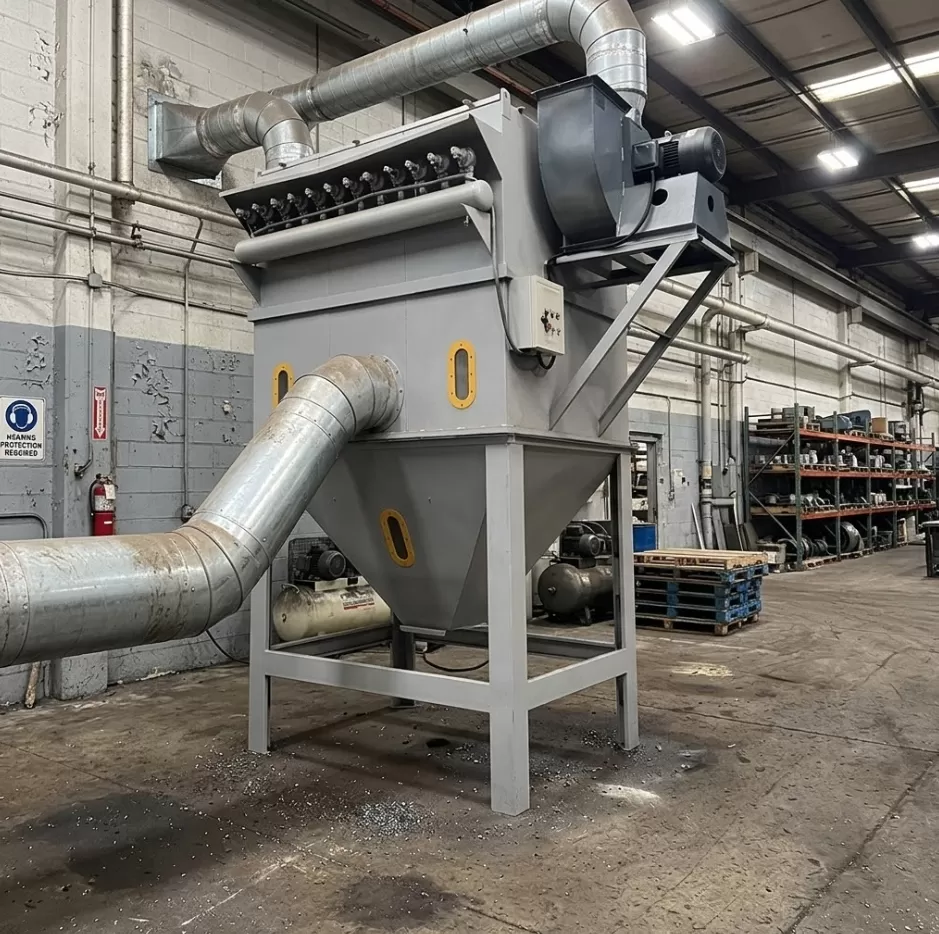
Baghouse Dust Collectors are fabric filters that are used to remove dust from industrial air streams. They are essential for maintaining workplace safety and air quality, and are used in a variety of industries, including the cement industry, grain elevators, woodworking shops, metal fabricating plants, and pharmaceutical manufacturing.
The #1 cause of under-performing baghouses is improper sizing. If it's too small, there are pressure drop problems and filter overload, if it's too large, then it's wasting capital and energy. The U.S. Environmental Protection Agency (EPA) states that improperly sized dust collection equipment at industrial facilities can result in maintenance expenses 30%-40% higher and filter replacements 2-3 times more often in the first year of operation.
Created in collaboration with Senotay's engineering team, this guide outlines the exact formula and method for baghouse sizing, including CFM calculation, air-to-cloth ratio, and practical examples and benchmarks.
CFM (Cubic Feet per Minute) indicates the amount of air volume that your dust collection system needs to process every minute. This is the basic data on which all baghouse sizing calculations are based. All other parameters (filter area, number of bags, pulse-jet timing) are derived from an accurate CFM value.
The general CFM formula is:
CFM = Capture Velocity (fpm) × Duct Cross-Sectional Area (sq ft)
Example: A grinding booth with a 2 ft × 3 ft face opening (6 sq ft) and a required capture velocity of 200 fpm yields:
CFM = 200 fpm × 6 sq ft = 1,200 CFM
For systems with multiple dust-generating points, sum each individual CFM load, then add a 15–20% safety margin.
The amount of air that passes through each square foot of filter fabric per minute is called the air-to-cloth ratio (A/C ratio) or filter velocity or can velocity. The expression is in units of ft³/min per ft² of cloth, or ft/min.
Air-to-Cloth Ratio = Total CFM ÷ Total Filter Area (sq ft)
A lower A/C ratio means more filter area relative to airflow — which extends bag life and reduces pressure drop. Industry practice generally targets:
Pulse-jet baghouses: 4:1 to 6:1 ft/min for general dust
Shaker or reverse-air baghouses: 1.5:1 to 3:1 ft/min for fine or cohesive dust
High-temperature or hazardous applications: 1.5:1 to 2.5:1 ft/min
The table below is a compilation of data from Senotay applications and ACGIH Industrial Ventilation standards, and offers some benchmarks for the A/C ratio for common industries:
Note: Values above reflect clean-air side conditions. Always consult Senotay's sizing engineers when dealing with moisture-laden, explosive, or high-temperature dust streams.
Create a map of any emission area in your process—conveyor transfer points, crushing stations, filling heads, grinding wheels or sanding stations. Record the physical size and process air velocity for each source.
Industry data: A typical mid-size cement packaging plant has 8-14 individual dust generation points and each point has 800-3,500 CFM dust generation requirement, total system load is 15,000 – 30,000 CFM.
Capture velocity depends on dust toxicity and generation intensity. Use ACGIH guidelines:
Low-toxicity, low-generation (flour, wood shavings): 75–100 fpm
Moderate hazard (grain dust, rubber fumes): 100–200 fpm
High hazard (metal grinding, lead dust): 200–500 fpm
Very high hazard (toxic fumes, carcinogens): 500–2,000 fpm
Sum all the CFM sources. Then times by 1.15 to 1.25 for system leakage and future expansion, as well as pressure drop margin. A 20% buffer is recommended by Senotay for most industrial applications.
Example calculation for a woodworking facility with 3 stations:
Table saw: 150 fpm × 1.2 sq ft = 180 CFM
Wide-belt sander: 100 fpm × 4 sq ft = 400 CFM
CNC router: 200 fpm × 2 sq ft = 400 CFM
Subtotal: 980 CFM × 1.20 safety factor = 1,176 CFM → Size for 1,200 CFM minimum
With total CFM established, divide by your target A/C ratio to get required filter area:
Required Filter Area (sq ft) = Total CFM ÷ Target A/C Ratio
To determine the amount of filter area for the woodworking example: 1,200 CFM ÷ 5 ft/min = 240 sq ft of filter area. A typical 6" × 8' (12.57 sq. ft.) bag house would require 20 bags to meet this requirement.
CFM Capture Velocity Quick Reference by Hood Type
Use the table below during preliminary baghouse sizing to estimate CFM requirements before detailed engineering is performed:
A grain processing plant was having an excessive amount of bag failures at 250,000 bushels/day, with the filters used for this plant being replaced every 4 months for a cost of $18,000 per filter change. Following the root cause analysis, the A/C ratio was determined to be 6.8 ft/min, which is much higher than the target ratio of 2.5:1 for fine grain dust.
Senotay's engineering team re-sized the system: Total CFM (38,000 CFM) and a filter area of (15,200 sq ft) at an A/C of (2.5:1). Once the unit was replaced with the appropriate size pulse-jet baghouse, the bag life was extended from 4 months to 22+ months, resulting in more than $50,000 saved per year in maintenance costs.
The pharmaceutical packaging line is producing fine API (Active Pharmaceutical Ingredient) dust, which needs to be filtered at sub-micron level. An arbitrary A/C ratio was initially used to size the baghouse. The emissions test produced a result of 12 mg/Nm³, which was the level that was found to be higher than the level of 1 mg/Nm³ that the facility was designed to achieve itself.
Following the re-engineering of the system by Senotay using a 1.8:1 A/C ratio with PTFE membrane filter bags and HEPA after-filters, emissions have been reduced to 0.3mg/Nm³, which is 70% lower than the internal target. The pressure drop was kept under 4 inches w.g. during the entire production period.
A separate calculation but as important is duct transport velocity, which is calculated and must remain above 3,500–4,500 fpm to avoid dust settling in the pipe.
Always test particle size distribution (PSD) of your particular dust sample when using catalog A/C ratios without dust testing. The median diameter of dust will be 10 microns for a 1 micron dust and 1 micron for a 10 micron dust; so these two types of dust will have different filter velocity targets.
No temperature correction: Air density is dependent on temperature. Air becomes about 40% less dense at temperatures of 300°F. (70°F. is equivalent to 100% density.) This has a significant impact on actual filter velocity.
Not accounting for moisture: Relative humidity in excess of 70% can lead to dust caking on bags which can significantly increase pressure drop and decrease effective filter area up to 30%.
Undersizing for peak loads: Size for peak production rates, not average. Many of the plants operate at 150-200% of their average production.
Senotay provides complete, end-to-end dust collection solutions, including initial CFM calculations, filter media selection, system commissioning, and performance monitoring. Senotay has had application engineering experience in 40+ different industries for more than 15 years, sizing and supplying baghouse systems from 500 CFM lab units to 250,000 CFM industrial units.
Senotay's proprietary sizing methodology combines five variables—total CFM load, dust particle size distribution, temperature, moisture content and regulatory emission limits—into a single equation. This allows us to avoid having a baghouse that is just the right size, but not the optimal size for long-term operation and filter life.
Systems sized using generic industry tables only result in an average 22% reduction in filter replacement frequency and 35% reduction in energy consumption for clients working with Senotay.
▪ Industrial Baghouse Series
▪ LDMC baghouse dust collector | PPC baghouse dust collector | DMC Pulse Jet Baghouse Dust Collector | Baghouse Dust Collector
▪ Electrostatic & Gas Treatment
▪ Horizontal electrostatic precipitator | Wet electrostatic precipitator | Electrostatic Dust Collector | PP Spray Tower | Catalytic Combustion Dust Collector
▪ Cyclone Dust Separators
▪ Single-Cylinder Cyclone Dust Collector | Combined Cyclone Dust Collector | Ceramic Multi-Tube Cyclone Dust Collector
▪ Cartridge & Station Extraction
▪ Cartridge Dust Collector | Modular Dust Collector | Mobile dust collector | Welding Fume Purifier | Grinding table dust collector
The ratio of air to dust is normally in the range of 4:1 to 6:1 ft/min for general industrial dust (moderate particle size, ambient temperature), and lower ratios will be used for fine dusts, cohesive dusts and hazardous dusts to achieve acceptable pressure drop and bag life.
Multiply capture velocity (in feet per minute) by the cross sectional area of each source of dust (in square feet). Add up all source CFM values and add a safety margin for system leaks and future expansion of 15-20%. The end result is your minimum system CFM requirement.
An undersized baghouse will have a high pressure drop (usually more than 6-8 inches w.g.), will have a tendency to blind rapidly and will have less air through the process and higher emissions. In regulated environments, this will lead to compliance issues and EPA fines that often amount to $10,000 to $100,000 per day.
Calculate total filter area / each filter bag area. A typical 6” x 8' (6 x 7.32) bag offers about 12.57 sq ft of filter area. If a total of 500 sq ft is needed, then 40 bags is the minimum needed, but round up to the next available quantity of bags in the selected baghouse module size.
Yes, significantly. The higher the temperature, the less dense the air becomes, and thus the actual filter velocity is altered from standard air conditions. If not corrected, a 70°F system running at 250°F will have an effective air-to-cloth ratio which is about 30% less than that of the original system. This can lead to premature bag failures. Use temperature correction factors when calculating CFM.
Senotay offers comprehensive application engineering support, such as on-site dust characterization, CFM load studies, filter media recommendation and full baghouse specification packages. They rely on industry validated sizing software and real world application data to guarantee that your system will perform as required by the industry from the start and meet regulatory standards.