
EN
What are you looking for?
Industrial filtration systems only work to the extent that their consumable components will. Filter Bags, cartridges & media are the first line of defense for your process equipment to keep downstream equipment free from particulate contamination and to meet regulatory requirements. But, one of the most common problems in plant maintenance is when (and if) to change a filter bag without changing it too soon and discarding valuable filter media life.
Late filter bag change out can cause system pressure spikes, product contamination, and unexpected downtime which can cost industrial operations approximately $250,000 per hour. Such early replacement will also expend filter media that may still have 30–40% of its useful life left. The answer is to pair up two key data points, running hours and differential pressure (ΔP) readings. Senotay offers the technical intelligence and top quality filter media to assist facilities to achieve this balance.
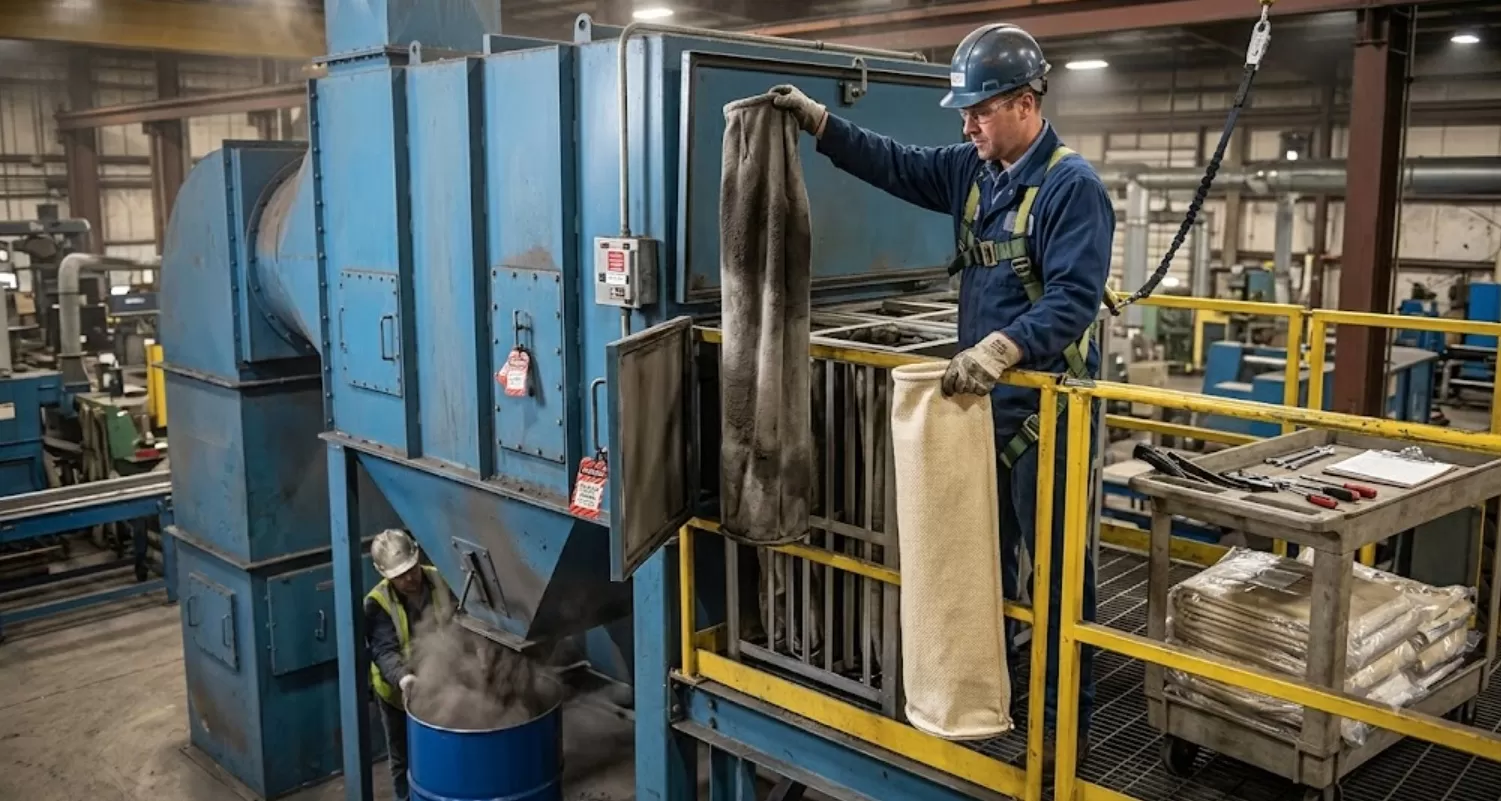
The difference in pressure is commonly called differential pressure or ΔP, which is the pressure drop across a filter element before it (upstream) and after it (downstream). Where the filter bag traps particles its resistance to the flow of air or fluid increases and therefore the pressure drop increases.
What the Numbers Tell You
In the majority of industrial applications with the conventional pulse-jet or shaker-type baghouse systems:
Normal operating ΔP range: 1.0 to 2.5 inches of water column (in. WC) or 250–625 Pa
Caution zone: 2.5 to 4.0 in. WC - increase in monitoring suggested
Replacement threshold: ≥ 4.0 in. WC (1,000 Pa) - filter bag replacement due
Emergency zone: ≥ 6.0 in. WC - potential bag rupture, blowup or bypass
These thresholds may vary depending on the application. Liquid filter systems can have various units (PSI or bar), and HVAC rated bag filters can use ASHRAE 52.2 standards with a final Airflow resistance of 1.0 in. WC above initial.
Table 1: ΔP Thresholds vs. Recommended Action (Pressure Drop Δp Maintenance Timing Guide)
Running hours are a time-based predictive maintenance framework while ΔP is a real-time performance snapshot. Most manufacturers, including the industrial grade media provided by Senotay, include the number of hours of expected service life under normal conditions.
Typical Running Hour Benchmarks by Filter Type
These figures represent general industry benchmarks for common filter bag materials:
Woven polypropylene bags (general dust): 2,000 – 4,000 hours
Polyester felt bags (light to medium duty): 3,000 – 6,000 hours
PTFE membrane bags (high-efficiency/fine dust): 6,000 – 10,000 hours
Fiberglass bags (high-temperature applications): 4,000 – 8,000 hours
Nomex/Aramid bags (elevated temperature, up to 204°C): 5,000 – 9,000 hours
In 2023, Industrial Filtration Association (IFA) commissioned a survey of industry that showed that 67% of the unplanned baghouse downtime events were in facilities that tracked only one indicator (either hours or pressure) and not both.
Table 2: Filter Bag Service Life Matrix - Hours & ΔP Combined (Filter Bag Replacement Schedule Reference)
Running hours and ΔP are not enough to make filter bag replacement decisions. A bag that has been in service for 3,000 hours and the ΔP is stable can have years of useful life remaining. On the other hand, if a bag has a high rate of increase in ΔP, and a short life at 1,200 hours, this process is referred to as 'blinding' and may need immediate attention.
Three Scenarios That Demand Immediate Replacement
If there is a change of greater than 0.5 in., it is a sudden ΔP spike. WC in one 8 hour shift no matter how many hours worked.
Unstable ΔP oscillation: Pressure cycling more than ±0.8 in. WC without process change - indicates bag fabric failure or seam breach
Cleaning cycle failure: Bags that fail to return to near-baseline ΔP after a pulse-jet or mechanical shaking cycle have exceeded their regeneration capacity
Senotay suggests taking a baseline ΔP reading for any new bag installation and plotting trend readings at a minimum of weekly intervals. With a basic statistical control chart, the facility can detect an abnormal trajectory of ΔP 3-5 weeks before critical failure limits are reached.
A mid size cement manufacturing plant in Southeast Asia that uses a baghouse to remove dust from 1,200 metric tons per day (MTD) was experiencing an average of 4.2 baghouse shutdowns a year with an average of 6.5 hours of plant downtime each shutdown. The facility was changing bags every 5,000 hours, with no reference to the ΔP readings.
The facility had the following results after 18 months with the dual-indicator protocol implemented as recommended by Senotay:
Unplanned shutdowns reduced from 4.2 to 2.6 per year (38% reduction)
Average filter bag service life extended from 5,000 to 6,800 hours (36% improvement)
Annual filter media cost reduced by approximately $47,000
Emissions compliance violations: zero in the 18-month period (previously 2 per year)
That result proves that it's not about changing filter bags more often, it's about smarter data used to maintain your filters efficiently.
In addition to the ΔP numbers and hour counters, maintenance engineers need to keep an eye on the physical and operational indicators:
Rising dust emissions or opacity at outlet stack - may be due to a bag breach.
The contamination of the product after the filter housing.
Unusual noises from the pulse-jet cleaning system (Bags have stiffened)
The holes, seam failures or cake buildup over 12mm is detected through visual inspection.
The cleaning pulse frequency was raised beyond 30% of the original set-point, with no ΔP recovery.
Senotay is an industrial filtration solutions provider and has a wide range of expertise in filter media selection, application engineering, and lifecycle optimization. Senotay's filter bag portfolio covers a complete range of materials: polyester, polypropylene, PTFE, fiberglass, Nomex and specialty composites with meticulously tested and documented ΔP performance curves.
Senotay's difference is the focus on combining high-quality filtration media with technical advice that is specific for the application. If you set up a filter bag with Senotay, you will get:
Manufacturer certified service hour benchmarks specific to your dust load and temperature profile
Accurate threshold-setting based on published ΔP performance curves for each media grade
Replacement scheduling integrated with your CMMS or maintenance calendar – consult the schedule.
Media upgrade analysis - assessing if a better grade of media (PTFE membrane) would increase media life cycles and decrease total cost of ownership
Precise Pressure Drop Δp Maintenance Timing has the potential to affect safety, regulatory compliance and profitability in industries such as cement, power generation, chemical processing, food manufacturing and metal casting, which Senotay's technical team supports.
Explore More Air Pollution Control Equipment
Q1: What is considered a normal ΔP for industrial filter bags?
The normal operating differential pressure for most baghouse applications is between 1.0 and 2.5 inches of water column (in. WC). It is determined by the type of filter media, airflow velocity and the concentration of dust. Senotay suggests the application specific baseline should be set prior to commissioning.
Q2: How often should I log ΔP readings?
For stable operation at least, record at a weekly rate during the operation. In applications that involve high dust loads, cement or chemical processes, daily logging is recommended. Continuous automated ΔP monitoring systems offer the most detailed information, and alert when thresholds are being approached.
Q3: Can I clean filter bags instead of replacing them to reduce ΔP?
Pulse-jet, shaker and reverse air cleaning systems are meant to remove collected cake in a periodic manner from filter bags. If a bag gives no response to a cleaning cycle to return it to within 80% of its baseline ΔP, though, it is a good sign that the media in the bag is at the end of its cleaning life and needs to be changed.
Q4: What happens if I exceed the replacement threshold and keep running?
Pressures above the critical ΔP can result in the failure of the bag fabric, bypass of the filter (allowing contaminated air or fluid to go unfiltered), pressure imbalance in the system and possible damage to downstream equipment. It can also form a violation of the regulations for regulated industries.
Q5: How does Senotay help determine the right replacement schedule?
Senotay offers media-specific performance data such as ΔP curves, service hours at various operating conditions and technical consultation to aid the development of a data-driven replacement schedule. This method helps to even out the cost of media with the risk and expense of downtime.
Q6: Are running hours a reliable standalone indicator for filter bag replacement?
The running hours are a good starting point but do not consider changing dust loadings, unusual operating conditions or process changes. The lifespan of a bag in a lightly-loaded application can be well exceeded, and in a heavy-loaded application, the bag can fail before reaching the benchmark. Always to use running hours in conjunction with ΔP trend monitoring for proper decisions.