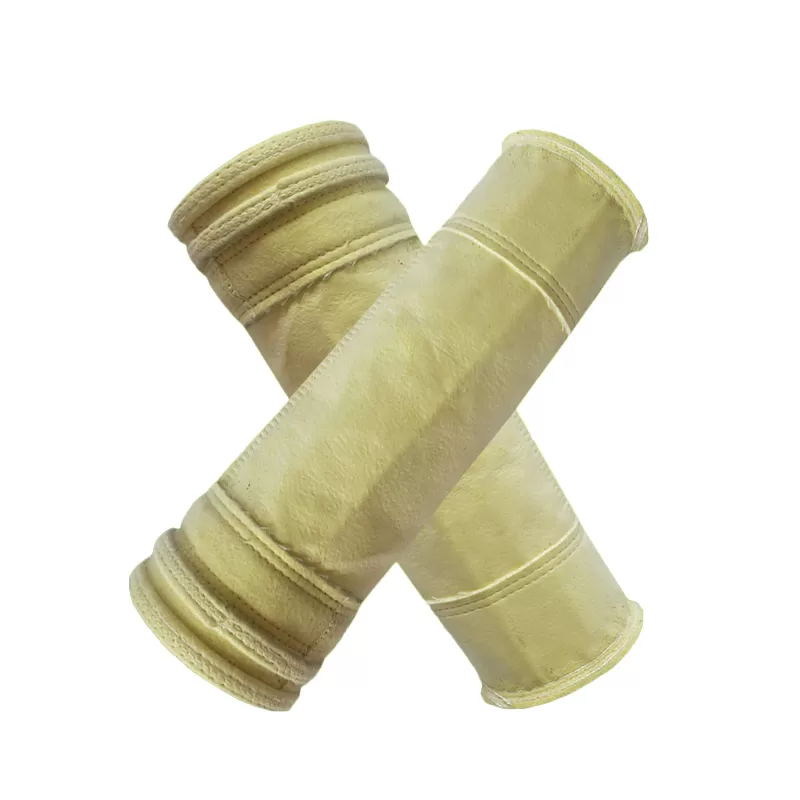
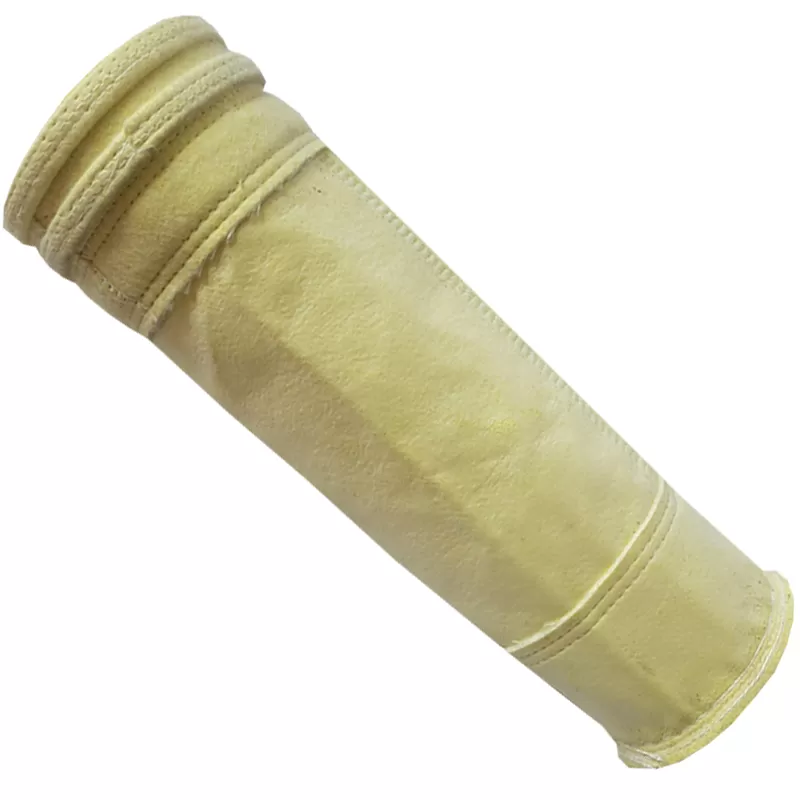
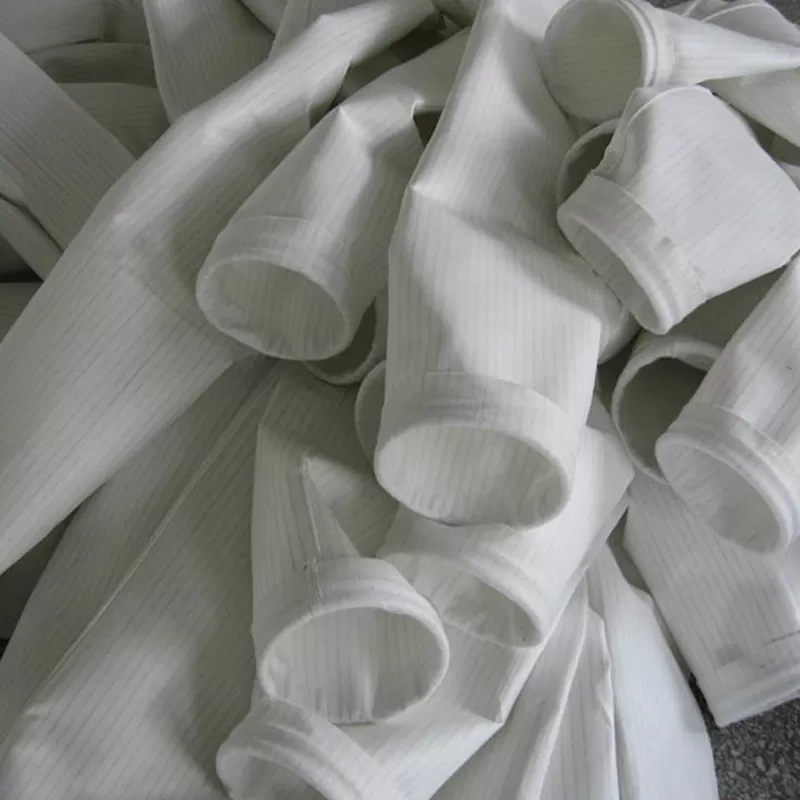
Extreme Thermal Stability: The SENOTAY Fiberglass Filter Bag
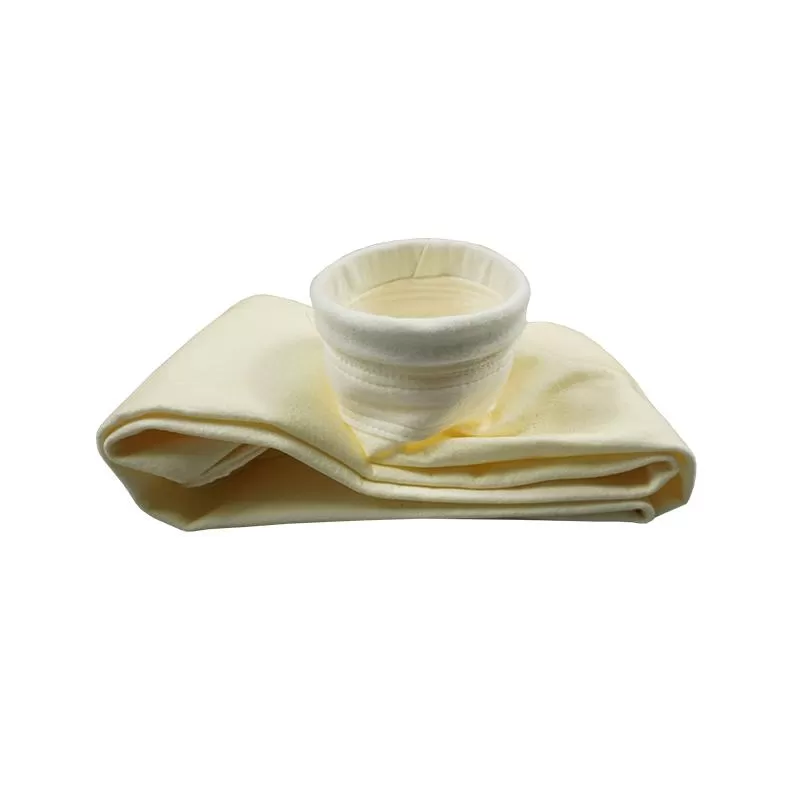
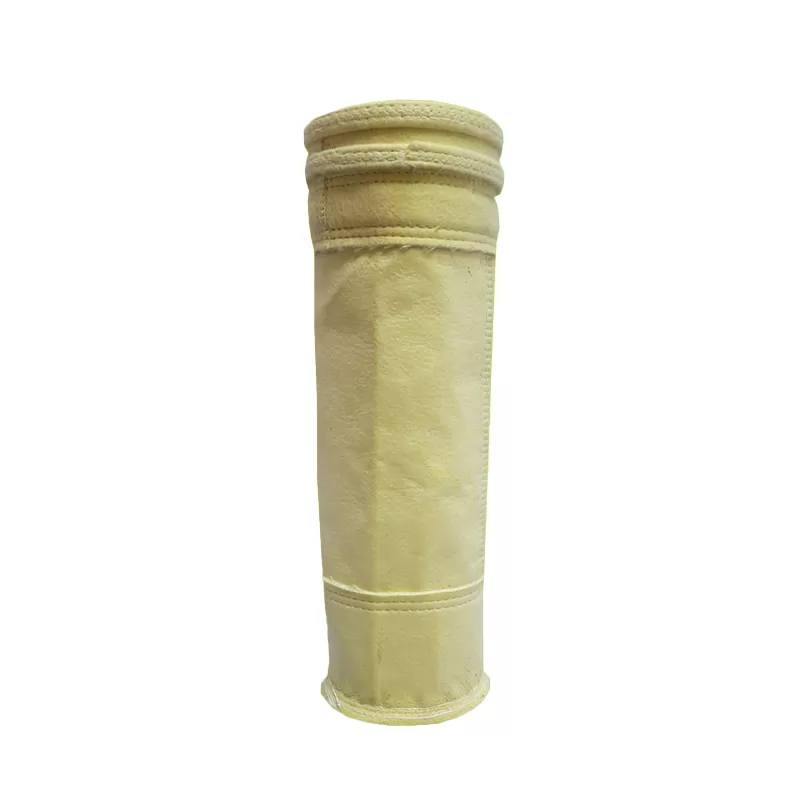
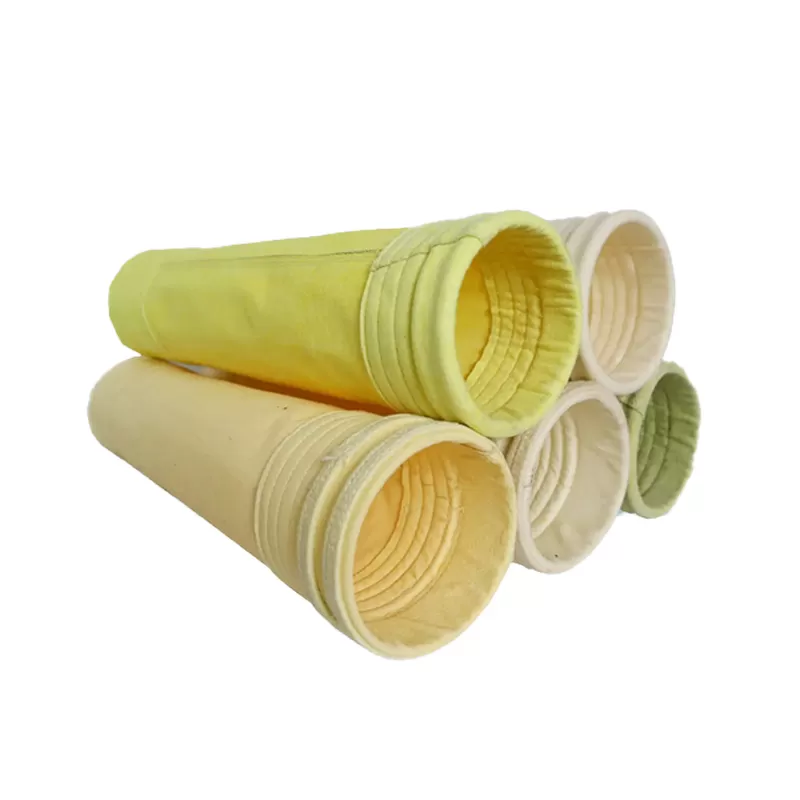
The Fiberglass Filter Bag is woven from continuous glass fiber yarn rather than needle-felted like Senotay's FMS or Basalt lines, giving it a smoother surface for easier dust cake release and tensile strength that exceeds steel wire of the same diameter at a fraction of the weight. It operates continuously at 260 to 280 degrees Celsius with peak tolerance to 300, reaching up to 99.5 percent filtration efficiency, though its woven glass structure requires minimum 20-wire support cages to prevent the flex fatigue pure glass filament is prone to under repeated pulse-jet cleaning. Cement kilns and steel furnaces choose fiberglass specifically for steady, continuous-flow high-temperature systems where its smoother weave sheds dust with less pulse energy than a felt-based alternative needs. Carbon black and calcium carbide plants rely on the same PTFE or silicone surface treatment to protect the glass fibers from the self-abrasion that would otherwise shorten bag life under constant mechanical shaking. Hebei OuTai Environmental Protection Equipment Co Ltd manufactures the FGB Series in Hebei, China, from FGB-100 through FGB-1000, with weave density, surface finish, and cage compatibility matched to the gas flow pattern and cleaning method of each baghouse.
Why Leading Plants Choose SENOTAY Fiberglass Filter Bag
Factory-Direct Pricing. Certified Quality. Dedicated Support.
Best Price Guarantee
Certified & Compliant
Fast, Reliable Delivery
Comprehensive After-Sales Support
Lifetime Technical Support: Expert assistance with structural support requirements (fiberglass requires specialized minimum 20-wire support cages to prevent flex fatigue), air-to-cloth ratios, and gas chemistry screening (noting limits with hydrofluoric acid or strong alkalis).
Full System Availability: Immediate access to matching heavy-duty 20-wire galvanized, epoxy-coated, or stainless steel filter cages (essential for maximizing fiberglass service life).
Remote Troubleshooting: Fast diagnostics to resolve differential pressure spikes, premature mechanical bag breakage, or localized abrasive wear patterns.
Trusted by high-heat metallurgy and cement plants worldwide. Ready for yours.
Main Features & Properties of Fiberglass Filter Bag
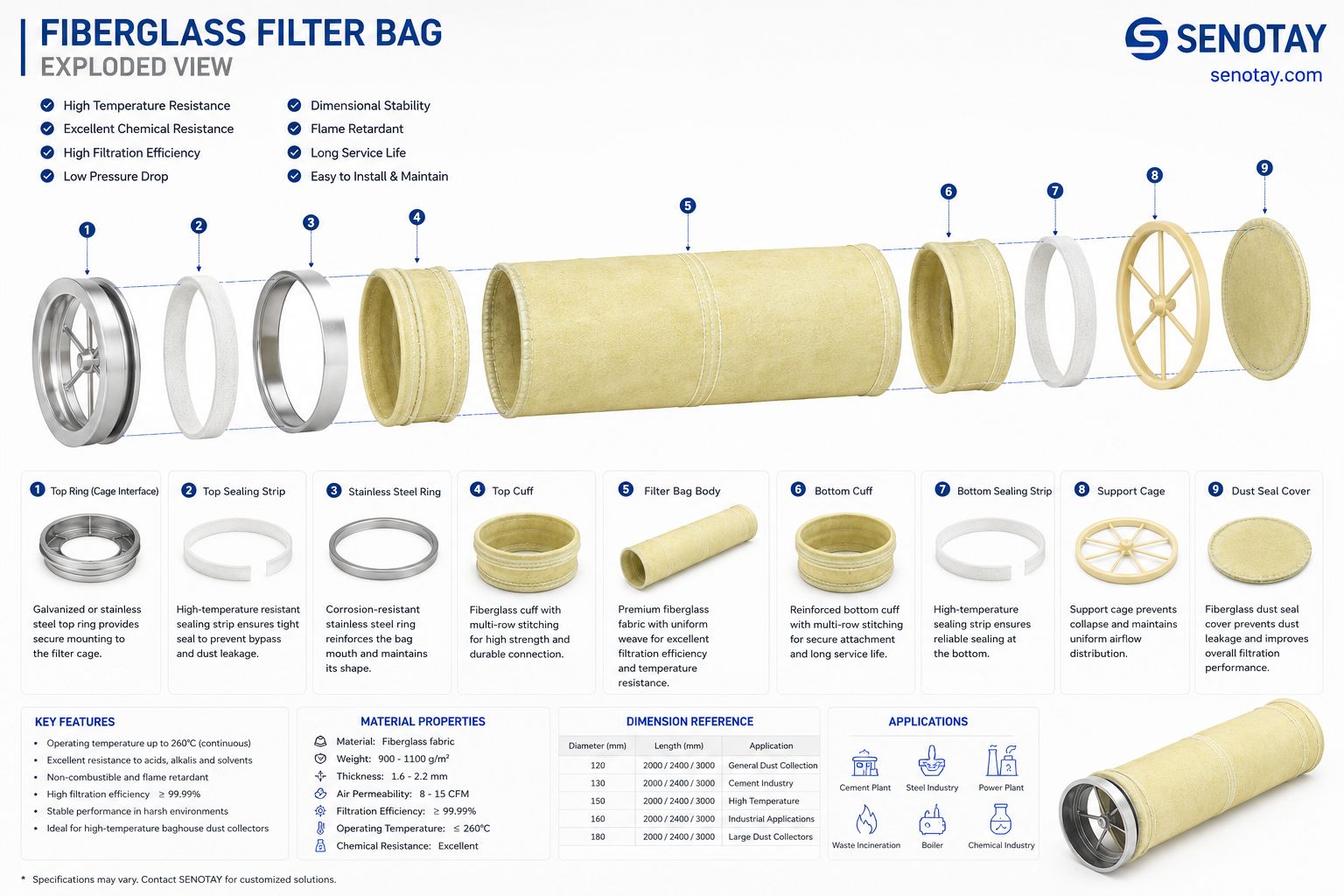
· Continuous operating temperature:Temp. upto up to 260°C, peak Temp is 300°C.
· It is Excellent in acid and oxidation resistance.
· It have Low elongation and high dimensional stability.
· It have High filtration efficiency with minimal pressure drop.
· Compatible with PTFE membranes, graphite coatings and silicone treatments.
· Superior resistance to hydrolysis and mechanical wear.
Technical Advantages in Manufacturing Fiberglass Filter Bags at Senotay
At Hebei OuTai Environmental Protection Equipment Co., Ltd. (Brand: Senotay) we apply advanced technology and strict quality control to produce premium fiberglass filter bags that meet industrial and environmental standards worldwide.
Senotay’s Manufacturing Advantages
· In-House Weaving Lines: It is well Controlled fabric density for optimal filtration efficiency.
· Surface Enhancement Treatment: We put PTFE coating In this bag for anti-adhesion and chemical protection.
· Precision Stitching: It deal with Heat-resistant sewing threads to maintain bag integrity.
· ISO 9001:2015 Certified Production: We Ensures consistent quality across every batch.
· Custom Fit Production: Tailored for various pulse-jet and reverse-air dust collectors.
Senotay’s fiberglass filter bags deliver superior dimensional stability, longer life, and lower operating costs — key reasons it’s a trusted choice among chemical and metallurgical industries.
Difference Between Woven vs. Non-Woven Fiberglass Filter Bags
Property | Woven Fiberglass | Non-Woven Fiberglass |
Structure | Interlaced yarns forming a stable weave. | Randomly bonded fibers (needle felt) |
Air Permeability | Lower (dense structure) | Higher (porous, flexible fabric) |
Mechanical Strength | Higher tensile and tear resistance | Good flexibility, less stiffness |
Dust Release | Easier due to smoother surface | Requires additional coating |
Common Use | High-temperature steady flow systems | Pulse cleaning and flexible housing systems |
Advantages of Fiberglass Filter Bags
· Excellent Heat Resistance – Operates continuously at 280°C with minimal shrinkage.
· Superior Filtration Efficiency – Up to 99.5% efficiency in particle capture.
· Chemical Durability – Withstands acids and oxidation gases.
· Low Energy Cleaning – Easier dust release reduces pulse energy demand.
· Non-hygroscopic – Does not absorb water or moisture.
· Extended Lifespan – Resistant to abrasion, maintaining stable performance for years.
Types of Fiberglass Filter Bags
Type No. | Weight (g/m²) | Thickness (mm) | Operating Temp (°C) | Surface Finish |
FGB-100 | 450 | 0.8 | 250 | Glazed |
FGB-200 | 500 | 1.0 | 260 | PTFE Coated |
FGB-300 | 550 | 1.1 | 270 | Graphitized |
FGB-400 | 600 | 1.2 | 280 | Silicone Treated |
FGB-500 | 650 | 1.3 | 280 | Acid-Resistant |
FGB-600 | 700 | 1.4 | 250 | PTFE Laminated |
FGB-700 | 750 | 1.5 | 260 | Plain Finish |
FGB-800 | 800 | 1.6 | 280 | Dual Layer Coated |
FGB-900 | 900 | 1.8 | 280 | Oil & Water Repellent |
FGB-1000 | 950 | 2.0 | 280 | High Density Weave |
How Senotay Improves the Performance of Fiberglass Filter Bags
· Surface Finishing Treatments: PTFE or silicone coatings enhance resistance to acids and sticky dust.
· Thermal Stabilization: Heat-setting guarantees stable dimensions during continuous high-temperature use.
· Reinforced Stitching: High-temp threads prevent seam failure under stress.
· Customized Gas Flow Design: Optimizes collector efficiency, making Senotay filters compatible with all major bag filter housings.
Comprehensive Technical Specifications
Parameter | Typical Value | Test Method | Range | Notes |
Fiber Content | 100% Glass Fiber | Visual inspection | 85-100% Glass | May include composite materials |
Weight | 700±50 g/m² | ISO 9073-1 | 600-900 g/m² | Varies by construction type |
Thickness | 0.6-1.8 mm | ISO 9073-2 | 0.5-2.0 mm | Measured at 200 Pa pressure |
Tensile Strength | Warp >2500 N/5×20cm | ISO 9073-3 | 2200-2800 N | Woven construction |
Weft Strength | >1800 N/5×20cm | ISO 9073-3 | 1500-2100 N | Woven construction |
Air Permeability | 50-120 L/m²/s | ISO 9237 | 40-150 L/m²/s | At 200 Pa pressure |
Continuous Temp | ≤280°C | ASTM D5587 | 260-280°C | Varies by construction |
Peak Temp | 300°C | ASTM D5587 | 290-300°C | Short-term exposure |
Filtration Efficiency | >99.5% | EN 1822 | 1μm particles | Depends on surface treatment |
Acid Dew Point Margin | >20°C | Industry standard | Application specific | Critical for longevity |
Maintenance and Longevity
Proper maintenance ensures long-term reliability of fiberglass filter bags.
Maintenance Tips:
· Kindly Maintain steady operating temperatures below 280°C.
· Please keep Avoid exposure to hydrofluoric acid vapors.
· Periodic pulsing with clean, dry air.
· Kindly Store in a dry and non-humid environment.
· Service Life Expectancy: Up to 6–8 years under optimal use.
▪ Dust Filter Bag
▪ Polyester Filter Bag | FMS Filter Bag | Basalt Filter Bag | Nomex Filter Bag |
PTFE Filter Bag | Acrylic Filter Bag | Fiberglass Filter Bag | P84 Filter Bag | PPS Filter Bag
▪ Dust Collector Bag Cage
▪ Dust Collector Bag Cage | Galvanized Bag Cage | Silicone Bag Cage | Trapezoidal Bag Cage | Envelope Bag Cage | Cage Venturi Tube
▪ Dust filter element
▪ Air Filter Element | Top-mounted Dust Filter Element | Oblique-insert Dust Filter Element |
Lifting Dust Filter Element | Six-Ear Quick-release Dust Filter Element | Threaded Dust Filter Element | Flange Dust Filter Element
▪ Electromagnetic pulse valve
▪ DMF-Z Right Angle Solenoid Pulse Valve | DMF-Y Submerged Electromagnetic Pulse Valve
▪ Industrial Electric Precipitation Accessories
▪ Cathode Wire | Dust Collecting Plate | Vibrating Hammer | Bearing In Dust | Electrostatic Precipitator Porcelain Sleeve
Fiberglass Filter Bag — Frequently Asked Questions (FAQ)
Q1: What is a fiberglass filter bag used for?
Fiberglass filter bags are used for high-temperature dust collection and gas filtration in cement kilns, power plants, steel furnaces, and chemical processing industries. They perform efficiently where ordinary fabric filters cannot withstand heat or chemical exposure.
Q2: What temperature can fiberglass filter bags handle?
They can continuously operate up to 260°C and withstand peak temperatures up to 300°C, making them ideal for extreme industrial environments such as boilers and incinerators.
Q3: Are fiberglass filter bags chemically resistant?
Yes. Fiberglass filter bags have excellent resistance to acids and oxidation and moderate resistance to alkalis. They are also non-flammable and corrosion-resistant, providing stable performance in chemical gas streams.