Integrated VOC Destruction & Fine Particulate Filtration-Catalytic Combustion series
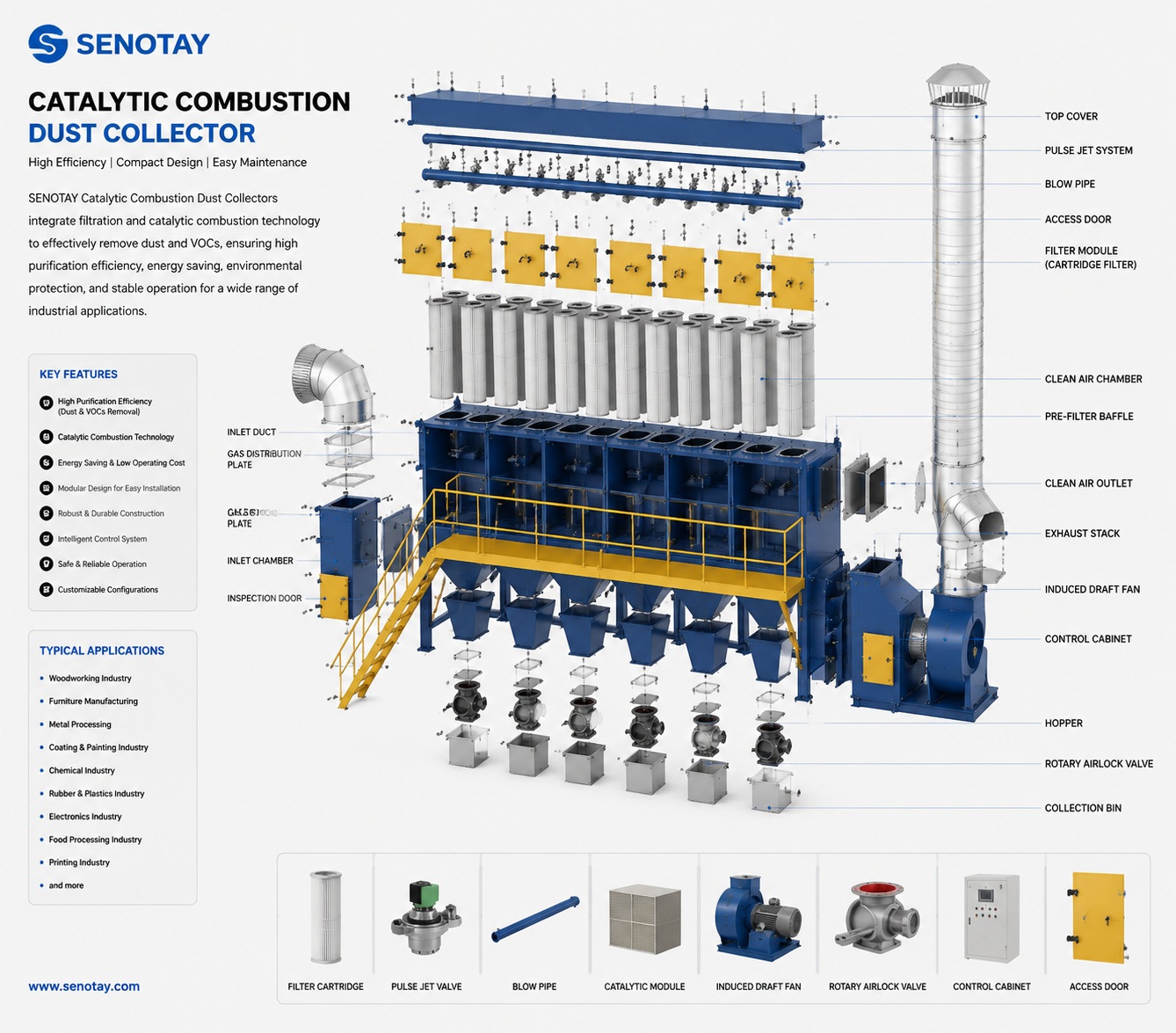
The HCC Series Catalytic Combustion Dust Collector combines particulate pre-filtration with a precious-metal catalytic oxidation chamber. Designed to eliminate volatile organic compounds (VOCs), odorous hydrocarbons, and industrial dust in a single footprint, it utilizes catalyst-assisted oxidation to decompose harmful emissions into harmless carbon dioxide and water vapor at 250°C to 500°C. Featuring integrated heat exchangers, it recycles thermal energy from treated gas streams to preheat incoming exhaust, drastically cutting energy consumption compared to direct thermal oxidizers.
Featured Model Variants
Type 6 | Petrochemical & Chemical VOC Control
Airflow: 10,000 m³/h | Power: 22 kW | Catalyst: Precious Metal Mix | VOC Destruction: 99%
Engineered for heavy continuous solvent vapor streams and chemical synthesis plants.
Type 10 | High-Volume Industrial Systems
Airflow: 25,000 m³/h | Power: 55 kW | Catalyst: Heavy-Duty Platinum | VOC Destruction: 99%
High-capacity system for large-scale industrial coating, printing, and manufacturing complexes.
Key Technical Specifications
Handles gas volumes from 3,000 to 50,000 m³/h with VOC destruction rates of 95–99.5% and particulate emissions under 15 ppm.Operating temperature range of 250–400°C (up to 480°C limit) with system resistance maintained at 800–1,800 Pa.Built with 304/316L stainless steel or reinforced carbon steel housing, ceramic fiber insulation, and a 12,000–20,000 hour catalyst lifespan.
Why Catalytic Combustion Dust Collector?
Industrial production often releases odorous gases, hydrocarbons, and fine dust that can cause severe environmental and health hazards. A Catalytic Combustion Dust Collector provides an integrated solution for pollution control and energy recovery.
Main Benefits
High purification efficiency: Oxidizes and decomposes harmful pollutants at 300–500°C, achieving >99% degradation.
Energy savings: Functions at lower combustion temperatures compared to direct thermal oxidizers.
Low maintenance: Extended catalyst lifespan and self-cleaning design.
Environmental compliance: Meets international environmental standards such as ISO and CE.
Safe and reliable: Advanced temperature control, automatic ignition, and explosion-proof design.
Why Leading Plants Choose SENOTAY
Factory-Direct Pricing. Certified Quality. Dedicated Support.
Best Price Guarantee
Certified & Compliant
Fast, Reliable Delivery
Types of Catalytic Combustion Dust Collector – Specification Table
Type No. | Airflow Capacity (m³/h) | Operating Temp (°C) | Catalyst Type | VOC Removal (%) | Power (kW) | Ideal Application |
Type 1 | 1000 | 250–300 | Honeycomb Pt | 98% | 5 | Small coating lines |
Type 2 | 2000 | 250–350 | Ceramic Pd | 98–99% | 7.5 | Printing workshops |
Type 3 | 3000 | 300 | Pt/Pd mix | 99% | 11 | Adhesive production |
Type 4 | 5000 | 300–350 | Honeycomb Pt | 99% | 15 | Paint spray booths |
Type 5 | 8000 | 300 | Ceramic Pt | 99% | 18 | Electronics manufacturing |
Type 6 | 10,000 | 350 | Precious metal | 99% | 22 | Petrochemical VOC control |
Type 7 | 12,000 | 350–400 | High-efficiency catalyst | 99% | 30 | Rubber & plastic plants |
Type 8 | 15,000 | 350 | Dual-catalyst design | 99% | 37 | Pharmaceutical factories |
Type 9 | 20,000 | 380–450 | Platinum-based | 99% | 45 | Industrial coating lines |
Type 10 | 25,000 | 400–500 | Heavy-duty catalyst | 99% | 55 | Large VOC exhaust systems |
How It Works – Working Mechanism
The Catalytic Combustion Dust Collector operates in several key stages:
Air Intake: Polluted air (dust and VOCs) is collected and directed into the system.
Pre-filtration: Large particulates are separated to protect the catalyst layer.
Heating Zone: Air is heated using an electric or gas heater to reach activation temperature.
Catalytic Reaction Zone: Pollutants undergo oxidation on the catalyst surface, decomposing into CO₂ and H₂O.
Heat Recovery System: Extracted energy is recycled to preheat incoming air, reducing energy consumption.
Clean Air Discharge: Purified, odor-free air is released safely into the atmosphere.
Catalytic Combustion Dust Collector — Technical Specification Table
Physical Dimensions | Performance Ratings | Material & Construction | Operational Data | Certifications & Lifecycle |
Length: 2,000–6,500 mm | 3,000–50,000 m³/h | Pt/Pd Precious Metal | 250–400 °C | 12,000–20,000 hours |
Width: 1,200–3,200 mm | 95–99.5% | SS304 / SS316L | 480 °C | 8–12 years |
Height: 1,800–4,200 mm | 90–98% | Ceramic / Glass Fiber | -2.5 to +3.0 kPa | ISO 9001 / CE |
Ø: 300–900 mm | 800–1,800 Pa | Viton / Silicone | 15–25 min | EN 13284-1 |
Outlet Ø: 300–900 mm | 450–650 kg/m³ | 3.0–8.0 mm | 4–25 kWh | IP55 |
(BCD): 12–24 bolts Ø18–Ø22 mm | 65–85% | Ceramic Fiber 25–50 mm | 3–30 kW | EN 746-2 |
Access Door: 400×600 mm | ≤ 15 ppm | Reinforced Carbon Steel | 1,800–12,000 kg | 12–24 months |
Inspection Ports: 2–6 pcs | 500–4,000 mg/m³ | High-Temp Resistant Paint | 4–8 pcs | Supported |
Catalytic Combustion Dust Collector Installation Method
Installation steps for the Senotay Catalytic Combustion Dust Collector are straightforward and ensure fast commissioning:
Foundation Preparation: Prepare a level, load-bearing foundation.
Positioning: Place the catalytic system near the pollutant exhaust source.
Duct Connection: Connect the inlet and outlet ducts to the dust and VOC sources.
Electrical Wiring: Connect power supply and control systems per electrical schematics.
Catalyst Loading: Install catalyst elements following safety and direction guidelines.
System Calibration: Adjust temperature, air pressure, and flow control for optimal performance.
Trial Run: Conduct test operation to verify emission efficiency and safety.
Standard Physical & Mechanical Properties of Catalytic Combustion Dust Collector
Property | Specification | Description |
Airflow Capacity | 3000–100000 m³/h | Suitable for different process sizes |
Operating Temperature | 250–500°C | Lower than direct thermal oxidizers |
Purification Efficiency | ≥99% | VOC and dust removal |
Heat Recovery Efficiency | ≥95% | Energy-saving performance |
Structure Type | Modular / Compact | Easy installation and maintenance |
Catalyst Life | 3–5 years | Regenerable catalyst system |
Power Supply | 380V/50Hz (customizable) | Adaptable to global markets |
Technical Advantages of Manufacturing at Senotay
Hebei OuTai Environmental Protection Equipment Co., Ltd. (Senotay) integrates research, design, production, and service for catalytic oxidation systems. Our exclusive manufacturing strengths include:
Advanced thermal processing and catalyst technology.
Automated CNC machining and laser welding for precision fabrication.
Customizable air treatment design for various industrial emissions.
Energy recovery optimization for reduced carbon footprint.
Rigorous quality testing that each system is tested for combustion efficiency and leak integrity.
Global support and technical assistance.
Explore More Air Pollution Control Equipment
▪ Industrial Baghouse Series
▪ LDMC baghouse dust collector | PPC baghouse dust collector | DMC Pulse Jet Baghouse Dust Collector | Baghouse Dust Collector
▪ Electrostatic & Gas Treatment
▪ Horizontal electrostatic precipitator | Wet electrostatic precipitator | Electrostatic Dust Collector | PP Spray Tower | Catalytic Combustion Dust Collector
▪ Cyclone Dust Separators
▪ Single-Cylinder Cyclone Dust Collector | Combined Cyclone Dust Collector | Ceramic Multi-Tube Cyclone Dust Collector
▪ Cartridge & Station Extraction
▪ Cartridge Dust Collector | Modular Dust Collector | Mobile dust collector | Welding Fume Purifier | Grinding table dust collector
Why Choose Senotay Catalytic Combustion Dust Collector
Experienced Manufacturer: Over 15 years of professional expertise in air pollution control systems.
Turnkey Solutions: From design to after-sales service, Senotay ensures complete project delivery.
Energy-Efficient Design: Combines heat recovery and optimized airflow control.
Safe and Durable Operation: Explosion-proof and corrosion-resistant structures.
Global Export Quality: ISO and CE certified products trusted across 30+ countries.
FAQs - About a cataytic dust collector
Q1: What is the difference between a catalytic oxidizer and a thermal oxidizer?
Answers: A catalytic oxidizer uses catalysts to promote oxidation at lower temperatures (250–500°C), saving energy and extending equipment life compared to direct-fired thermal oxidizers.
Q2: How often should the catalyst be replaced?
Answers: Typically every 3–5 years, depending on the type of pollutants and operating conditions.
Q3: Can Senotay customize a catalytic combustion dust collector for my specific VOC source?
Answers: Yes, our engineering team provides customized design and material selection to match your industrial requirements.
Q4: Does it handle both gaseous and particulate pollutants?
Answers: Yes, Senotay’s systems integrate dust collection and gas oxidation in one efficient process.
Q5: What certifications does Senotay provide?
Answers: Our products comply with ISO9001, CE, and environmental protection standards globally.