
EN
What are you looking for?
The U.S. Department of Energy estimates that fans and blowers, powering dust collection systems, suck up about 31% of all motor energy use in U.S. industry. A medium sized facility running a 30 kW baghouse 8 hours / day, 250 days / year ends up using around 60,000 kWh a year — which is like $6,000 at $0.10/kWh. Senotay’s data-driven kWh cost reduction approaches deliver 20–40% energy savings mostly by VFD integration, pressure drop tuning, and “smart” controls, but not only, also by tracking operating patterns in practice. So a Dust collector is really necessary for industrial air filtration.
Core Engineering & Sourcing Objectives
Reduce fan motor energy — this is the big one as the largest energy consumer; VFDs can cut usage by 18–30%
Minimize pressure drop — every 1 inWC added to the pressure drop, tends to bump energy demand by 8–12%
Optimize compressed air use — pulse jet cleaning can represent 15–25% of total energy costs
For the kWh cost reduction strategies, we aim at three main energy consumers: the fan motor (about 60–70% of total), compressed air for pulse cleaning (roughly 15–25%), and control systems (around 5–10%). The Affinity Laws also matter here, because fan power tracks the cube of air speed, so a 10% drop in fan speed gives about 27% power savings, even if the setup feels “small” at first.
1. Initial Parameter Identification & Data Collection :
Do an energy audit, measure the fan motor power draw in kW at full load. For example, a 46.2 kW fan motor running 24/7 at $0.10/kWh racks up **$40,481 every year**. Also log the differential pressure ΔP across the filters—your baseline should be around 3–5 inWG, and each 1 inWG above that baseline tends to push energy demand up about 8–12% . Don’t forget to write down operating hours and production schedules , so you can spot partial-load moments where you can do less rather than more.
2. Core System Execution & Formula Application :
Use the energy cost formula: Annual Cost = kW × Hours × $/kWh. If you have a 30 kW system running 8 hours/day for 250 days/year, it becomes 30 × 2,000 × $0.10 = $6,000/year. Then size the VFDs properly—install variable frequency drives on induced-draft fans so motor speed tracks the real airflow requirement. For pulse-jet cleaning, don’t just leave it on a fixed loop, optimize the settings by recalibrating cleaning cycles using real time ΔP instead of relying on the same timers, this can cut compressed air consumption by an average of 27% .
3. Regulatory Compliance, Verification & Safety Sign-Off :
Confirm emissions compliance , outlet particulate has to stay under the required limits (commonly 0.02 gr/dscf or 10 mg/m³). Keep an eye on the fan operating point too—make sure any VFD tweaks don’t reduce capture velocity at the dust sources. Finally, prove the savings: take before and after measurements of power draw for ROI support and for sustainability reporting, then sign off on safety requirements so everything stays credible.
Key Engineering Compliance Standard
EPA NESHAP / ASHRAE Standard 199 / OSHA Combustible Dust Standards are basically the “line in the sand” for folks running dust collection, right. Critical Threshold is usually outlet emissions ≤0.02 gr/dscf (or 10 mg/m³) , and the differential pressure has to stay under the design maximum , most times that’s 6–8 inWG. When you run outside those limits, the real operational impact shows up fast. Energy consumption can jump 30–50%, plus there’s regulatory fines, the kind that run $10,000–$100,000+ , and you’ll see filter wear accelerate up to 300% or so.
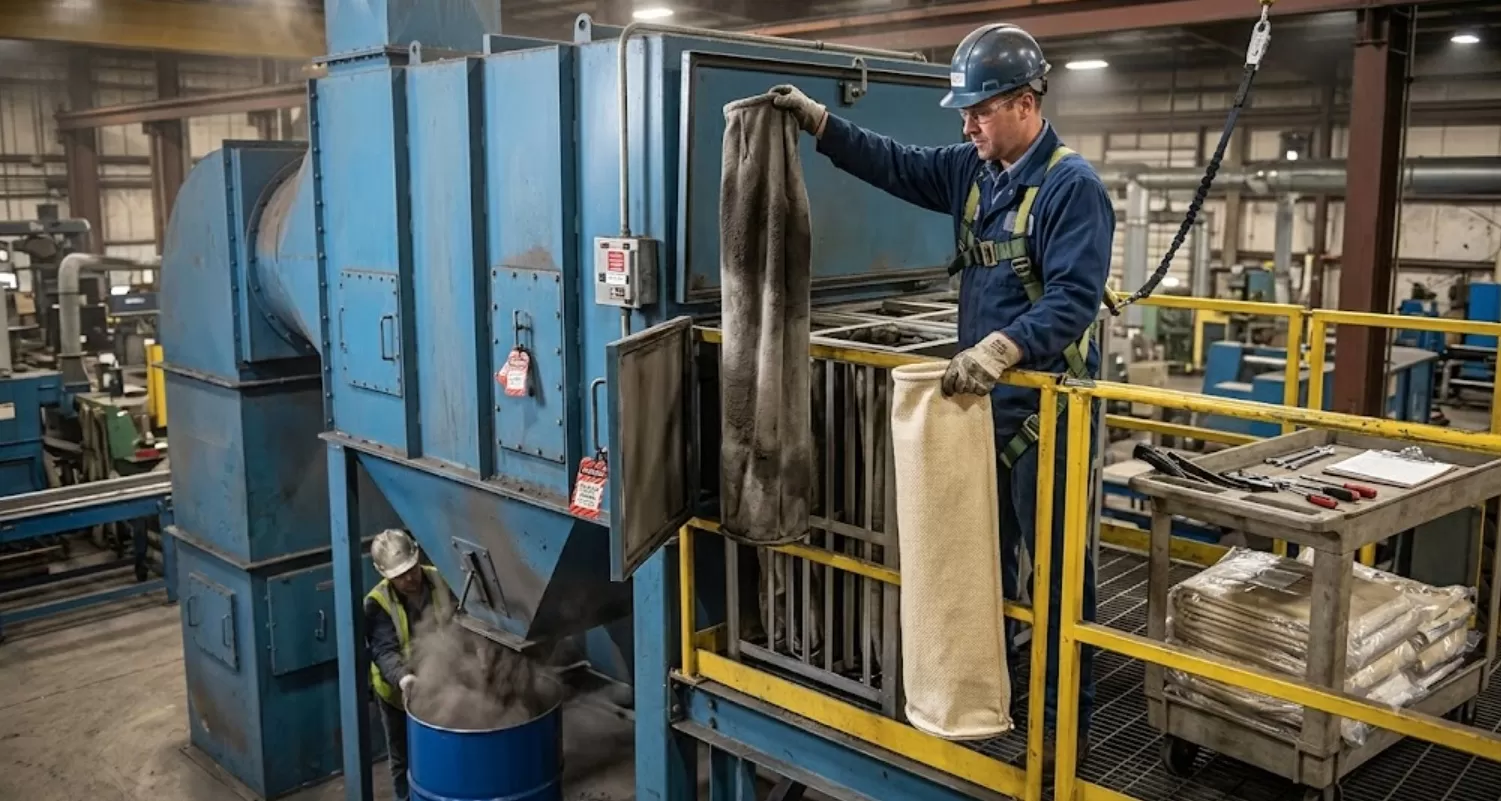
Pressure drop is kind of a hidden energy tax. As the filters load with dust, airflow has to fight harder resistance. Even a 4–6 inWC increase over the baseline can push motor energy draw up 30–50% without any real efficiency gain, it’s just extra drag. Senotay PTFE membrane bags help keep pressure differentials lower, which means less fan energy consumption, we saw about 19% reduction in field tests.
Fixed-speed motors waste an honestly absurd amount of energy. Typical dust collector motors go full power , all day, even when filters are spotless or production is low. VFDs fix that by tuning fan speed automatically. When the filters are fresh the drive backs down speed, then as the filters load it ramps up to hold consistent airflow, not just “guessing” with run-times.
Also compressed air overuse is a real issue, and it’s not just “extra cost”. Over-cleaning wastes compressed air—only about 10–20% of compressor energy actually reaches the point of use—and that can shorten cartridge life. So demand based pulsing matters. Use a ΔP trigger instead of fixed timers, because it’s the energy efficient way to do it.
Duct leakage compounds all this. In many plants the actual airflow ends up 15–25% over design, because leaks are always there, even if nobody wants to admit it. That pushes effective ACR higher and increases fan energy consumption almost proportionally.
Fan and Motor: basically the biggest energy eater. Premium efficiency motors (IE3/IE4) cut electrical losses about 5–10% though it feels smaller in day to day numbers. VFD compatible motors let you modulate speed and still keep efficiency mostly intact, no big efficiency penalties.
Filter Media: we go for high efficiency media with a low residual pressure drop, Senotay uses PTFE membrane bags, and they show a more steady lower ΔP over time. That steady lower ΔP translates to fan energy savings, up to 19% maybe depending on how dusty the process gets.
Pulse Jet Cleaning System: the pulse jet cleaning is on demand, not just a timer thing. It’s controlled by ΔP triggers, so compressed air consumption drops by 27% . And the submerged pulse valves from Senotay help keep air consumption down, plus they reduce pressure drop, it’s kind of a two for one situation.
Control System: intelligent controls with Modbus TCP/IP, Profinet, or Ethernet/IP, so you can do remote monitoring, predictive maintenance, and production-linked fan speed modulation without babysitting everything.
Control loop topology: PID loops keep steady state ΔP stable. Pressure transmitters stream continuous data into the PLC, and then the PLC decides when to trigger pulse jet cleaning only when ΔP passes the setpoints. Senotay systems also add automated monitoring for optimum airflow and energy use, kinda like fine tuning in the background.
Communication protocols: native support for Modbus TCP/IP, Profinet, and Ethernet/IP means easier integration into the plant SCADA layer. This lets you tie fan speed modulation to production needs, and still do remote energy tracking, without extra conversion boxes.
VFD sizing & harmonics: VFDs modulate motor speed off real time demand. If you reduce fan speed by 10% you can get about 27% power savings. Also, size properly with line reactors or harmonic filters so you don’t inject electrical noise into the system, because that becomes a whole other problem later.
Daily / Continuous: ΔP monitoring (target 3–5 inWG) , bearing temperature check validation , acoustic signature baselines , and pulse-valve function verification.
Quarterly (~2,000 hrs): filter inspection for tears or blinding, solenoid valve response validation, duct leakage inspection, and VFD parameter verification .
Annual (~8,000 hrs): filter media replacement (Senotay bags last 12–36 months), sensor recalibration, fan balancing, full system pressure drop mapping, plus compressed air system leak detection.
The Industrial Challenge: A Midwest USA furniture manufacturer , with three 22 kW baghouse dust collectors, was paying $19,300 every year for electricity. All three units ran at full load even when production was low.
The Custom Engineering Response: Senotay put VFDs on all three collectors and tied them into the plant’s production scheduling system, so the fans could run at reduced speed (22% on average) during those low-production windows.
The Quantifiable Outcome: Annual energy savings came to $7,400 (38%). VFD payback was reached in about 14 months. The system still held full capture velocity during production, but it cut way down on energy waste during idle periods.
Current Energy Data : fan motor kW rating annual operating hours , electricity rate ($/kWh) and also the monthly kWh consumption info.
Operating Profile: the production schedule (hours/day , days/year) dust load variability , and the partial-load operating hours numbers.
System Configuration : collector type (baghouse / cartridge), fan size, existing controls, plus a ΔP baseline data set.
Target Reduction: the desired energy savings (%) — Senotay usually delivers something like 20–40% reduction through combined , integrated strategies and not just one change.
How much can a VFD reduce dust collector energy consumption?
VFDs reduce fan motor energy consumption by 18–30% on average. If you drop fan speed by 10% you often get around 27% power savings, because of the Affinity Laws (power ∝ speed³).
What’s the relationship between pressure drop and energy cost?
For every 1 inch of water column (inWC) increase in pressure drop, motor energy demand can rise about 8–12%. So if your ΔP climbs by 4 inWC over baseline, it can push energy to draw up roughly 30–50%. Senotay PTFE membrane bags help keep ΔP lower, which in turn can reduce fan energy by as much as 19%.
How do I calculate my dust collector’s annual energy cost?
Use: **Annual Cost = kW × Operating Hours × Electricity Rate ($/kWh)**. Example: a 30 kW system running 8 hours/day 250 days/year at $0.10/kWh comes to about $6,000 per year. Also, for sites with multiple collectors, annual bills can pass $50,000 /year easily.