
EN
What are you looking for?
When sourcing industrial filtration media, looking into top-tier China Filter Bag Manufacturers you’ll often notice that premium PTFE and FMS filter bags can push particulate emissions down below 5 mg/m³, and still cost roughly 20% to 35% less compared with Western equivalents. In practice, suppliers such as Senotay can produce custom high-temperature bags in 15 to 20 days, which is kinda like an instant refinement to dust collector efficiency, and also helps with compliance.
Accelerate Procurement Timelines: figure out how to secure fast 20-day delivery cycles from a verified Filter Bag Manufacturer, without sacrificing material integrity.
Navigate the Supplier Comparison: map the exact Price Quality ratios across several media styles, from basic polyester to high-temperature aramid, P84 fibers, and FMS composites.
Mitigate Compliance Risks: make sure your imported filter bags meet international industrial emission standards, plus strict physical testing procedures.
Finding a reliable Filter Bag Manufacturer is not just about availability , it is about matching their material range to your operational limits. Most standard ordering patterns fail because buyers skip cross-checking media capability with exhaust gas temperatures. Senotay offers a wide assortment of engineered fabrics in order to tune your Price Quality balance, in a more repeatable way.
To make sure a tailored filter media quote actually matches what the plant is doing right now, plant engineers should run a kind of structured three-step check before they even send an inquiry to China Filter Bag Manufacturers. Like, not just “send it” you know, but verify it first, in an almost methodical way.
1. Initial Parameter Identification & Phase 1 Data Collection
Start by logging real-time exhaust stream variables. The reader should write down the current exhaust temperatures, differential pressure readings ( ΔP ), and the dust chemical composition. Those raw numbers, they help block procurement of low-grade bags that will, basically, degrade fast under corrosive or high heat conditions.
2. Core System Execution & Mathematical Formula Application
Then apply industrial air-to-cloth ratios. Engineers must compute the total filtration surface needs using the gas volume. So if the exhaust volume is 5,000 m3/h and the required filtration velocity is 1.0 m/min, the total bag area has to be worked out exactly, otherwise the media can get overloaded too soon, and the whole arrangement starts behaving oddly.
3. Regulatory Compliance, Verification & Safety Sign-Off
Next, compare the metrics with the relevant environmental codes. Confirm that the chosen filter media can keep stack emissions below the local regulatory caps, for example < 10 mg/m3, before final commissioning. This step is where a lot of “oops later” situations usually get prevented.
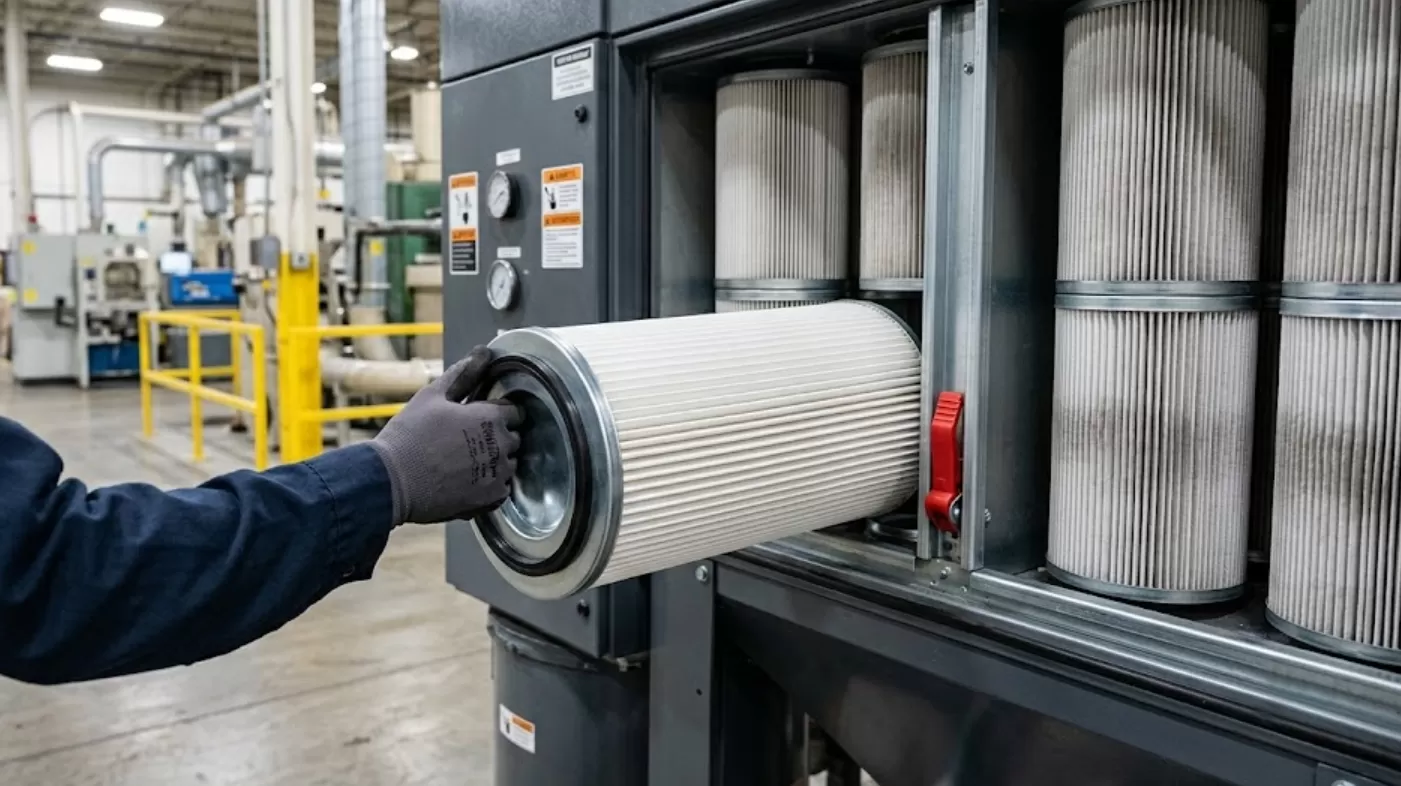
Industrial filtration also carries serious operational hazards, including harsh thermal breakdown and chemical hydrolysis. During a supplier comparison, if you ignore moisture content or the acid dew point of the exhaust gas stream, component lifespans get shortened dramatically. For instance, using common fiberglass bags in high-alkali and high-moisture sites can trigger quick fiber embrittlement and then catastrophic tearing during pulse-jet cleaning.
Key Engineering Compliance Standard
Standard Code: ISO 11057:2011 / EPA PM2.5 Mandates
Critical Threshold: Continuous emission levels must not exceed $5 \text{ mg/m}^3$ for fine particulate matter in sensitive industrial zones.
Operational Impact: Failure to utilize PTFE-coated or high-density media causes immediate regulatory violations, resulting in automated plant shutdowns and heavy fines.
The long livedness of a baghouse is kind of determined by the metallurgy of the cages, and the way the filter bags material gets finished. Senotay engineering sort of bridges that gap between the raw sourcing budgets and long-term reliability by using advanced material sciences not just the obvious stuff, you know.
Substrate Fiber Blends: Advanced FMS (Fluorometallic Synthetic) bags combine alkali-free glass fibers , aramid, and P84 fibers. Together they deliver the tensile strength you expect from fiberglass, but with better folding resistance and a more agreeable flexibility from the chemical fiber side.
Surface Treatments: When PTFE (Teflon) membranes are applied, they form a microporous surface with strong hydrophobic behavior. This blocks fine dust from seeping into the felt matrix, which then gives better surface filtration and leads to a notably reduced cleaning resistance.
Seam Construction:Higher grade bags rely on triple-stitched PTFE thread or heat-welded seams, to help stop dust leakage through needle holes during high-pressure pulsing .
A structural failure can happen if a filter bag cannot tolerate the real-world system vibrations or the higher differential pressures. Premium manufacturers test every structural limit so the media stays intact, even through aggressive cleaning cycles, without ending up physically deformed.
Filter bags can’t just sit there doing their own thing they have to connect just right with the baghouse pneumatic cleaning system, or well… it stops working smoothly.
Pulse-Jet Dynamics: The bag fabric needs to tolerate sudden, sharp shockwaves of compressed air (usually about 0.4 to 0.6 MPa) that get fired off by the PLC system.
On-Demand Cleaning Topology: PLC controllers, using differential pressure ΔP sensors, only start the cleaning cycles when the resistance climbs to a set limit (for example 1,200 Pa). Basically this control flow helps extend the lifespan of the bag because it reduces unnecessary mechanical shock, even if the factory keeps changing loads.
Cage Compatibility: The bag inner diameter has to line up exactly with the installed metal cage. If the tolerances are loose, the PLC pulse-jet blast may snap the bag against the cage, pretty violently, and that can speed up wear fast.
To keep a lower Total Cost of Ownership TCO, facilities have to stick to a prevention-first maintenance setup that’s built around the filter bag life-cycle.
Daily / Continuous Diagnostics: Confirm differential pressure baseline values across the main plenum, and keep an eye on stack emission opacity with continuous emission monitoring systems (CEMS).
Quarterly Intervention Matrix (~2,000 Operating Hours): Check the bag tensioning mechanisms. Look closely at the bag bottom area for localized abrasion and then confirm the PLC cleaning sequences are actually firing on schedule.
Annual System Refit Protocols (~8,000 Operating Hours): Pull some bags for lab checks, like permeability and tensile strength testing. Also plan full media replacements using degradation curves that you can quantify, not guess.
The Industrial Challenge: a mid-sized smelting plant was hit with bag blinding and a fast drop in media life, mainly from an abrasive dust that ran hot , around 230°C on average. Their usual chemical fiber filter bags started to stretch, then break down quickly, mostly because the corrosion resistance was not strong enough. In the end, production stops happened too often.
The Custom Engineering Response: Senotay pushed a filtration upgrade that was tailored, swapping the older components with high performance FMS filter bags using a glass fiber / P84 composite. On top of that, the filtration layer was treated with a PTFE membrane coating to limit corrosive chemical wear, erosion.
The Quantifiable Outcome: filtration efficiency settled and stayed at 99.99%. Because the P84 fibers deliver stronger wear resistance and better fold stability, the filter bag service life improved by more than 60%, which cut the clients operational downtime quite drastically.
Before you submit an engineering inquiry to China Filter Bag Manufacturers, use this full checklist so your data bundle has the right key metrics , for a clean commercial reply.
Dimensional Requirements: include the exact bag diameter and bag length , plus the top and bottom style (for example snap band top, envelope form).
Volumetric Process Data: provide the system airflow capacity in m3/h and the max continuous inlet temperature it must handle.
Detailed Particulate Specification: list the chemical composition of the dust, the average moisture %, whether acids or alkalis are present, and the particle size distribution.
Mandatory Regulatory Certifications: specify every regional compliance standard that matters, the ISO quality requirements, plus any specialized industry approvals that are mandatory.
What counts as the usual commercial lead time for custom high temperature filter bags ?
Typically, its around 20 days if you’re doing standard bulk orders. This is the kind of schedule Senotay accounts for raw material weaving, then these specialized surface treatments like a PTFE coating, and finally the very careful visual quality assurance inspections, before the global shipping happens , you know.
How can I tell if my system really needs a PTFE membrane?
Usually, it’s when tight emission targets insist on capturing sub micron particles, or when the dust is properly aggressive, meaning highly corrosive. A PTFE membrane gives strong corrosion resistance against acids and alkalis, while also blocking those fine sticky dust particles from getting into the felt matrix. In practice, that helps keep differential pressure low and makes airflow more consistent, overall.
How does the price of FMS bags measure up versus 100% synthetic chemical fiber bags?
In general, FMS bags are priced comparatively lower, but the performance is much higher for high temperature use. With a blend approach , like fiberglass plus advanced synthetics such as aramid and P84, the manufacturer can reach extreme heat resistance (up to about 260°C) and strong chemical tolerance. This setup also helps avoid the more obvious elongation and deformation issues that show up in standard chemical fiber bags.