
EN
What are you looking for?
Industrial baghouse design is the engineering discipline of sizing, arranging, and specifying fabric filtration systems that pull particulate matter from hot, high-load industrial exhaust streams. In cement, and in steel production, where the process gases can run above 200°C and dust loads hit around 100 g/Nm³, good baghouse design ends up deciding if a site actually satisfies emissions rules or winds up shutdown. This piece goes through the key principles of industrial baghouse engineering for heavy industry—starting from filter media choosing to the cleaning system setup—using practical guidance taken from decades of on-site experience.
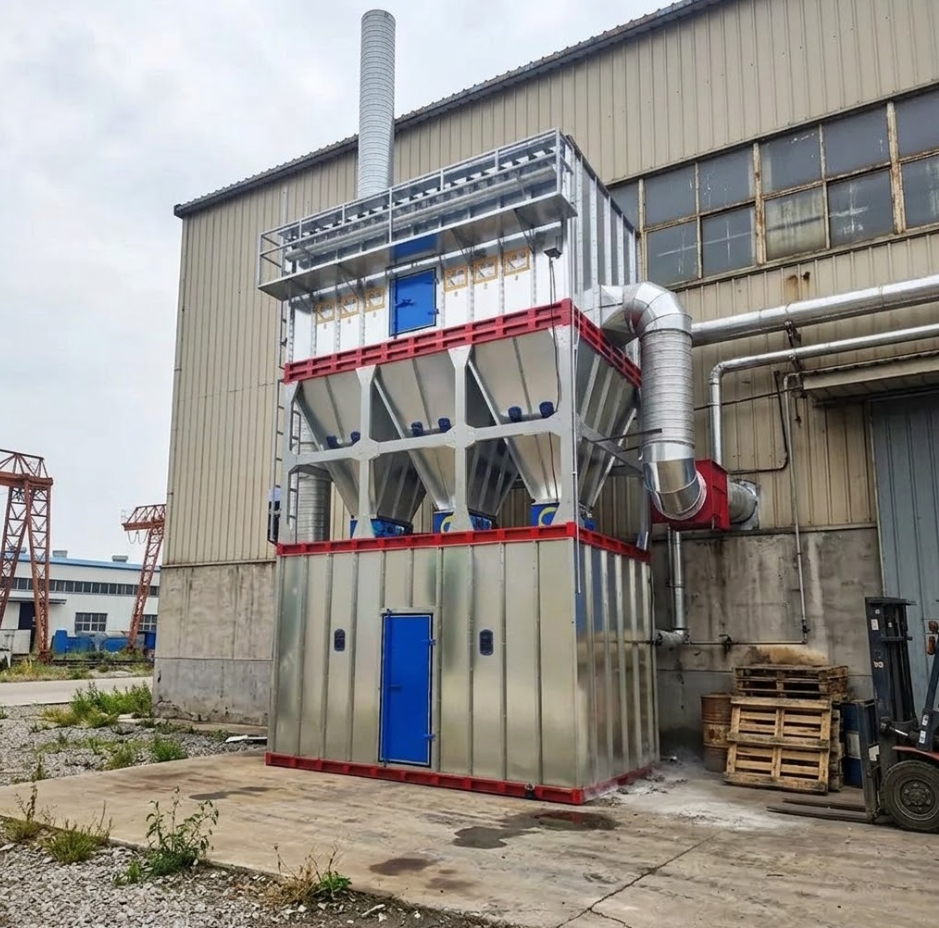
An industrial baghouse is basically a big air pollution control device, it uses fabric filter bags to remove particulate matter from industrial exhaust gases. Dirty gas moves into the baghouse, then passes through the filter bags, and exits as cleaner gas. The dust sticks on the bag surfaces, forming what people call a dust cake, and that cake somehow improves filtration, at least for a while. Then, from time to time, a cleaning system knocks the cake off, so the bags keep working properly. In cement and steel plants, baghouses are commonly placed at kilns, clinker coolers, raw mills, sinter plants, blast furnaces, and also at electric arc furnaces.
Filter media selection is a make-or-break decision in industrial baghouse engineering. The table below summarizes the most common media types and their suitability:
Pulse-jet cleaning, kind of the main tech in today's industrial baghouse setups, relies on quick high-pressure blasts of compressed air (about 5–7 bar) that are sent down into the bag interior to knock off the dust cake. In practice the pulse moves like a shock wave, it flexes the bag a bit and then, the buildup dust lets go. Pulse-jet systems can run all the time, so they’re considered online cleaning, and they also fit really well when the dust load is heavy. The usual design headaches to watch for are things like nozzle plus venturi sizing , because they have to deliver enough energy to actually clean the whole bag length. Then there is pulse duration and interval, commonly around 50–150 ms every 3–10 minutes, and lastly the air header sizing, it must be sized to give the right volume without causing a big pressure drop.
Reverse-air cleaning is different. It uses a secondary fan to push “clean” gas back through the bags, which tends to collapse them slightly and break loose the dust. This type usually works offline, meaning the baghouse sections get isolated during cleaning. Compared to pulse-jet, it’s gentler on the bags so it can be a better fit for fragile media such as fiberglass. The catch is it needs a larger footprint, so it is less frequently chosen for new installations these days.
Then there’s shake-deflate cleaning, where mechanical shakers vibrate the bag frame to loosen the dust. It is basically the oldest method and it’s now mostly pushed into small, low-duty situations, because maintenance tends to be higher and the actual cleaning effect is limited.
For cement and steel plants, though, pulse-jet cleaning is almost always the one specified, mainly for efficiency, reliability, and the fact it can handle high inlet dust concentrations without much drama.
The structural design of the baghouse vessel is often overlooked but critically important. Key considerations include:
Thermal expansion — differential between the shell and the internals, which has to be accommodated with expansion joints or sliding supports especially for units running above 150° C. If you don’t, the whole setup can start working against itself.
Hopper angle — it has to exceed the dust’s angle of repose (usually around 60–70°) so the dust actually slides out in a reliable way. For cement and steel dust, steep hoppers plus vibration aids like air cannons or vibrators are pretty standard.
Gas distribution — uneven flow creates localized high velocities and that means faster bag wear, and then premature failure. Perforated inlet baffles and deflector plates are essential, they help smooth the path, even if the incoming stream is messy.
Access platforms — for bag inspection, replacement and general maintenance, because operators need to actually reach everything. Those platforms must comply with safety regulations, even if the vessel design is otherwise solid.
Cement kiln dust is often alkaline and, if moisture shows up, it can build up hard cementitious layers, so you really do need proper insulation and careful temperature control above the acid dew point. Steel plant dust—especially from EAF operations—tends to be finer and more abrasive, which means you need better filter media grade and usually more frequent cleaning cycles, not just “standard” intervals.
Sizing a baghouse involves a stepwise calculation:
Determine gas flow rate — actual volumetric flow at operating temperature (m³/h)
Select air-to-cloth ratio — based on dust characteristics, temperature, and required emissions
Calculate total filter area — flow rate ÷ air-to-cloth ratio
Select bag dimensions — typical bag diameters: 130–160 mm; lengths: 3–8 m (longer bags reduce footprint but require higher cleaning energy)
Determine number of bags — total area ÷ (π × diameter × length) per bag
Add 10–20% margin — for future capacity increases or fouling
Size hopper — based on dust load and required storage capacity between discharges
Size cleaning system — compressor capacity, air receiver volume, piping, and valving
For instance, take a cement kiln with 500,000 m³/h gas flow at 180°C. If the air-to-cloth ratio is 1.0 m/min, you end up needing 8,333 m² of filter area. With 160 mm diameter × 6 m bags (about 3.0 m² per bag), that works out to roughly 2,780 bags. In a typical Senotay modular arrangement, those bags get split into several compartments, so maintenance stays flexible and you can isolate sections without stopping everything at once.
Regular maintenance is essential to achieve the expected 2–4 year bag life. Key practices include:
Daily — check pressure drop, temperature, compressed air pressure, and emissions (opacity)
Weekly — inspect hopper discharge systems, clean level indicators, check for air leaks
Monthly — inspect bags in one compartment (visual for tears, holes, or excessive dust on clean side)
Quarterly — check cleaning system valves and diaphragms; test differential pressure sensors
Annually — full internal inspection; structural integrity check; bag sampling for lab analysis
Quality management (ISO 9001) keeps fabrication and assembly consistent even when people move around and timelines get weird. Environmental management (ISO 14001) shows a clear commitment to sustainable manufacturing. Occupational health and safety (ISO 45001) protects the workforce, in practical daily terms, not only on paper.
For industrial baghouse design , these certifications aren’t just badges , they’re more like proof of systematic engineering steps, traceable materials, and documented quality controls, which then turns into dependable long lasting equipment. Senotay has held on to these certifications since 2005 , and with more than two decades of experience supplying heavy duty baghouses to cement and steel plants across China and also internationally.
Filter bag life for cement applications usually sits around 2 to 4 years, depending on operating temperature, dust characteristics , and how effective the cleaning system is. If the design and maintenance are done well, lifespan can push toward the higher end, somewhat reliably.
Temperature drives the choice of filter media, the shell material (carbon steel vs stainless), the insulation needs, and the expansion joint approach. As a rule, every 10°C above 150°C tends to shorten bag life quite a bit for many media types.
Pulse-jet cleaning uses short high-pressure air bursts to clean bags online during operation. Reverse-air cleaning relies on calmer reverse airflow and usually needs offline compartment isolation. Pulse-jet, in other words, is more frequently seen in newer heavy-duty installations.
Not really in the “optimal” sense. Cement dust is alkaline, and it can turn somewhat cementitious; steel dust is usually finer, more abrasive, with a kinda different vibe. So filter media selection, air-to-cloth ratio, plus hopper design … all shift quite a bit depending on the service.
A heavy-duty industrial baghouse design for cement and steel sites needs a more methodical, almost step-by-step mindset: get the air-to-cloth ratio right, choose the proper filter media, use a sturdy cleaning system, and pay close attention to thermal, mechanical, and flow details. When those basics are done well you typically get consistent emissions compliance, longer bag life, and lower total cost of ownership.
For clients who need expert engineering and ISO certified manufacturing, Senotay provides full baghouse solutions… from design and fabrication through installation support. Reach out to Senotay’s engineering team for a consultation on your next cement or steel filtration project.