
SENOTAY
Factory-Direct vs Distributor Dust Collectors: Responsibilities and Risks
Choose a purchasing channel by the engineering, delivery, installation and support work it actually covers. Includes a responsibility matrix, written service terms and payment-change verification.
INDUSTRIAL BUYER’S TECHNICAL GUIDE
Factory-direct and distributor offers should be compared by what each party supplies and supports. A lower equipment price may exclude local engineering, installation, import administration or service that appears in another offer. The buying decision is therefore a scope and responsibility comparison—not simply a percentage markup comparison.
Compare equivalent scope
Identify equipment, engineering, site work and testing included in each offer.
Price the responsibility gaps
Assign import, installation, commissioning and service tasks to named parties.
Check service commitments
Put response channels, spare-part scope and warranty exclusions in writing.
This guide compares purchasing channels: the factory, a distributor or another supplier arrangement. It focuses on which responsibilities and transaction risks remain with the buyer. The detailed direct-purchase contract guide addresses the supply package itself; here the decision is whether each channel offers the services and accountability the project needs.
1. Compare the offered work rather than the channel label
A direct quotation can give the buyer access to the manufacturer’s configuration discussion. A distributor may provide local stock, application support, installation or service. Neither description guarantees that those services are actually included. Ask each party to identify what it supplies itself, what it subcontracts and what the buyer must arrange.
A distributor’s price difference is not automatically an unnecessary markup. It may pay for activities missing from another proposal. Conversely, an intermediary does not automatically add useful engineering or local support. Compare the work, documents and enforceable commitments rather than assuming one channel is universally superior.
Separate the contracting seller from the equipment manufacturer and any installer or service company. Identify which entity accepts responsibility for the complete promised supply and who approves technical changes. Use the supplier-diligence guide for identity and capability checks; a factory photo or trading name does not complete that investigation.
2. Give both channels the same technical brief
State the source duties and operating combinations, actual airflow and pressure basis, dust or fume characteristics, gas conditions, required outlet result, utilities, layout and access constraints. Define the complete-unit evidence needed rather than treating a filter label as proof of a finished system.
Baghouse and cartridge describe configurations, while a filter-performance classification concerns a defined filter and test basis. They are not interchangeable efficiency tiers. A particle filter also does not automatically address gases or vapors. Match the proposed treatment and capture arrangement to the actual contaminants.
Identify fire, explosion, reactive-material and other applicable hazards through a competent assessment. OSHA’s combustible-dust overview explains that many finely divided materials can present hazards. A general industry label, a safety logo or the country of manufacture does not establish a suitable complete protection arrangement.
For a defined configuration, use the baghouse information or cartridge collector information as enquiry starting points. Their product categories do not replace the duty sheet or the seller’s exact bill of supply.
3. Assign the responsibility gaps before judging the price
Compare who performs and pays for the work
| Activity | Questions for either channel |
|---|---|
| Application and system engineering | Who defines source capture, duct/fan duty, layout and the interfaces between packages? |
| Local requirements | Who checks applicable structural, electrical, environmental and equipment obligations? |
| Manufacture and inspection | Who controls drawings, materials, substitutions, records and release of the identified equipment? |
| Transport and import | Who arranges packing, carriage, insurance, import documents and additional charges? |
| Site work | Who unloads, lifts, erects, connects utilities and completes ducts, supports and discharge equipment? |
| Commissioning and acceptance | Who supplies the test conditions, measures the result, resolves failures and approves completion? |
| Service and spares | Who responds, provides exact parts and performs agreed warranty or maintenance work? |
Mark each line included, buyer-supplied, separately priced or unresolved. Name the responsible organization and the needed deliverable, not simply “by others.” A gap between two packages should remain visible until someone accepts it. Do not treat a missing line as free work or automatic buyer responsibility without agreement.
Include the buyer’s capability to manage the retained work. A site with experienced engineering and maintenance resources may choose a different arrangement from a buyer needing local integration and field support. This is a practical scope decision, not a claim that one channel always gives the lowest lifecycle cost.
4. Check configuration access and quality evidence directly
Ask who can answer technical questions and who has authority to approve an offered change. Direct access may shorten the communication chain, but it does not prove that every requested modification is feasible, safe or included. A distributor may also obtain engineering input from its manufacturer; confirm the process and response commitment.
Request the approved drawing revision, component schedule, media construction, inspection scope and relevant test records for the actual equipment. Do not assume that every component is manufactured or every test performed under one roof. If work is subcontracted, record how its quality and documentation remain controlled.
The published management-system documents name Hebei Outai and ISO 9001, ISO 14001 and ISO 45001, with printed dates of 25 August 2025 to 24 August 2028 subject to surveillance and current-status verification. Their production scope covers dust collectors and associated ventilation ducts and valves. They are not product-performance, CE or ATEX certificates for every configuration.
ISO explains that certification is performed by external bodies. Separately determine the exact equipment and destination requirements. The European Commission’s CE guidance concerns applicable EU conformity responsibilities; it is not a universal requirement for every purchase or proof that a particular offered system is approved.

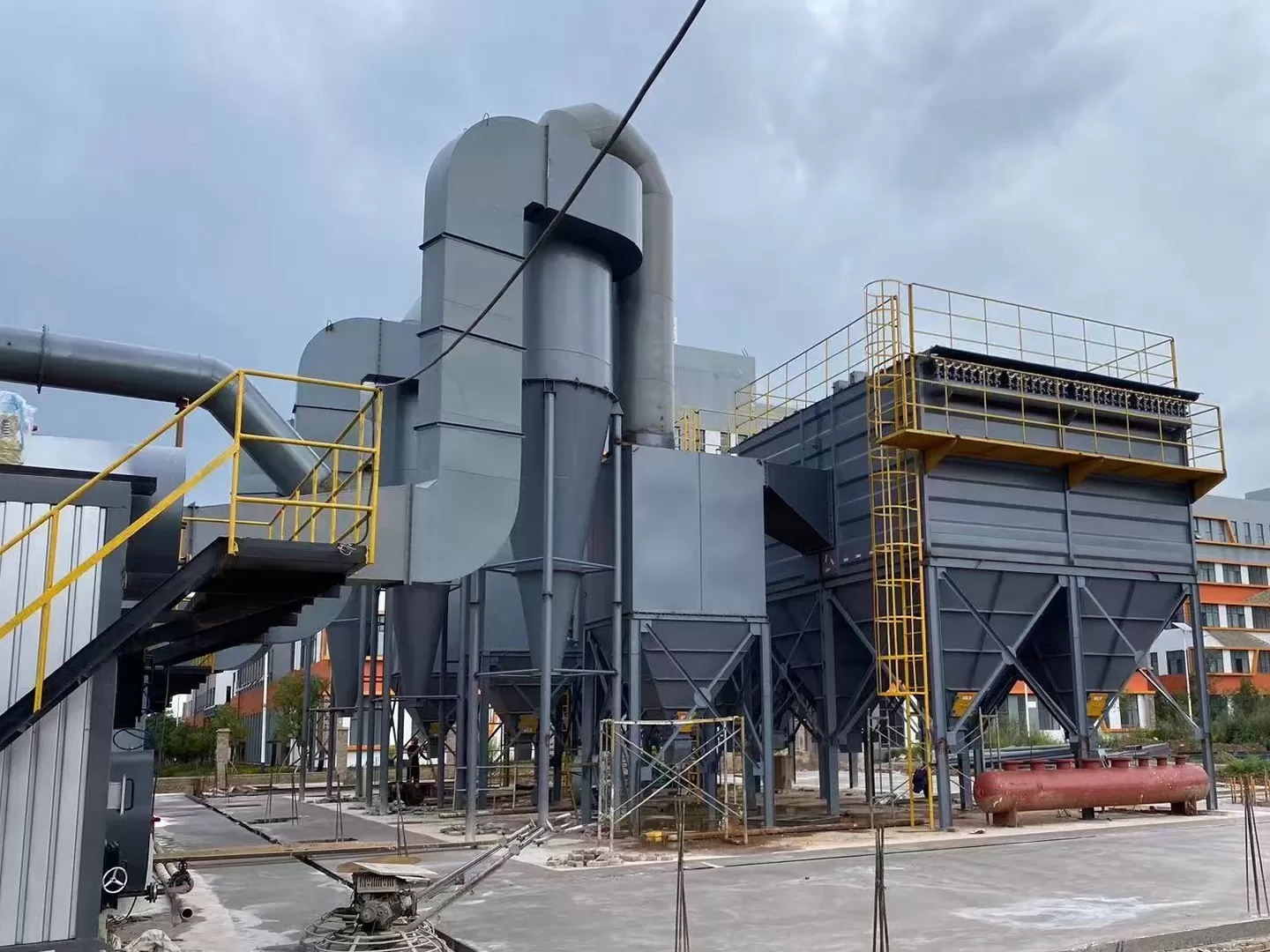
Contextual equipment illustration only. It is not a verified factory production line, an inventory record, proof that work occurs under one roof or an approved installation design.
5. Compare stock and delivery commitments at the same boundary
A distributor may have relevant stock, or it may order from the same factory after receiving the purchase order. A factory may have standard assemblies available, while a custom unit needs engineering and production. Neither channel automatically supplies faster delivery or a standing volume discount.
Request dated availability and a project-specific schedule. Identify drawing approval, material procurement, manufacture, inspection release, dispatch, arrival and site work. The delivery-milestone guide distinguishes these events. A generic two-to-four-week statement is not a commitment for a customized installed system.
For multiple units, obtain written quantity pricing for the same configuration, warranty, delivery and service scope. State whether the units ship together and whether the discount depends on payment, standardization or another condition. Do not apply an assumed wholesale percentage to a different order.
6. Keep transport and import obligations explicit
ICC’s public Incoterms explanation addresses specified delivery obligations, risk and cost when the chosen rule is incorporated into the contract. Record the rule, edition and named place or point. Technical acceptance, payment, title, warranty and remedies still require separate agreement.
Define packaging, lifting information, handling, transport dimensions, insurance and the destination boundary. Door-to-door wording does not by itself settle every customs, unloading or installation obligation. Sea and air options require route-specific quotations and practical handling review; neither gives one universal cost or duration.
Identify the importer and the party responsible for classification, customs value, documents and additional measures. The USITC tariff FAQ explains that importers remain responsible for US requirements and that a foreign supplier’s code may differ from the importing-country classification. This guide does not determine a tariff rate, classify a particular shipment or guarantee clearance.
7. Verify changes to commercial instructions
Keep the approved contracting entity, quotation revision, payment milestones and authorized contacts together. Resolve unexplained differences between the seller, invoice and intended recipient through the buyer’s established approval process. A last-minute instruction should not silently replace the agreed record.
The FBI’s business-email-compromise guidance warns that fraudulent requests can appear inside familiar-looking communications. It recommends verifying payment and purchase requests and changes in account numbers or procedures. Use an independently known contact channel rather than relying on a phone number or link newly supplied in the change request.
Agree who can authorize a design, price, delivery or payment change and how the revision is recorded. Preserve the previous version and approval trail. These checks reduce ambiguity but do not guarantee that a transaction is risk-free; obtain appropriate professional advice for material legal or financial questions.
8. Put service and warranty promises into usable terms
Compare named contacts, language, support hours, remote versus on-site work and escalation arrangements. Direct access to a factory engineer and local field service are different services. Determine which is needed and which party has agreed to provide it.
Record the warranty start, covered items and conditions, exclusions, claim evidence and remedy. Allocate labor, travel, freight and replacement-part costs. Clarify consumables and who investigates a failed acceptance test. Do not infer a standard warranty or global response promise from the seller’s channel.
Request exact spare-part identifiers, approved alternatives, current lead times and the drawings and maintenance instructions needed before handover. Maintenance access, safe isolation and parts availability can matter more than a headline promise of easy filter replacement. Any future expansion must also be checked against the actual system duty and interfaces.
9. Make the channel decision on documented coverage
Compare the same technical baseline and equipment scope.
Price the work retained by the buyer and the gaps between suppliers.
Check current availability, delivery responsibilities and import arrangements.
Confirm inspection, acceptance, support and warranty commitments in writing.
Record why the chosen channel fits the project’s engineering and service needs.
Treat cleaner equipment, improved reliability and lower costs as objectives until verified under the actual duty. A factory-direct purchase does not automatically prove compliance, an energy saving or a shorter schedule. Send the common duty and responsibility matrix through the SENOTAY enquiry page to obtain an offer that can be compared on that basis.
Frequently asked questions
Is buying a dust collector directly from a factory always cheaper?
No. Compare the same equipment, engineering, delivery, installation, acceptance and support scope. A distributor may include stock or local services that are excluded from a factory offer, while a factory may provide direct configuration access. The actual offers determine the difference, not a universal markup percentage.
What responsibilities can move to the buyer in a factory-direct purchase?
Depending on the agreement, the buyer may need to arrange local engineering, import administration, transport interfaces, unloading, foundations, utilities, installation, commissioning and service. Assign each activity to a named party and price the gaps rather than assuming a delivered collector is a complete installed system.
Does a shipping term settle warranty and technical acceptance?
No. Incoterms allocate specified delivery obligations, risk and costs when incorporated into the contract. The parties still need to agree the equipment scope, performance and test conditions, warranty, payment provisions, ownership and remedies separately.
How should a changed payment request be checked?
Use the buyer’s established verification process and an independently known contact channel before acting. The FBI recommends verifying payment requests and changes to account numbers or procedures. Do not rely only on a familiar-looking email thread or a new phone number supplied in the change request.
What should both a factory and a distributor provide about support?
Request named contacts, support scope, available hours, escalation arrangements, spare-part identifiers, relevant lead times and written warranty conditions. Clarify who investigates a failed acceptance test and who pays for labor, travel, freight and replacement parts. A sales channel alone does not establish these commitments.
Request a quote
Discuss your project with SENOTAY
Send your application and equipment requirements through our contact page.