
EN
What are you looking for?
A properly maintained Dust Collector, specifically a Bag Type Dust Collector, is one of the highest-return maintenance investments an industrial facility can make. According to the U.S. Environmental Protection Agency (EPA), inadequately maintained fabric filtration systems operate at 12–27% below their rated collection efficiency within 18 months of installation — generating regulatory exposure, unplanned downtime, and accelerated equipment wear that can cost three to seven times the price of a proactive maintenance program.
Senotay, a China-based manufacturer and direct supplier of industrial dust collection equipment, has tracked performance data across hundreds of deployed units globally. The findings are consistent: facilities that follow a structured 7-point maintenance schedule extend equipment service life to 12–15 years on average, versus 5–7 years for units operating under reactive-only maintenance. That translates directly to deferred capital expenditure and lower total cost of ownership.
The global bag filter market was valued at $4.3 billion in 2023 and is growing at a CAGR of 6.8% through 2030 (Grand View Research). As regulatory pressure on particulate emissions tightens worldwide — the EU's Industrial Emissions Directive (IED) sets PM limits as low as 5 mg/Nm³ in some sectors — the operational standard required from every dust collector in service is rising. Maintenance is no longer optional. It is the primary lever for compliance.
A bag type dust collector is not a single component — it is an integrated system of filter media, pulse-jet cleaning mechanisms, compressed air delivery, material handling hardware, and instrumentation. Effective maintenance means active monitoring across all seven of the following zones:
• Filter media condition: The fabric bag is the heart of the system. Polyester needle felt bags (the most common type sourced from Chinese factories) have a standard service life of 2–4 years under normal conditions. High-temperature applications using PTFE membrane or fiberglass media require inspection every 12 months. Any bag showing visible blinding, pinhole damage, or moisture absorption must be replaced immediately.
• Pulse-jet cleaning assembly: Solenoid valves, diaphragm membranes, and pulse timers control the energy delivered to each bag row during cleaning cycles. A failed solenoid on a 12-row system means 8.3% of the filter area goes uncleaned per pulse event — compounding to a 35–50% efficiency drop within 60 operating hours.
• Compressed air supply: Bag cleaning relies on sharp, high-pressure pulses at 5–7 bar. Moisture in the compressed air line is the single leading cause of premature bag failure. Install auto-drain moisture separators and check dew point monthly.
• Hopper and discharge system: Collected dust bridges in hoppers when particle size exceeds 150 microns or moisture content rises above 12%. A blocked hopper creates back-pressure that re-entrains settled dust into the clean air stream — completely defeating the collector's purpose.
• Differential pressure (dP) monitoring: The dP across the filter bank is the most reliable single indicator of system health. A reading consistently above 2.5 kPa signals bag blinding or caking. A reading below 0.5 kPa indicates bag damage or bypass. Both extremes require immediate investigation.
• Fan and motor assembly: A 10% rise in motor amperage draw without a corresponding increase in process volume is almost always caused by increased system resistance — meaning the bags need attention before the motor protection trips.
• Structural integrity: Annual inspection of all welds, access hatches, gaskets, and expansion joints prevents the slow air leakage that silently degrades collection efficiency by 5–15% in many aging systems.
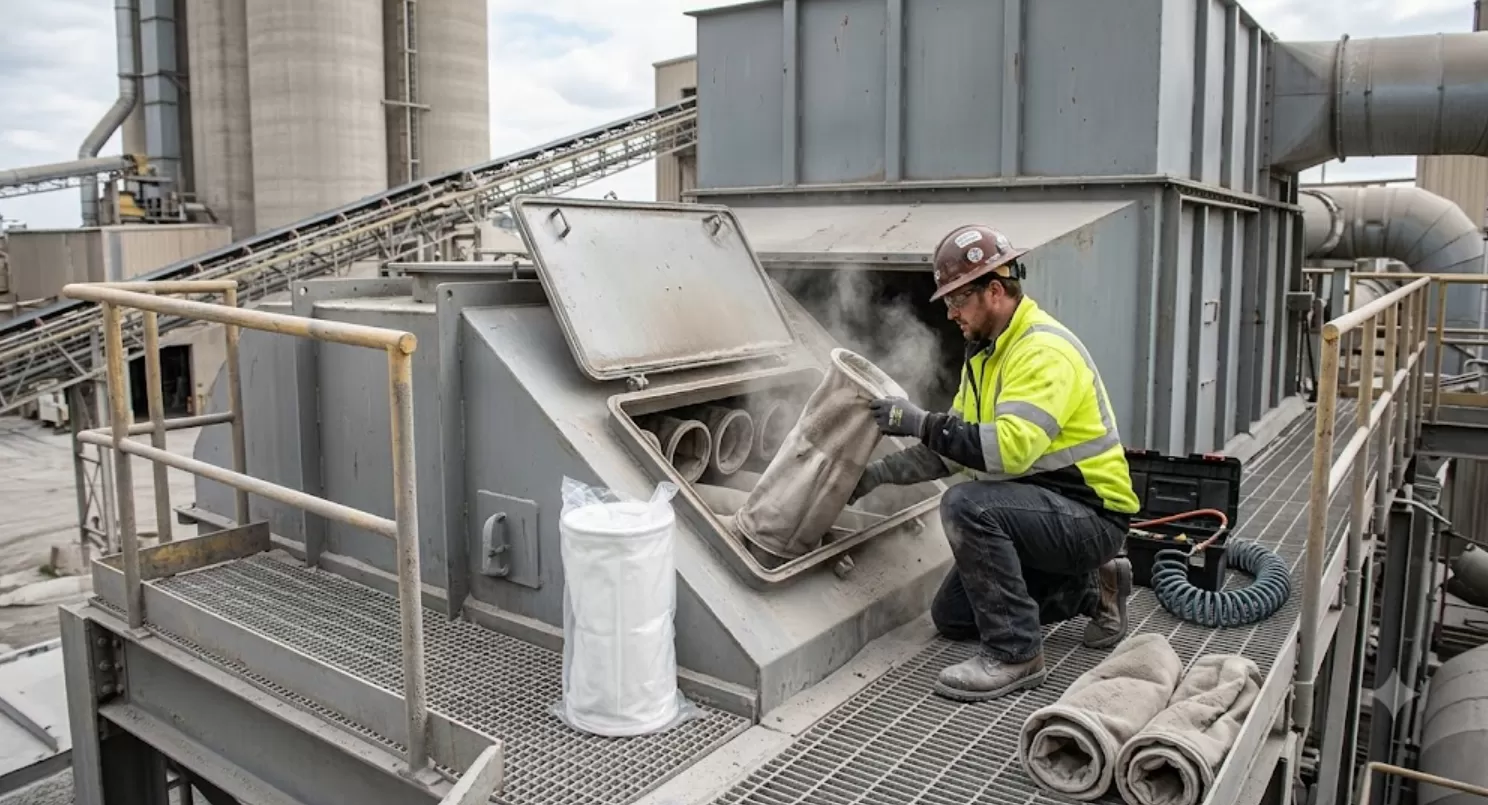
Applicable to all Senotay SNT-BH series bag type dust collector units. Frequency may vary based on dust load, temperature, and moisture conditions.
Source: Senotay engineering guidelines; EPA AP-42 fabric filter maintenance standards; ISO 16890 filter performance protocols.
A wheat flour processing facility in Thailand operating four Senotay SNT-BH-2000 units was experiencing an average of 3.2 unplanned shutdowns per quarter — each lasting 6–14 hours and costing an estimated $8,400 per event in lost production. Root cause analysis identified deferred bag replacement and infrequent pulse-valve inspection as the primary failure drivers.
After implementing Senotay's recommended 7-point maintenance schedule in Q1 2023, the facility recorded the following results over a 12-month period: unplanned shutdowns dropped from 12.8 per year to 3.7 per year — a 71% reduction. Annual maintenance cost increased from $6,200 to $11,800 (primarily bag and solenoid replacements sourced from Senotay's in-stock inventory at wholesale pricing), but total avoided downtime cost was $76,440. Net savings: $70,840 in year one alone.
The facility's maintenance manager noted that the fastest ROI came from weekly compressed air checks and monthly hopper inspections — two tasks that together require less than 45 minutes per unit but had historically been skipped due to perceived low priority.
Use this diagnostic guide to identify the most common field issues and resolve them with the correct replacement parts. All parts available to order through senotay.com with in-stock shipping from China.
Senotay factory support team available for remote diagnostics. Replacement parts ship within 5–10 business days from China warehouse for standard SKUs.
Explore More Air Pollution Control Equipment
Senotay is not simply a source for the initial equipment purchase. As a direct Chinese manufacturer with an established export infrastructure, Senotay provides buyers with ongoing maintenance support throughout the full equipment lifecycle. Every unit sold includes a technical documentation package covering maintenance intervals, torque specifications, filter media compatibility, and compressed air system requirements.
For buyers looking to order replacement filter bags, source solenoid valve sets, or obtain a quote for a full maintenance kit, Senotay maintains an in-stock inventory of all standard consumables at the Senotay China warehouse. Standard parts ship within 5–10 business days to most global destinations. OEM-compatible parts for third-party bag collector brands are also available — contact Senotay with model specifications to confirm compatibility and receive a factory-direct cost estimate.
Maintenance is the single most controllable factor in a dust collector's lifecycle cost. With the right schedule, the right spare parts inventory, and the right supplier relationship, a bag type dust collector sourced from Senotay can deliver consistent filtration performance above 99.9% efficiency for 12 or more years — protecting both your facility's air quality compliance and your operational bottom line.