
EN
What are you looking for?
Industrial buyers in 2024–2025 aren’t only picking filtration equipment they’re, essentially, buying compliance. Emission limits have tightened across big economies, and the distance between an old baghouse and a certified low-emission solution now turns into very direct money consequences like fines, shutdowns, or even lost contracts. Basically knowing where the targets sit, and how fast they shift, is now a core procurement skill, even for teams that didn’t used to track regulation that closely.
China’s 2019 ultra-low emission (ULE) rule for steel is a good example. It sets a cap for particulate matter (PM) from sintering and pelletizing at 10 mg/m³, which is about an 80% reduction versus the 2012 limit. Real plant data backs up what that means in practice: continuous monitoring across China’s steel sector recorded average PM levels dropping from 5.11 mg/m³ in 2021 to 3.49 mg/m³ in 2023, so roughly a 17.4% decline over two years.
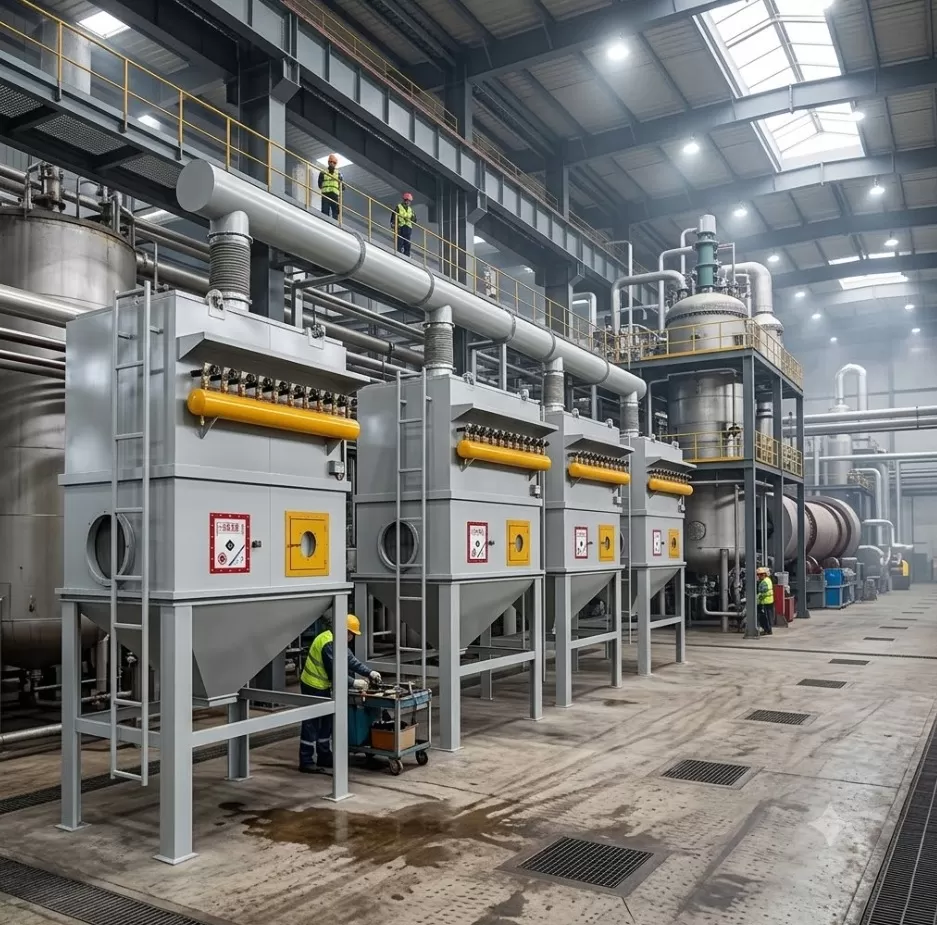
Dust Emission Standards don’t look the same everywhere—they shift by industry, region, and the specific process setup. But many of the 2024–2025 frameworks end up circling a similar set of measurable benchmarks. The table below, if you’re wondering, summarizes the figures buyers commonly reference when they’re defining filtration equipment requirements.
Right now Air Pollution Limits are shaped by two opposing currents. On one side, agencies finalized tougher rules in 2024. The US EPA’s chemical-plant rule, for instance, is projected to cut more than 6,200 tons of toxic air pollutants every year, across 200+ facilities. On the other hand, 2025 brought regulatory reconsideration. The EPA proposed rolling back parts of the 2024 Mercury and Air Toxics Standards (MATS), and it also loosened the stricter 9 µg/m³ PM2.5 threshold that was once tied to preventing up to 4,500 premature deaths and 800,000 asthma cases each year.
For Industrial Compliance teams, this volatility is kind of the real challenge. Buyers can not just assume one national figure stays steady through a five or ten-year equipment lifecycle, because it won’t . Compliance planning more and more means designing for the strictest plausible limit, not the one that’s “current” right now, and retrofitting after a rule tightens costs far more than installing the adequate capacity upfront
Regional Snapshot: Compliance Triggers Buyers Should Track
China: Hebei and Shandong provinces enforce limits that are stricter than national GB standards, and often that ends up being the actual constraint for manufacturers
United States: Facility-level NESHAP reviews are now effectively in play at all times, so the old startup shutdown or malfunction, SSM exemptions are no longer the same
European Union: Best Available Techniques, BAT conclusions, get reviewed periodically, and that tends to tighten Associated Emission Levels, AELs over time
Southeast Asia: Thailand (Euro 5, 2024) and Cambodia (Euro 4 since 2022, Euro 5 by 2027) show a pretty clear regional tightening trend
Getting a filtration solution aligned to present and forecast Dust Emission Standards is not just about grabbing a filter bag from a catalog. Senotay engineers help buyers run the comparison end to end before recommending bag filters, electrostatic precipitators, or hybrid systems.
With almost nine years designing dust-removal systems for metallurgy, mining, cement, foundry, chemical, and pharmaceutical plants, Senotay engineers tune each filtration line— filter bags, cages, pulse valves, screw conveyors—so it performs below the applicable emission ceiling, and that gives operators a compliance buffer as the standards keep getting more demanding, over time.
Explore More Air Pollution Control Equipment
What is the difference between Emission Limits and Air Pollution Limits ?
Emission limits usually mean rules at the source, like the pollutant concentration coming out of a stack or vent. These are often reported in mg/m³ or lb/MMBtu, so it’s kind of very “point-ish”. Air Pollution Limits, on the other hand , more often refer to ambient air quality targets, such as PM2.5 standards by a regulator. That’s measured across an area or region rather than just one facility, so it behaves more like a neighborhood average thing, if you will.
How strict are China's Dust Emission Standards compared to global norms?
China’s ultra-low emission approach for steel (10 mg/m³ PM) sits among the tightest sector based limits you’ll see globally. In many cases it’s stricter than several pre-2024 US or EU benchmarks. Still, how much they actually get enforced can vary quite a lot by province, and that’s where the real-life story sometimes gets messy.
Why do Air Pollution Limits keep changing between 2024 and 2025 ?
They shift because health studies get updated, government priorities change, and legal objections or court decisions happen. In the US, for example, you can see both directions within about a year and a half—tightening in chemical-plant related rules , and then loosening around PM2.5, plus MATS reconsideration. That’s exactly why buyers should not just assume a number will stay stable, instead they should spec filtration equipment against the strictest plausible case they can justify.
What should buyers ask suppliers before purchasing filtration equipment?
Request a guaranteed outlet PM concentration in mg/m³, not only a filtration efficiency percentage.
Confirm the test method matches the buyer’s regional requirement , like GB, EPA Method 5, or EN 13284.
Ask whether they offer a safety margin above the current legal limit, so you are not trapped if standards tighten again later on.