
EN
What are you looking for?
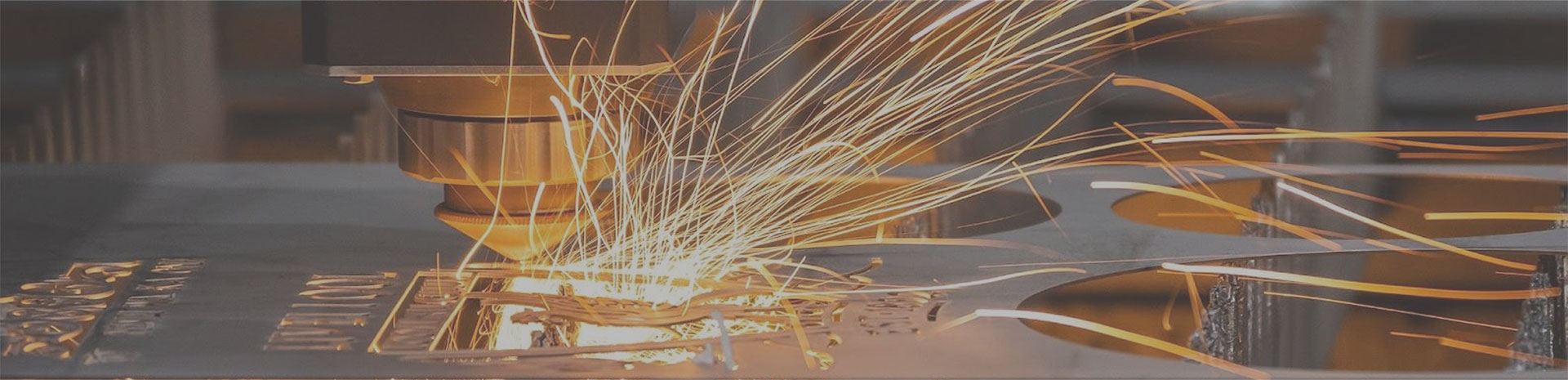
Not all baghouses are equal, at least not in practice. An Industrial Baghouse Dust Collector engineered for a cement kiln sort of has a totally different life than one used on a pharmaceutical packaging line. You’re looking at gas stream temps up to 450°F (232°C) , volumetric flow rates beyond 500,000 CFM, abrasive particulate loadings in the 50–200 g/m³ range, and a 24/7 run schedule where downtime is not just inconvenient it’s basically not allowed. In steel mills and power generation facilities, the stakes are just as real. Fugitive dust doesn’t only lead to regulatory headaches, it also pushes corrosion faster, can mess with product consistency, and creates serious safety and worker health issues.
Senotay has designed and commissioned more than 250 heavy-industry baghouse systems across cement, steel, and power sectors worldwide. And it shows in the field. Our performance data indicates that engineering tuned to the actual industry cuts total lifecycle cost by about 28–44% versus generic off-the-shelf units installed in the same applications. This guide kinda walks through what that “tuned” engineering actually includes—by industry, by operating parameters, and by outcome you can measure without guessing.
Each heavy industry sector imposes a distinct set of engineering requirements. The table below captures the critical design parameters Senotay addresses in each application:
Source: Senotay field commissioning records and verified stack test results, 2021–2024.
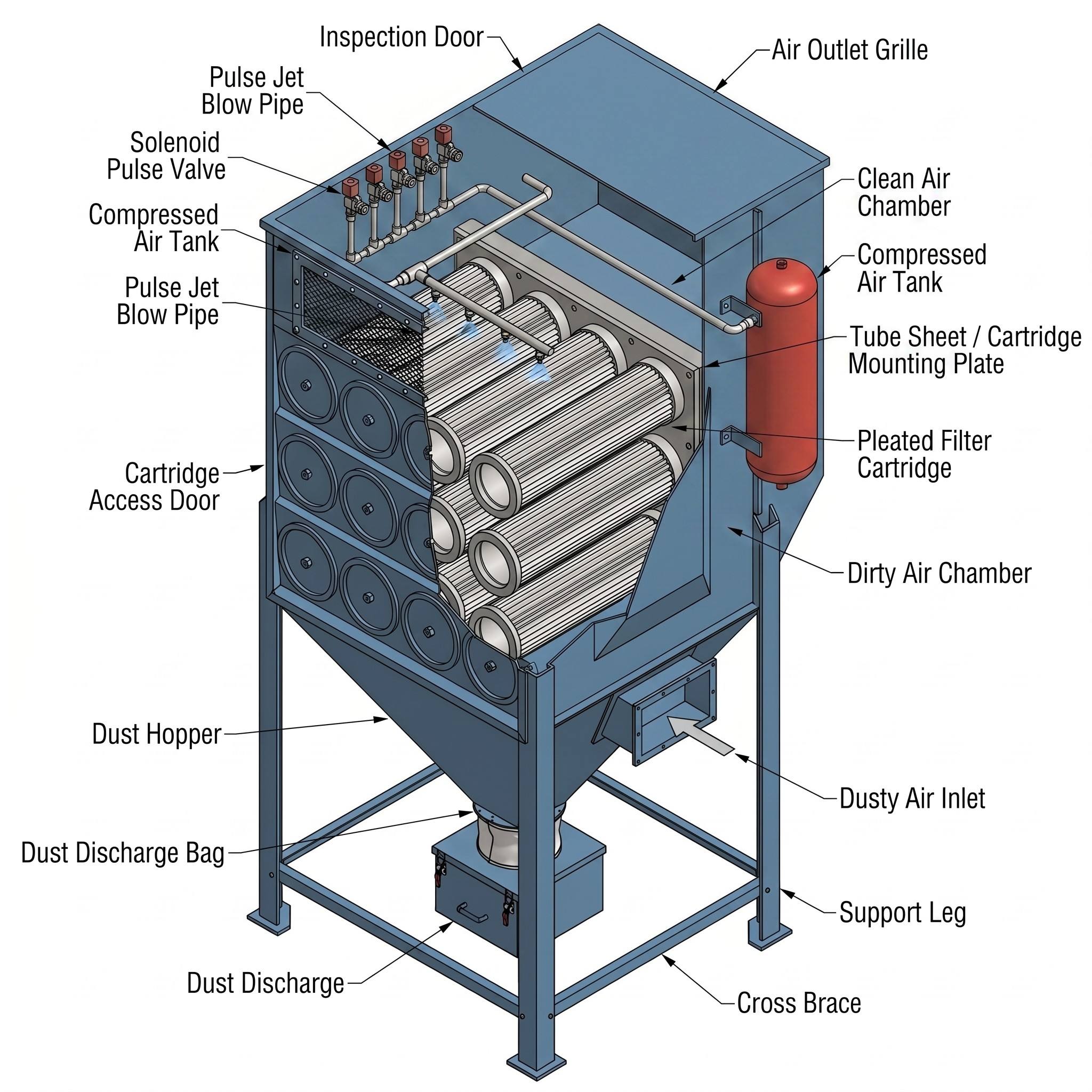
For cement kiln dust the filtration problem is especially brutal. Mohs hardness sits around 6–7 (close to steel file hardness), inlet concentrations can reach 180 g/m³, and temperatures are often above 400°F (204°C). In that environment, conventional bags may get destroyed in as little as 3–6 months. Senotay’s cement-specific approach typically includes tungsten carbide-coated inlet baffles for particle deflection, aramid-fiber bags with reinforced woven tops, and modular compartment isolation so one compartment can be serviced while the rest stays online. One Senotay cement plant installation in Southeast Asia reached 44 months of uninterrupted bag service, which was also the longest documented run life in that site’s 22-year history.
An electric arc furnace (EAF) baghouse kinda deal has two problems at once. First molten metal sparks, they can race through the flow and ignite filter bags in seconds, kind of a no-warning situation. Second, heavy metal particulates like lead , zinc, chromium need tight capture so the operation stays compliant with hazardous waste rules, not something you can just sweep away. Senotay handles both sides with an integrated spark arrestor chamber placed upstream of the filter housing, so the gas temperature is knocked down to under 250°F (121°C) before the bags ever get near it. On top of that there’s a heavy duty stainless steel hopper built plus a sealed discharge system that’s RCRA-compliant, so what leaves the unit is managed correctly. In one case at a Turkish steel mill, Senotay’s EAF baghouse system took heavy metal fugitive emission violations from 6 incidents per year down to zero for a 30-month run.
Cement: check inlet baffle wear every quarter. abrasion losses of 3–5 mm per year are pretty typical when there isn’t a protective lining, even if the plant says “it looks fine”
Steel EAF: verify spark arrestor performance monthly by confirming the inlet gas temperature drop to below 250°F at the arrestor outlet, not just “it seems cooler”
Power plant: measure fly ash resistivity twice a year. high-resistivity ash over 10¹² ohm-cm usually needs a conditioning agent injection so the collector keeps working consistently
Everywhere: record hopper discharge weights each shift to catch bridging early before it turns into a compartment overflow event
Don’t wait: schedule full bag replacement 3 months before the end-of-life estimate. End-stage bag failures in big industrial systems can leave compliance gaps for 48–96 hours, which is longer than teams like to admit
Industry: Coal Power Generation | Location: Eastern Europe | System: 440,000 CFM multi-compartment baghouse | Compliance Target: EU IED ≤ 10 mg/m³
The 1,200 MW plant was basically running an older electrostatic precipitator (ESP) that, pretty much every time, showed outlet values around 38–55 mg/m³, which is well over the EU Industrial Emissions Directive threshold. Because of regulatory pressure and the threat of €2.4 million annually in fines, the upgrade decision was unavoidable. Senotay was brought in to think through a full ESP-to-baghouse conversion ,and importantly use the existing structural footprint so the civil construction spend stayed as low as possible.
Senotay’s approach: a 12-compartment pulse-jet baghouse, with fiberglass/ePTFE membrane bags rated for 380°F continuous operation. Cleaning was demand-based (not just “on schedule”), and the system also included real-time opacity monitoring plus delta-P tracking. For fly ash corrosion protection, SO₂-resistant hopper liner materials were used, so the internals could handle the actual chemistry without cutting corners.
Electrostatic Precipitator (ESP): A dust control unit that uses electrical charge to pull particles onto collection plates. ESPs tend to work better for larger particles ,but when it comes to fine PM2.5 and smaller, they can be less consistent, so baghouses are often the go-to option for modern emissions rules.
Fly Ash: The fine residue carried along with flue gas from coal burning. Its makeup, particle size distribution, and electrical resistivity can swing a lot depending on coal source and combustion conditions. That’s why the baghouse media selection is never one-size-fits-all, it needs to be chosen for the site.
RCRA Compliance: In the US, the Resource Conservation and Recovery Act is the rule framework for handling hazardous waste, including certain dust streams that may contain heavy metals from industrial processes. For example, Senotay’s steel plant baghouse designs include sealed hopper discharge arrangements, built to support fully compliant collection and disposal workflows.
Explore More Air Pollution Control Equipment
Q1: What is the largest baghouse system Senotay has designed?
Senotay has engineered baghouse systems up to 800,000 CFM for large scale coal power generation uses, honestly. These multi compartment designs use 10–16 separately controllable filter sections, so you can do maintenance on just one area without taking the whole thing out of service, which matters a lot for 24/7 continuous production.
Q2: How does an industrial baghouse differ from a commercial dust collector?
Industrial baghouses are built for continuous high volume duty, higher temperatures, abrasive or potentially hazardous particulate types, and they’re held to regulatory expectations like EPA MACT and EU IED. Commercial dust collectors are typically sized for stop and go operation, more normal air conditions, and generally non hazardous dust. Using a commercial style unit on an industrial line is, very often, a main trigger for early wear and also compliance headaches.
Q3: Can a baghouse replace an electrostatic precipitator in an existing plant?
Yes, and ESP to baghouse conversions are showing up more and more as PM2.5 limits tighten up. In practice, baghouses tend to grab fine particles with steadier results, often hitting 99.97%+ efficiency, where typical ESP performance on sub 5 μm material might land around 95–98%. Senotay has finished 14 of these ESP-to-baghouse changes over the last 4 years, and all of them were done within the original precipitator’s footprint,more or less the same structural boundary.
Q4: What is the typical installation timeline for a large industrial baghouse?
For a new 100,000–300,000 CFM baghouse, Senotay’s usual schedule is about 14–22 weeks, from engineering sign off through commissioned operation, it really depends on site conditions and how much civil work is in scope. Also the modular prefabrication approach for the baghouse housings at Senotay’s manufacturing area cuts the on site build duration by roughly 30–40% versus options that rely more on field erection.
Q5: How does Senotay approach cement, steel and power plant projects differently
Each industry really needs a distinct engineering focus, in cement it is abrasion resistance plus high-temperature media, for steel it’s spark protection and also hazardous waste compliance and for power generation it’s more about ultra-low PM emissions and SO₂ resistance . Senotay puts industry specialist engineers on every single project so the design decisions are based on sector specific operating data, not just generalized specifications . That way the team sort of tailors the approach, instead of forcing a one size plan that doesn’t fit.