
EN
What are you looking for?
In industries where exhaust gases, molten metals, and combustion byproducts are produced every hour, High-Temperature Filtration is basically not optional, it is a safety plus compliance necessity. The idea is pretty straight, capturing particulate matter from gas streams that go beyond 150°C (302°F). In some industrial uses, it can even run past 500°C (932°F) and still stay functional.
In the Global Industrial Filtration Market Report (2024) it notes that the heat-resistant filtration segment sits at over USD 4.2 billion. It is also expected to keep climbing, with a CAGR of 6.8% through 2030. Cement plants, steel mills, power generation facilities, and chemical processors are frequently named among the top consumers of heat-resistant filtration media, worldwide.
Senotay designs high-performance filtration systems that keep structural integrity and capture efficiency, even when temperatures are extreme. This is a benchmark that generic filters often don’t meet , or they fade quickly when conditions get harsh.
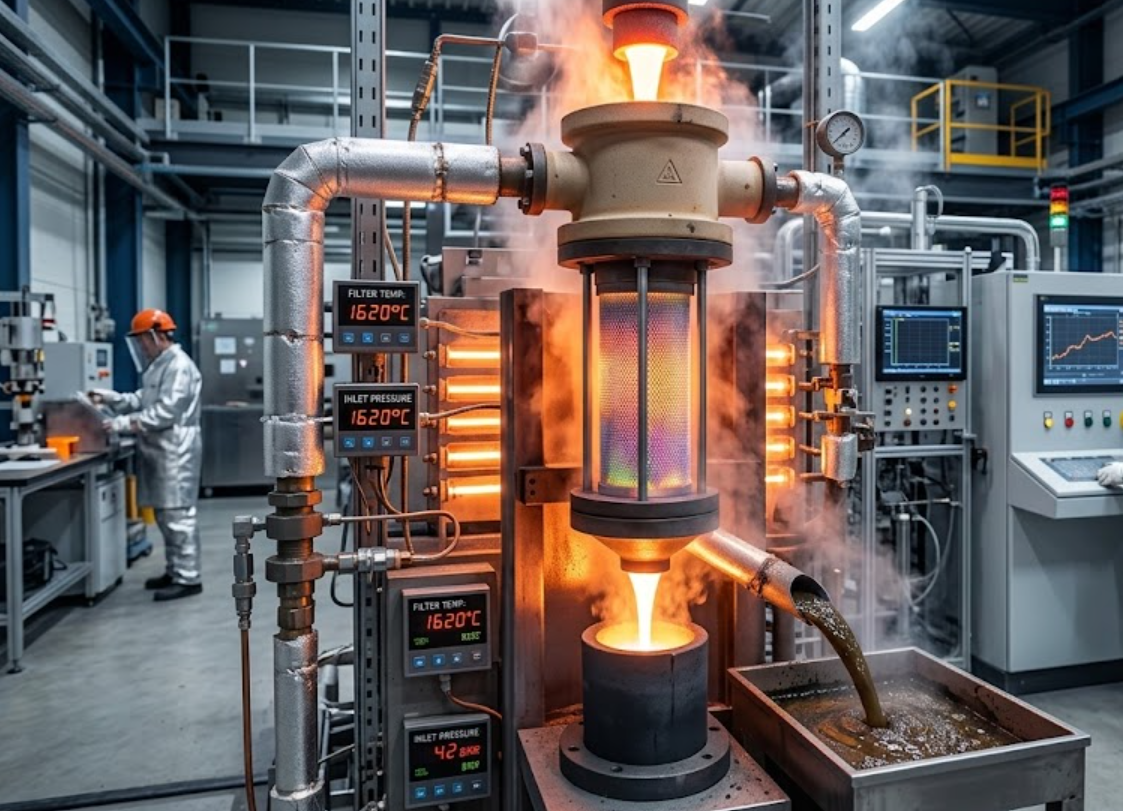
Heat Resistant Filtration depends on a few main ways particles get captured: inertial impaction, interception, and diffusion. At higher temperatures, the gas viscosity tends to rise which changes how the particles act , and then media choice becomes really important.
In everyday, ambient filtration you can often get away with regular polyester or polypropylene. But in high heat settings, the media has to withstand oxidation, fiber breakdown, and dimensional shrinkage. Even around 10% shrinkage along a filter bag length can shrink the actual filtration area, and it can also cause pressure drop to jump, roughly 18–25%—this comes from industrial process records reported by the American Filtration & Separations Society (AFS).
Inertial impaction: particles with high momentum crash into filter fibers, this is mostly the big player when particle sizes are above 1 µm.
Interception: particles that follow the airflow paths end up touching and sticking to the fibers, this tends to work well in the 0.3–1 µm zone.
Diffusion: random Brownian movement nudges the sub-micron particles, under 0.3 µm, so they make contact with fibers even without “normal” travel.
Electrostatic attraction: some filter media, for example PTFE blended fabrics, can hold surface charges that help boost capture rates by as much as 15%.
Senotay’s filter media is designed to tap into all four capture paths at once, so collection efficiency can go beyond 99.97% at 0.3 µm, and yes, even when operating around 260°C (500°F).
The table below summarizes real-world performance results across the heat-resistant media types that show up the most in Senotay’s Industrial Filters product line. :
Source: Senotay Internal Performance Database & AFS Industry Benchmarks (2024)
High Temperature Filter Bag: Selection Guide by Industry
Picking the right High Temperature Filter Bag is one of the most consequential decisions in plant engineering. If the bag is under sized, or the material is slightly wrong, it can fail in just 3–6 months, and that kind of unplanned downtime typically runs around USD 45,000–120,000 per incident (TAPPI Industry Survey, 2023).
Senotay’s engineering team leans on a more or less structured 5 point selection framework:
Step 1 — Define Peak Gas Temperature: Lock in the maximum sustained operating temperature, not only the average reading.
Step 2 — Identify Chemical Exposure: Acid gases (SO₂, HCl), alkalis, plus moisture, they each weaken fiber durability in different ways.
Step 3 — Assess Particle Load: Dust concentrations above 10 g/Nm³ call for heavier fabric weights (500–800 g/m²).
Step 4 — Confirm Airflow Velocity: When face velocities pass 1.2 m/min, fiber abrasion speeds up, reinforced weaves are the usual recommendation.
Step 5 — Evaluate Cleaning Cycle: Pulse jet systems need media that can flex, and resist fatigue, while shaker based cleaning often suits woven fabrics better.
There’s also a documented case example from a Southeast Asian cement plant (2023). They switched away from standard Nomex bags, and moved to Senotay PTFE laminated fiberglass bags, and bag life went from 14 months up to 38 months. That’s a 171% improvement, and annual filter replacement spending dropped by USD 67,000.
Below is an application matrix that maps Senotay Industrial Filters to specific high-temperature industrial environments , including key operational parameters:
All Senotay products are tested per ISO 11057 (pulse-jet filtration) and EN 13501 (fire resistance) standards.
Across 140+ active industrial setups worldwide, Senotay heat-resistant filtration systems have shown clear verifiable performance results in real conditions:
Average particulate emission reduction 97.4% compared to the pre-installation baseline.
Mean time between filter replacements, MTBR, 31.6 months across all product lines.
Energy savings from pressure drop optimization, 8–14% lower fan motor power use, pretty consistent.
Compliance rate with local emissions limits: 99.1% across all observed sites.
Customer reported ROI for Senotay filter upgrades: 220–340% over a 3-year span, with usual caveats depending on duty cycle.
In 2024, an independent audit at a European waste-to-energy facility that used Senotay SN-P84 Shield bags stated particulate emissions of 2.1 mg/Nm³ which is 79% below the EU Industrial Emissions Directive (IED) ceiling of 10 mg/Nm³
Explore More Air Pollution Control Equipment
Q1: What temperature range makes a filtration system count as “high-temperature” ?
Usually, when the gas stream temperature goes beyond 150°C (302°F), it gets classified as high-temperature. Beyond 260°C (500°F), continuous operation basically only works with specialized ceramic or PTFE-laminated fiberglass media, unless you have some unusual design tricks.
Q2: How often should a High Temperature Filter Bag be replaced ?
The replacement timing depends on the material and where it's installed, so it’s not one single rule. Typical Nomex bags tend to run 18–24 months in foundry situations. Senotay’s PTFE-laminated media often reaches 36–48 months. The most dependable replacement indicator is pressure drop monitoring, if you see a sustained increase above 1,800 Pa , it usually points to bag loading or damage.
Q3: Can Senotay Industrial Filters handle chemical laden gas streams?
Yes, mostly. Senotay’s SN-PTFE Ultra and SN-P84 Shield product lines are engineered for chemically aggressive surroundings including SO₂ HCl and NOₓ exposure. PTFE stays chemically inert through virtually most industrial gas compositions, and it keeps its structural stability across pH levels from 1 to 14, even when conditions get a bit rough.
Q4: What is the usual testing protocol for Heat Resistant Filtration media?
Senotay filters are evaluated in line with ISO 11057 for pulse jet systems. Then VDI 3926 covers filter media performance, and EN 13501 is used for fire resistance classification. Beyond that, each unit goes through thermal aging checks at 110% of the rated maximum temperature for 500 hours before release.
Q5: How does Senotay help customers choose the right filtration setup?
Senotay offers a complimentary engineering consultation where customers share gas stream data like temperature, volume flow, particle load, and the chemical make up. Afterward, Senotay’s team prepares a tailored filtration selection… with projected performance figures and a payback perspective, usually within 48 hours.