
EN
What are you looking for?
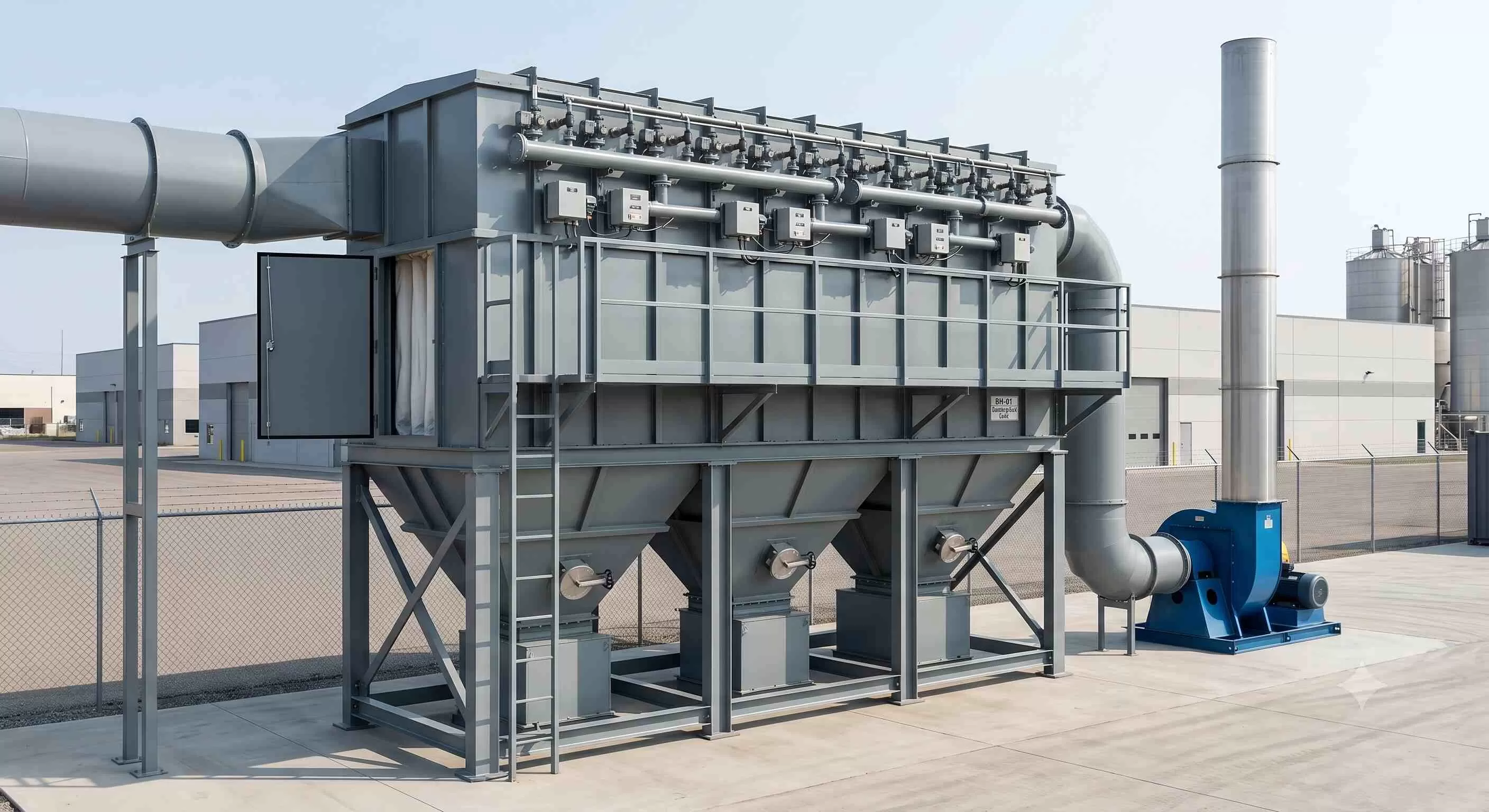
When procurement teams evaluate dust collection equipment , they usually end up staring at one figure, 99.9% efficiency. But Baghouse Efficiency isn’t some tidy fixed value , it’s more like a moving target dynamic performance variable that shifts with particle size, dust loading, filter media condition, gas velocity, and even operating temperature. So yeah, a system that looks perfect with 99.9% on paper can end up releasing 3–8x more particulate than the specification , if the wrong micron rating gets applied to the actual dust profile.
Senotay’s emissions testing data across 150+ active installations shows a pretty real gap : 63% of underperforming baghouses were specified using a generic efficiency rating rather than being matched to the actual particle size distribution PSD of the dust they handle. This guide swaps marketing numbers for verified performance data, and it gives engineers and facility managers the working framework to specify, measure, and keep improving true dust capture performance over time.
Efficiency ratings only have meaning when matched to a specific particle size range. The table below maps filter media types to their real-world capture efficiency across the particle sizes most common in industrial dust streams:
Source: Senotay in-house isokinetic emissions testing, EPA Method 5 / Method 17 measurements, and EN 13284 European standard field results.
Most baghouse efficiency ratings are tested at 1–10 μm , which is basically the easiest window to filter. Sub‑micron particles (PM1.0 and lower) behave differently, they ride along with gas streamlines and can dodge inertial capture mechanisms. Senotay’s nano-fiber laminate bags reach 99.95% efficiency at 0.3 μm — a key particle size tied to respiratory health risk and increasingly the center of industrial air quality regulation globally.
2. Operating Velocity Above Design A/C Ratio
When the airflow velocity through the filter fabric climbs over the design specification , the filter efficiency falls, not in a straight line, but in a more complicated way. Usually a 20% jump in face velocity can shave off about 4–8 percentage points of sub-micron capture efficiency, which is roughly the same as taking outlet emissions concentration and multiplying it by a factor of 3–5. In fact, Senotay’s velocity mapping audits have shown airflow distribution headaches in 38% of the multicompartment baghouses they reviewed. In those units, uneven loading can push localized over-velocity into 2–3 compartments while the other zones stay under-loaded.
3. Incomplete Dust Cake Development on New Bags
Counter to what you might expect, brand-new filter bags often catch fine particles less well than broken-in bags. Early on, the initial dust cake layer—which is typically formed after around 50–150 operating hours—works like a secondary filtration plane and captures particles that the base fabric would otherwise let through. Senotay suggests a controlled cake conditioning protocol during commissioning, mostly to make the process settle faster and to keep compliance exceedances from showing up during the break-in window.
4. Damaged or Improperly Sealed Bag-to-Tubesheet Connections
Failures at the bag cage, or the tubesheet sealing interface, make up as much as 40% of efficiency losses you actually see, even when the filter media remains in good condition. One misaligned snap-ring , or a cracked tubesheet gasket, can open up a bypass path that multiplies outlet emissions by 10–20x in the affected compartment. Senotay runs a quarterly fluorescent tracer leak testing program— it’s included in all maintenance contracts— and it spots seal problems that standard opacity monitoring won’t notice.
Do isokinetic stack testing at least annually—opacity meters, by themselves can’t catch sub-micron particle seepage
Keep track of outlet particulate concentration in mg/m³ not only opacity percent , regulators are moving toward mass based constraints now
Run fluorescent tracer (leak verification) checks after every bag changeout, to verify tubesheet seal continuity and that kind of stuff
Record inlet particle size distribution at least twice a year — if the process drifts, the PSD shifts too , and the original media choices can stop making sense
Industry: Pharmaceutical Manufacturing | Location: South Korea | System: 18,000 CFM pulse-jet baghouse | Target: PM0.5 capture ≥ 99.9%
A Senotay client was getting stuck failing their stack tests on a quarterly schedule , reporting outlet concentrations of 14.2 mg/m³ versus a regulatory cap of 5 mg/m³. The current needle felt bags were advertised at 99.9% efficiency , but the dust profile was still ruled by 0.3–0.8 μm API (active pharmaceutical ingredient) particles. In that micron range, the standard felt basically hangs around 90–94% performance, even though the headline efficiency sounds higher.
Full ROI on the Senotay nano-fiber upgrade was realized within 6 months of installation, including zero regulatory fines in the 36-month post-upgrade period.
Micron (μm): One millionth of a meter. A human hair is roughly 70 micrometers across. PM2.5 , the particle fraction most harmful to human lungs — means particles at 2.5 microns or less. Baghouse filter media has to be matched to the specific micron sizes that exist in your dust stream , otherwise the capture story is incomplete.
Isokinetic stack testing is a way of measuring real particulate emissions at the exhaust stack by pulling samples at essentially the same velocity as the stack flow, so it does not mess up the capture efficiency or sampling results. In most cases it’s treated as the gold standard for compliance, and yeah it’s much more reliable than opacity meters, especially when you’re trying to catch fine particles that won’t show up well in a visible plume.
Dust cake: basically that layer of collected dust that builds on the surface of the filter bags while everything is running. Kinda counterintuitive but that cake layer actually improves filtration: it works like a secondary filter in addition to the media itself. Good cake management, not too thick, not too thin, is what keeps efficiency high over time.
Explore More Air Pollution Control Equipment
Q1: What efficiency rating should I specify for my baghouse?
You should match the efficiency number to your actual dust particle size distribution, not some generic industry benchmark that sounds right on paper. For PM10 compliance, 99.5% at 5–10 μm is usually sufficient. For PM2.5 regulatory needs, or pharmaceutical use where control is tighter, you typically want 99.9%+ at 0.3–1.0 μm. Senotay provides free particle size analysis and media matching with every system audit, so you can specify the right performance target.
Q2: Why does my baghouse pass visual opacity checks but fail stack tests?
Opacity meters mainly “see” visible particulates, mostly particles roughly above 2–5 μm. Sub-micron material is often basically invisible to the eye and it can remain optically transparent, so you won’t get a noticeable plume even when emissions by mass could still be above the allowable limits. That’s why Senotay recommends doing annual isokinetic stack testing even if your visual opacity readings look clean.
Q3: How long does it take for new filter bags to reach peak efficiency?
Usually around 50–150 operating hours under normal dust loading conditions. During that break-in stretch, emissions can run higher than true steady-state. Senotay’s commissioning approach includes a controlled cake conditioning step, which compresses that ramp-up to about 20–40 hours, and it helps reduce compliance exposure during startup, overall.
Q4: what is the efficiency difference between standard felt and ePTFE membrane bags?
For coarse dust, the situation gets almost boring, above 10 μm the difference is pretty minimal: both materials come in around 99.5%+ . But once you move to finer dust in the 1–5 μm band, things change a lot, standard felt is typically about 94–97% , while the Senotay ePTFE membrane bag usually reaches 99.9%+ . And for sub micron stuff below 1 μm, the gap widens dramatically, standard felt sits around 82–88% , whereas Senotay ePTFE is more like 99.5 -- 99.8% .
Q5: how does Senotay measure and also guarantee baghouse efficiency?
Senotay performance is guaranteed via a combination of steps , not only one trick. They start with pre-installation particle size analysis, then they choose the media carefully so it matches your PSD, then during commissioning they run isokinetic emissions testing. After that, periodic performance audits continue across the whole bag service life. Also, each Senotay installation is supported with documented field measurement results— not only lab based grades—so clients have defensible compliance data for regulatory submissions.
High-Temperature Baghouse Systems: Material & Performance Data
How to ensure Maintenance of Bag Type Dust Collector | senotay