
EN
What are you looking for?

Baghouse Optimization Baghouse Optimization is basically the process of tweaking a fabric filter dust collection setup so it runs at peak efficiency, uses less power, and keeps upkeep expenses to the minimum. For plant engineers and environmental compliance officers, it is not a one-time thing , it's an ongoing engineering discipline that has a direct effect on production uptime , regulatory position ,and overall operating spend.
Per the U.S. Environmental Protection Agency (EPA), industrial baghouses are collectively dealing with more than 500 million tons of particulate matter each year, across cement , steel , grain handling, and power generation. Even a 10% dip in filtration performance can lead to regulatory penalties that top $25,000 every day under the Clean Air Act, so optimization becomes a money necessity not only a technical preference.
At the middle of nearly any optimization plan there’s one key parameter: the Air-to-Cloth Ratio. Figuring out how to compute it , how to read it, and what to do afterward is basically the strongest control knob in baghouse design and day-to-day operation.
The Air-to-Cloth Ratio (A/C Ratio) — sometimes also written as the Gas-to-Cloth (G/C) Ratio — tells you how much air volume moves through each square foot of filter media per minute. It’s the main performance indicator used in baghouse design and filtration calculation.
Formula: A/C Ratio = Total Airflow (ft³/min) ÷ Total Filter Media Area (ft²)
Example: Suppose the baghouse is moving 30,000 ft³/min (CFM) and the filter media area totals 10,000 ft², then A/C Ratio = 30,000 ÷ 10,000 = 3.0:1
This ratio is usually reported in ft/min (feet per minute) and it effectively shows how aggressively the filter cloth has to work to trap particulates.
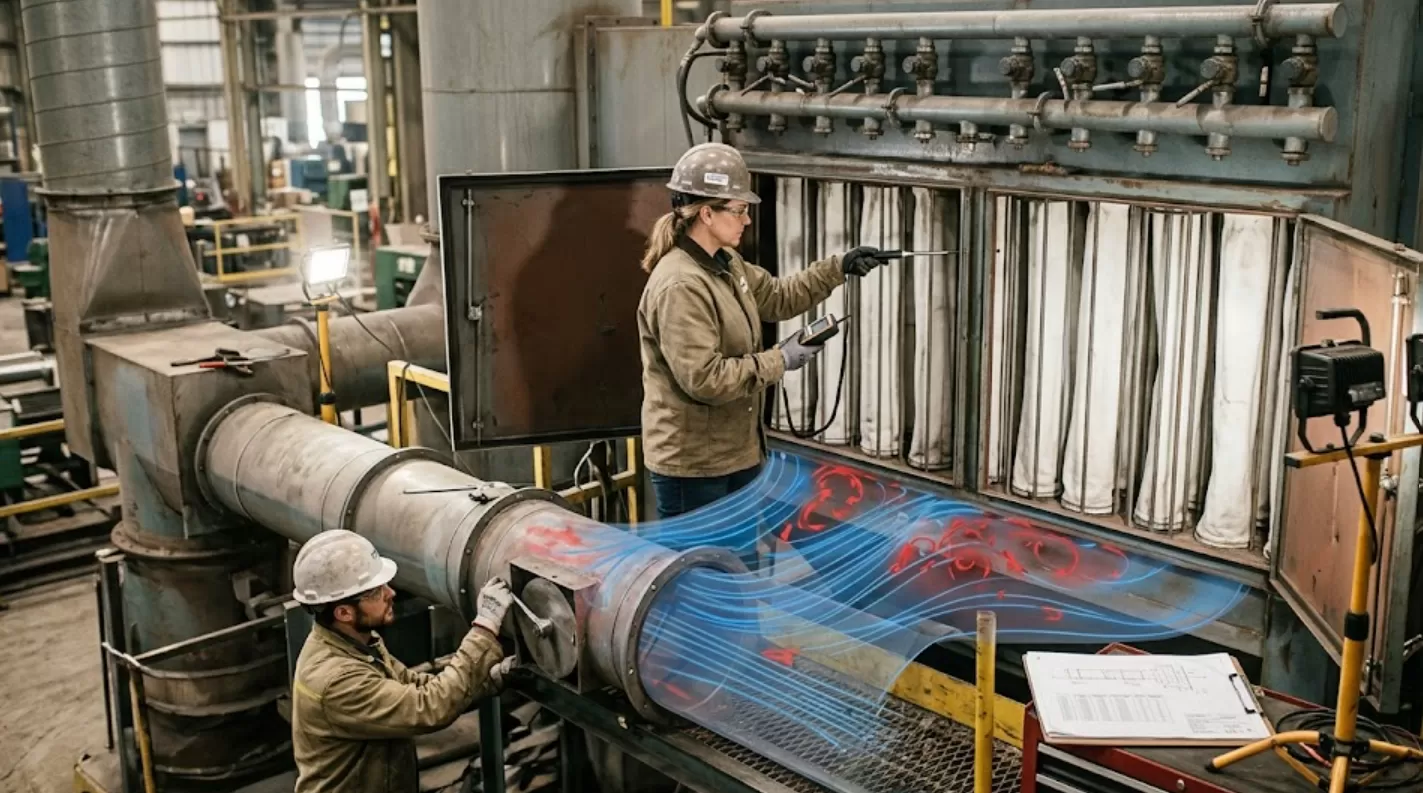
Every design parameter in a baghouse—bag count, bag dimensions, cleaning frequency, pressure drop— seems to sit either as a cause or a consequence of the A/C Ratio. Industry benchmarks compiled by the Air & Waste Management Association (AWMA) suggest that when systems operate inside the “optimal” A/C Ratio band, they tend to show:
Filter bag service life of about 3–7 years (compared to roughly 1–2 years in overloaded setups)
Pressure drop staying in the ballpark of 2–4.5 inches of water gauge (w.g.)
Particulate collection efficiency above 99.9% for particles ≥ 1 micron
Energy savings of as much as 20–30% against poorly tuned systems
Compliance rates at 98%+ in EPA stack emission tests
The following table, developed using data from OSHA industrial hygiene guidelines and Senotay's proprietary filtration database covering 1,200+ installations, provides recommended A/C Ratio ranges by application:
Note: Lower ratios apply to fine, sticky, or hygroscopic dusts that blind filter media rapidly. Higher ratios are suitable for coarser, free-flowing particulates with predictable cake release.
Use a calibrated Pitot tube, or a thermal mass flow meter, at the baghouse inlet duct. For new installs, this number usually comes from the process engineer’s ventilation design. In practice, industrial airflows range from about 2,000 CFM for smaller operations, to well past 500,000 CFM for bigger power plants.
Total filter area = Number of bags × π × Bag diameter × Bag length
Example: 200 bags × π × 0.5 ft × 10 ft = 200 × 15.71 = 3,142 ft²
Senotay's Bag Configurator Tool (available on senotay.com) automates this calculation and cross-references it against your dust particle size distribution (PSD) data for optimal accuracy.
Take your total CFM and divide by the total media area. Then compare the outcome with the benchmark table mentioned above. If the computed value lands outside the recommended range, go ahead to Step 4.
If the A/C Ratio is too high (meaning the system is kind of overloaded), you can look at options like:
Adding more filter bags into the existing housing
Extending bag length if the housing dimensions allow it
Adding a supplementary baghouse module in parallel
Reducing process airflow through source capture optimization
Now, if the A/C Ratio is too low (system oversized), you might:
Remove bags, temporarily or permanently, to cut down cleaning cycles
Re-check the original design if you’re planning a replacement—possibly downsizing toward a smaller system
Pressure drop across the filter system is probably the most immediate real-world clue for if your A/C Ratio is in a good healthy range. The table below gives a sort of fast diagnostic feel, based on Senotay’s field data from more than 400 operating installations across Asia and North America:
Case Study: A cement plant in Shandong Province, China saw persistent pressure drops of 7.2 inches w.g. , which was close to about twice the safe threshold. A Senotay engineering audit found an A/C Ratio of 6.8:1, and this happened because of a 15% reduction in the total bag count after maintenance damage. Once the bag inventory was brought back up, and airflow was rebalanced to reach 3.4:1, the pressure drop then leveled off at 3.1 inches w.g. , and the bag replacement costs fell by 42% each year.
In pulse-jet baghouses — these are well over 70% of new installations globally — cleaning usually gets triggered by either a timer or a differential pressure DP sensor. DP based cleaning (also called demand cleaning) tends to be 15–25% more energy efficient than timer based cleaning, per a 2022 study in Filtration & Separation journal
For optimal pulse pressure on standard woven or felted bags you typically want 80–100 psi. If you go under 70 psi you risk incomplete cake release, while pushing above 110 psi speeds bag wear by as much as 3×, and it also cuts the service life in a pretty big way
Choosing the wrong media can, basically, push an A/C Ratio that looked totally right into the unsafe zone. There are a few selection points that matter more than people think, like :
Temperature: when you are running above 275°F (135°C), fiberglass or PTFE-laminated media is usually the right way to go
Chemical resistance: for acid gas conditions, Nomex or P84 fiber bags are preferred, because the environment is pretty aggressive
Particle size: for ultra-fine dusts (< 1 micron), PTFE membrane laminates are often needed to hit efficiency above 99.97%
Moisture: hygroscopic dusts tend to want ePTFE membrane bags with anti-static treatment, or you can get trouble with charge build-up and performance
Nowadays baghouse optimization doesn’t just depend on occasional manual checks. IoT systems, with pressure sensors spread across the unit, plus bag leak detectors (triboelectric monitors) can usually spot a single bag failure within minutes. Senotay’s SmartFilter monitoring integration, already used in 85+ facilities, has shown about a 60% drop in unplanned downtime thanks to early fault identification.
Explore More Air Pollution Control Equipment
Q1: What is a good Air-to-Cloth Ratio for a pulse-jet baghouse?
For most pulse-jet baghouses working with dry industrial dust, an A/C Ratio around 3.0:1 to 5.0:1 is commonly treated as the sweet spot. But the “best” value depends a lot on the dust traits, like particle size, density and moisture, and also operating temperature, plus how the cleaning system is designed. Fine or sticky dusts generally need lower ratios (2.0 -- 3.5:1) , while coarse material can handle higher ones (5.0 -- 7.0:1).
Q2: How does pressure drop link to the A/C Ratio?
Pressure drop (in inches of water gauge) tends to go up when the A/C Ratio climbs. In practice, a baghouse that’s well tuned usually holds pressure drop somewhere around 2.0 to 4.5 inches w.g. If you keep seeing sustained readings past 6.0 inches w.g., that usually means the A/C Ratio is too high—so the filter media is basically overloaded, and it likely needs attention, intervention, or at least a prompt check.
Q3: How often should I redo the Air-to-Cloth Ratio?
You should recalculate whenever there’s a noticeable shift in the process. For example, when production throughput increases by more than 10%, or when raw materials change, or when maintenance work modifies bag count. Senotay suggests doing a formal filtration audit every 12–18 months for facilities that run continuously, just to keep things aligned and avoid gradual drift.
Q4: Can Senotay support Air-to-Cloth Ratio calculations for my actual setup?
Yes. Senotay offers custom engineering assistance for baghouse design, A/C Ratio optimization, media selection, and overall system commissioning. With more than 10 years focused in industrial filtration, and a wide global installation footprint, the engineering team can provide recommendations that fit your site—supported by practical, real-world data. Go to senotay.com to request a free filtration audit, or to schedule a system design consultation.
Q5: What occurs if the A/C Ratio is too low?
If the A/C Ratio is too low (under 2.0:1), the system can be effectively oversized for the application. This is often “better” than overload, but it can still cause problems like early bag blinding on certain dusts, where thin dust cakes do not really set up the way they should. You may also see less effective cleaning, plus extra capital expense that you probably didn’t need. The goal is always a balanced ratio, that’s the real engineering target.
Q6: How does Senotay approach baghouse optimization differently?
Senotay sort of mixes serious filtration media engineering with a more data focused system analysis. Instead of leaning on generic “industry ratios”, Senotay engineers look at what’s really happening , like the particle size distribution, opacity readings, and the historical pressure drop behavior. Then they craft optimization plans that are actually tied to that specific site. In practice, this method has shown documented energy savings of about 18–32% and also longer bag life, up to around 2.4× compared with the typical industry-average results.