
EN
What are you looking for?
Right Conveying Equipment: Screw Conveyors vs. Chain Conveyors
The selection of the right conveying equipment in the complex environment of industrial processing not only decides the viability of your production line for a long term but also creates a new one or keeps an existing one. The wrong selection would mean major losses due to mechanical breakdowns, material spoilage, and wastage of energy, rather than just a minor inconvenience. In a similar way, these two conveyors also differ in their working methods. Think of them as two paths leading from the screw conveyor and chain conveyor stand as the two primary workhorses., where one uses the twin-screw mechanism while the other relies on a chain-and-sprocket mechanism, hence guiding you through a side-by-side technical comparison based upon material flow characteristics, constriction in space, and ROI standards for 2026.
1. The Screw Conveyor: Precision, Containment, and Metering
The manner in which a screw conveyor works is based on Archimedean’s screw principle, where the rotating screw blade that also known as “flighting” which is given the shape of a helix and attached either to a central pipe or shaft. This unit is rotating in a fixed tubular pipe or U-shaped trough.
Key Advantages
Total Enclosure: Screw conveyors use a totally sealed environment which is quite safe and hence are termed as "Gold Standard" for those types of material that are hazardous or dusty and require full containment to meet environmental safety standards.
Multi-Functional Versatility: In simple terms transport only, screw conveyors can be tailored to do dual roles like mixing, blending, or heating/cooling materials during transit.
Volumetric Feeding: They are ideal for "metering" material, delivering a uniform, controlled flow rate that is crucial for subsequent processing.
screw conveyor Is Best For:
· Fine powders and dust
· Slurries and wet or sticky materials
· Short-to-medium conveying distances
· Systems requiring precise feed control
2. The Chain Conveyor: High-Capacity Durability
Chain conveyors that often referred to as "drag" or "en-masse" conveyors which utilize a continuous chain equipped with a series of flights or paddles.These flights pull the material through a rectangular duct and often moving the material in a solid, cohesive "slug."
Key Advantages
Extreme Durability: Because the chain and flights are designed for heavy-duty stress, these systems can handle highly abrasive, hot, or heavy materials that would rapidly erode the flighting of a screw.
High-Volume Throughput: Chain conveyors are capable of moving significantly larger volumes over longer distances (exceeding 200 feet) with lower horsepower-per-ton requirements than screw systems.
Minimal Product Breakage: In en-masse conveying, there is very little internal friction within the material, making it safer for fragile products.
Chain Conveyor is Best For:
· Grain, coal, clinker, ash.
· Abrasive or sharp bulk solid.
· Long horizontal or vertical conveying run.
· Continuous industrial processes.
3. Engineering Comparison: Material Characteristics and Flow Dynamics
Abrasiveness vs. Fragility
Screw conveyors can be hard on materials. The shearing action between the rotating flight and the trough wall can grind fragile particles. Conversely, chain conveyors move material as a single mass. However, if the material is highly abrasive, a screw conveyor requires specialized "hard-facing" or AR-steel liners, whereas a chain conveyor is naturally more resistant due to its lower internal velocity.
Inclination and "Fall-back"
The physics of "fall-back" is a major consideration for vertical or inclined conveying.
Screw Conveyors: Efficiency drops rapidly as the angle increases.7 At a 45° incline, a standard screw may lose 50% of its horizontal capacity.
Chain Conveyors: Specialized chain systems can handle steep inclines and even 90° vertical lifts with much higher volumetric stability.8
Screw Conveyors
· Hanger bearings (primary failure point).
· Flighting edges (abrasive wear).
· Trough liners.
Chain Conveyors
· Chain stretch and elongation.
· Sprocket tooth wear.
· Flight replacement intervals.
Screw conveyors continuously draw torque to surpass the friction between material and trough which is the main cause of energy waste when handling abrasive or heavy materials.
On the other hand, chain conveyors are usually slower but have greater mechanical efficiency and therefore consume less energy when moving the same amount of material, especially in the case of transporting over long distances.
Senotay conveying equipment is designed with an innovative maintenance-free principle. The quick access inspection panels help the maintenance teams to check on the wear parts without the need to dismantle the whole system which significantly cuts down the service time and labor costs.
The Senotay Edge: We have “Quick-Access” inspection panels built into our systems. As a result, your team can carry out visual inspection on chain tension or flight cleanliness without the need for the entire conveyor line to be dismantled.
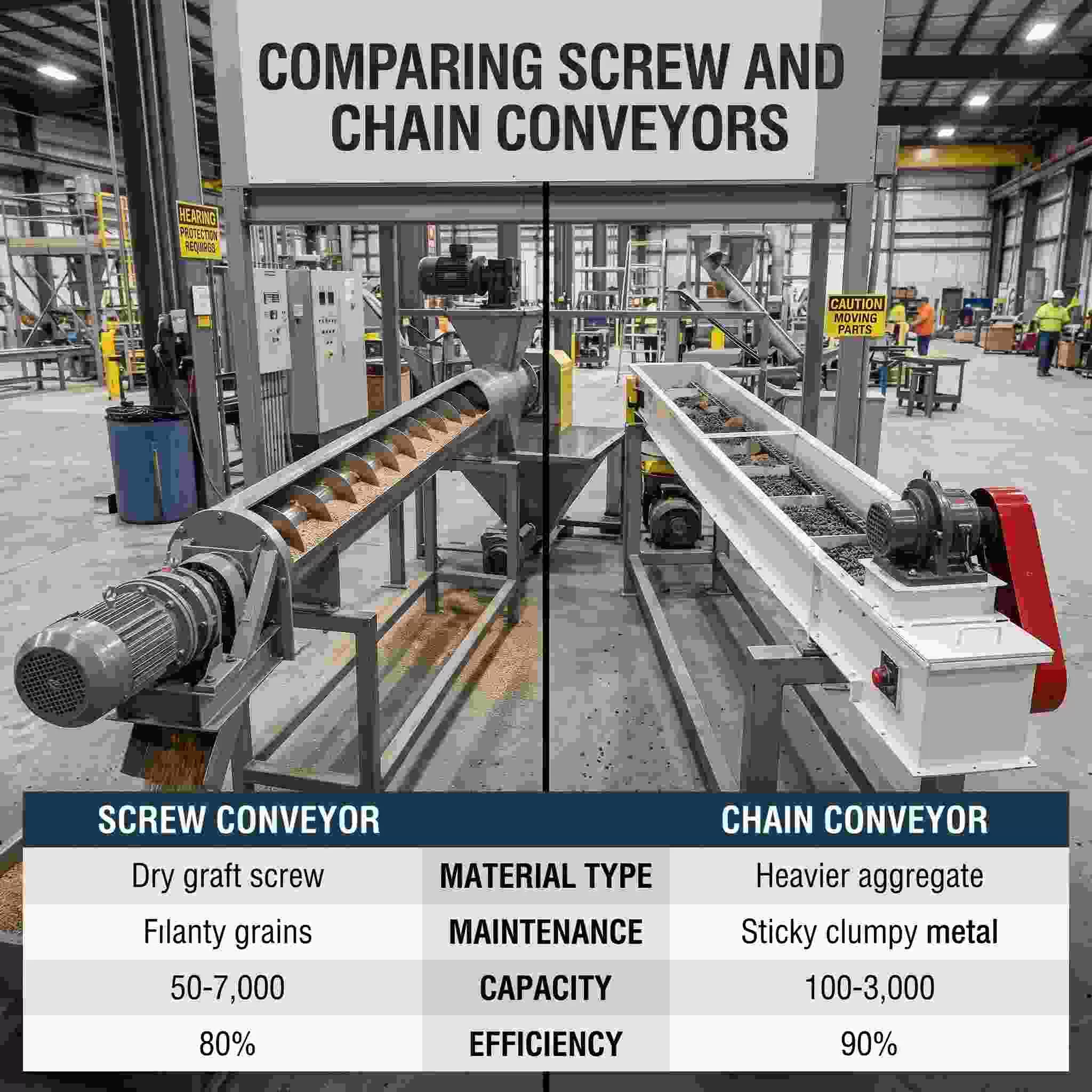
5. The Decision Matrix: Technical Selection Guide
6. Strategic Integration with Dust Collection
In modern facility design, these conveyors act as the critical "discharge" mechanism for industrial dust collectors. A Senotay Rotary Airlock feeding directly into a Senotay Screw Conveyor is the industry benchmark for managing collected dust without breaking the vacuum seal of the filtration system.
7. Certified Excellence: The Senotay Guarantee
At Senotay, our engineering goes beyond basic assembly. We ensure our conveying equipment meets the highest global standards for reliability and safety:
ISO 9001:2015: Our production strictly follows rigorous quality management systems to ensure structural integrity.
CE & ATEX Certification: It is Essential for handling combustible dusts and our conveyors are designed with explosion-proof motors and spark-resistant components where required.
CEMA Standard Alignment: Our designs strictly follow the Conveyor Equipment Manufacturers Association (CEMA) standards for torsional stress and load capacities.
Explore More Air Pollution Control Equipment
Conclusion: Engineering the Perfect Flow with senotay
The "right" conveying equipment is defined by your material's physical properties. Whether you need the 100% containment of a screw conveyor or the rugged, high-volume capacity of a chain system, Senotay provides the engineering expertise to keep your facility moving.
Not sure if your material is too abrasive for a screw? Don't guess with your CAPEX budget. Contact Senotay’s Material Handling Experts today for a free material flow analysis and a custom equipment quote.