
SENOTAY
Factory Baghouse Upgrade: Review Capacity and Control the Change
Evaluate an existing factory baghouse before expanding duty. Preserve the baseline, check connected-system constraints, test a transparent area example and approve a documented change package.
INDUSTRIAL BUYER’S TECHNICAL GUIDE
A factory baghouse upgrade should address a documented constraint in the existing system. Added production may change capture demand, filtration loading, fan duty and material handling together. Compare the current and proposed conditions, then approve and commission the complete change.
Key takeaways
Identify the constraint before selecting equipment.
Check actual airflow against the area available online.
Review downstream and upstream interfaces together.
Release the change with new acceptance benchmarks.
Locate the constraint
Use the existing design and operating records to identify the limiting component.
Check the connected system
Review ducts, fan, filter area, cleaning and dust discharge together.
Commission the new duty
Record the new operating modes, benchmarks and required performance evidence.
1. Define why the factory needs an upgrade
Expansion, changed materials, deteriorating equipment or a revised control requirement can justify a review. State the problem and the required outcome before asking for a larger collector. More motor power alone does not establish finer filtration, improved exposure control or lower energy use.
Identify whether the concern is dust escaping a source, inadequate duct transport, rising filter resistance, outlet performance, cleaning difficulty or solids-discharge interruption. These symptoms can have different causes. An upgrade that addresses the wrong component may leave the original problem unresolved.
Preserve the existing duty and evidence
Collect the current drawings, fan curve, media and area schedule, cleaning settings, instrument records, discharge arrangement and maintenance history. Record actual production modes, simultaneous machines and any modifications made since commissioning. Mark undocumented connections or settings for investigation.
Keep baseline measurements tied to the process, material, operating hours and test method. Temporary workarounds and degraded components should be visible in the record. Otherwise, a proposed expansion can inadvertently use a failed operating condition as its design starting point.
The baghouse pressure-diagnosis guide supports investigation when filter resistance is the symptom. This article follows the decision to modify capacity or configuration, rather than prescribing a maintenance adjustment.
2. Check the proposed airflow against online filter area
EPA’s baghouse design chapter defines the gas-to-cloth basis using actual volumetric flow and available cloth area, with allowance for relevant offline cleaning arrangements. Compare the proposed operating modes on that basis. Installed area is not necessarily the area available while a compartment is isolated.
Retain the arithmetic and its limits
Consider a hypothetical expansion from 24,000 actual CFM through 6,000 ft² of online filter area. The ratio is 24,000 ÷ 6,000 = 4.0 ft/min. Raising flow to 30,000 actual CFM through the same online area gives 30,000 ÷ 6,000 = 5.0 ft/min.
The airflow and ratio each rise by 25%: (30,000 − 24,000) ÷ 24,000 × 100 = 25%, and (5.0 − 4.0) ÷ 4.0 × 100 = 25%. These assumed values illustrate a loading change. Neither ratio is an approved value for an unspecified dust, media or cleaning arrangement.
Review the dust and gas conditions, cleaning capability, pressure behavior and required outlet result before accepting the new duty. Use the same actual-flow basis at the relevant gas conditions, and identify which compartments are online in each case. Do not mix a standard-flow quotation with an actual-flow calculation without the necessary conversion basis.
The filter-area sizing guide provides the separate sizing workflow. Here, the calculation is a change-review check: it exposes an altered duty that the responsible designer must evaluate.
3. Review the connected system for a new bottleneck
Check the hoods and operating combinations, duct sizes and material-transport conditions, inlet distribution, fan duty, filter area, cleaning utilities and hopper/discharge capacity. The limiting component can move when another component is enlarged.
DOE’s fan sourcebook supports evaluating the fan and system together. Review the selected curve and the proposed resistance, gas conditions and control range. Replacing a motor without checking the fan, drive and connected system is not a capacity assessment.
Factory baghouse upgrade review schedule
| Review item | Document for the proposed operating modes |
|---|---|
| Source and airflow demand | Connected machines, simultaneous use, hood/enclosure condition and required source performance. |
| Filter and cleaning duty | Online area, media identity, dust/gas basis, cleaning sequence and utility demand. |
| Fan and duct interfaces | Operating points, pressure boundary, power/drive limits, transport conditions and layout changes. |
| Hopper and collected material | Loading, discharge rate/duty, seals, receiving equipment and safe handling arrangements. |
| Energy and maintenance | Comparable duty, measured or justified utility input, removal access and spare requirements. |
| Safety and acceptance | Hazard-review consequences, protection/control interfaces, applicable requirements and test responsibilities. |
Assess the interfaces affected by expansion
Confirm electrical supply, motor and drive suitability, compressed-air availability, structural loads, access and lifting needs. Review the air-discharge route and any proposed return air. A new connection or additional compartment can change both physical interfaces and the control sequence.
Where combustible, reactive or toxic material is involved, the qualified project team must review the changed duty and protection arrangements. Do not assume that an existing protective device remains suitable after flow, volume, material or connected equipment changes. This guide does not size explosion protection or authorize a bypass.
Plan the outage, isolation and handling of contaminated parts. Intrusive checks or modifications require authorized people and approved hazardous-energy and exposure controls. An operating symptom is not a reason to open a running collector.

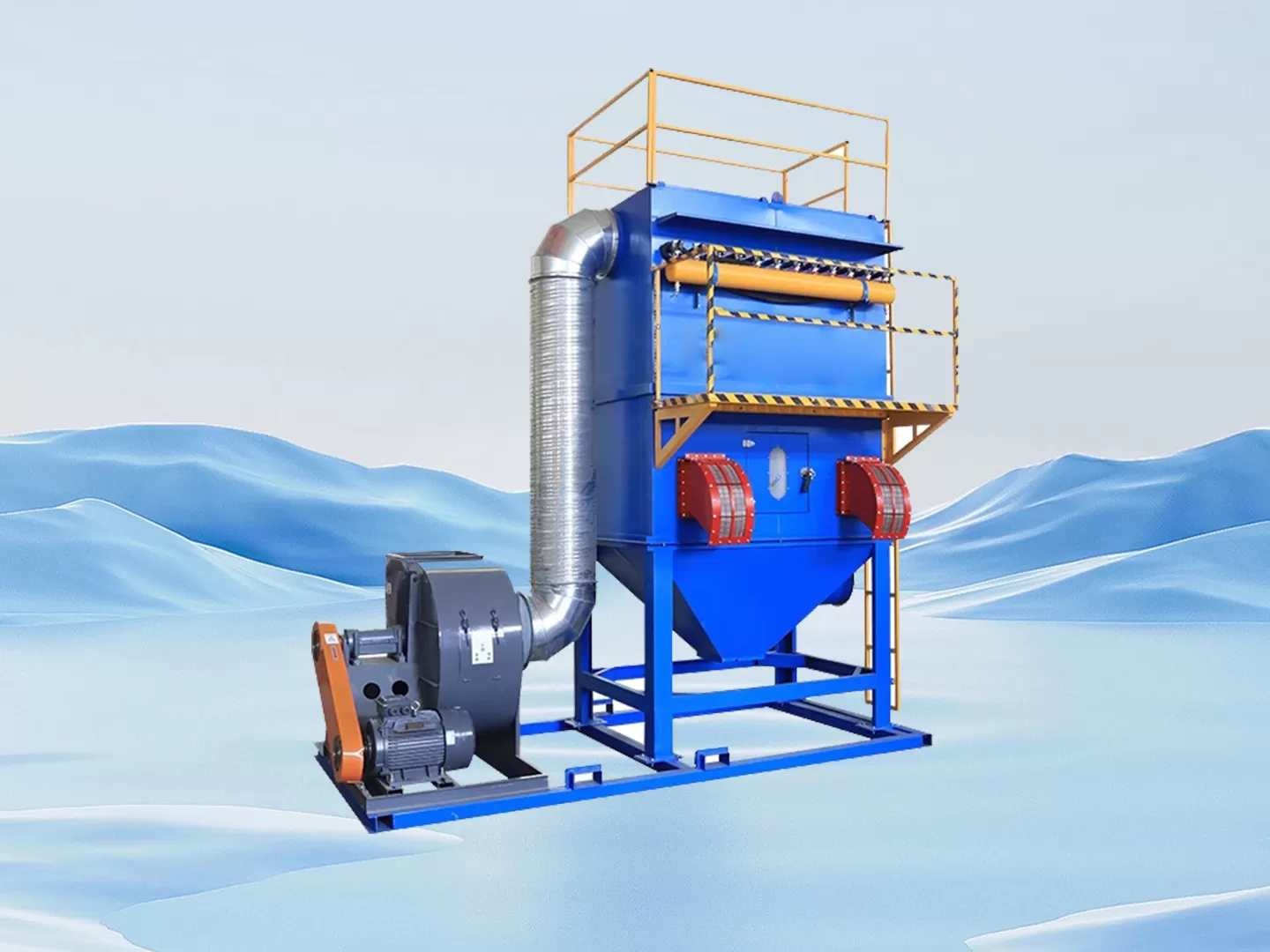
Existing catalogue-style collector image. It does not establish the selected model, airflow capacity, protection functions, approved access or suitability for a factory baghouse upgrade.
4. Evaluate features and the business case on equal terms
Pulse-jet cleaning uses compressed air to release accumulated dust from the selected filter arrangement. Ask for the sequence, utility quality and demand, controls and maintenance requirements. Automatic cleaning can support operation but does not guarantee longer filter life or reduced labor.
Request particle-filter classification or testing that applies to the offered assembly and duty. Where suitable gaseous contaminants require adsorption, activated carbon may form part of a separate treatment design; it is not a substitute for ultrafine particulate filtration.
Modular construction may make a planned expansion practical, but it does not prove spare capacity in the fan, ductwork, utilities, controls or discharge. Obtain the actual expansion limits and changes required, including any new acceptance conditions.
Measure outcomes without borrowing another plant’s percentages
Define installed cost and the operating-cost boundary. Compare energy, compressed air, consumables, maintenance labor, waste handling and downtime at the required control duty. Higher airflow can increase demand, while an improved arrangement may reduce some losses; neither outcome follows from the word “upgrade.”
Claims about reduced exposure, fewer health complaints, equipment life or increased output require appropriate evidence. Do not substitute a general dust percentage for a workplace assessment, or infer causation when other process changes occurred during the comparison.
Ask for the baseline, method, production conditions, measurement period and exclusions behind any supplier case study. A cement-plant or woodworking reference needs that context before it can inform the new project’s assumptions.
5. Release and commission a documented change package
Keep the existing and proposed duty points, drawing revisions, component changes, controls, utilities, interfaces and exclusions together. List unresolved assumptions with owners and record which conditions must be met before manufacturing, installation and operation.
Specify the performance tests before purchase. Identify the operating modes, measurement locations and methods, acceptance criteria and responsibility for corrective work. Distinguish factory checks from site performance under real production conditions.
HSE’s UK commissioning guidance emphasizes documenting the installed condition, operating circumstances, results and benchmarks. Use an applicable site commissioning plan to verify the changed system and establish a new reference for maintenance; do not assume the old baseline remains valid.
Update operating instructions, permitted production combinations, alarm responses, inspection records and the spares schedule. Communicate restrictions and outstanding items to the people who operate and maintain the equipment. Retain the history explaining why the change was made.
Request a configuration-specific response to the expansion schedule and current data. Confirm availability, delivery, support and warranty terms for the actual order rather than relying on general stock or wholesale-price statements.
Review the baghouse range and, where compartment operation matters, offline pulse bag-filter configurations against the required change. Submit the existing-system records through Senotay’s technical enquiry route. Ask the supplier to identify both the proposed improvement and the interfaces outside its scope.
6. Frequently asked questions
Does a larger motor increase useful baghouse capacity?
Not necessarily. The fan, ducts, source demand, filter area, cleaning, discharge and other limits must be reviewed together. Motor power alone does not establish delivered airflow or acceptable filtration.
Why use online area when reviewing an expansion?
A compartment unavailable for cleaning or maintenance cannot provide filtration in that operating mode. Compare actual airflow with the area available under the defined duty, rather than automatically using total installed area.
Does the 4.0 to 5.0 ft/min example recommend an operating ratio?
No. It is a hypothetical calculation showing a 25% increase when flow rises from 24,000 to 30,000 actual CFM through 6,000 ft². Suitability still depends on the actual dust, gas, media, cleaning and acceptance requirements.
Will an upgrade always lower energy and maintenance costs?
No. Compare the complete utility and maintenance boundary at equivalent required control duty. State the operating conditions and costs behind any savings claim, including any new equipment or service burden.
What should be updated after a factory baghouse upgrade?
Update the installed drawings, duty and component schedules, controls, operating instructions, acceptance results, maintenance benchmarks and spares. Record restrictions, outstanding items and the approved operating combinations.
Request a quote
Discuss your project with SENOTAY
Send your application and equipment requirements through our contact page.