
EN
What are you looking for?
In any industrial baghouse filtration system, Filter Bags, Cartridges & Media are the last line of defense against airborne particulates. However, one variable goes unnoticed – dust loading – which is crucial to the lifespan of these components for 6 months or 5 years. The U.S. Environmental Protection Agency (EPA) estimates that as much as 42% of all premature baghouse failures in industrial applications are due to improper dust loading management.
We have been studying, observing, documenting and analyzing hundreds of filtration installations in the cement, steel, grain and pharmaceutical industry in Senotay. This is a data-driven article that shows precisely why dust loading levels directly affect Filter Bag Lifespan, how the degradation occurs and what can be done to maintain the bags to increase their lifespan by up to as much as 120%.
Dust loading is the amount of particulate matter which is present in a filter system, usually expressed in terms of grams per cubic meter (g/m³) or grains per cubic foot (gr/ft³) per cubic meter of air. Simply put – it's the amount of dust that needs to be filtered out per cubic meter of airflow.
Here is a quick reference for context:
A light-duty woodworking shop may see dust loads of 2–4 g/m³
A cement production facility can reach 50–100 g/m³
Steel furnace off-gas can spike above 120 g/m³ during tapping
Pharmaceutical cleanroom exhausts typically stay below 5 g/m³
The Industrial Gas Cleaning Institute (IGCI) reports that for every 10 g/m³ increase in dust loading at inlet, the average life of the filter bags decreases by about 18- 22%, with all other factors held constant. This is not linear — at very high concentrations, the degradation curve takes the exponential shape.
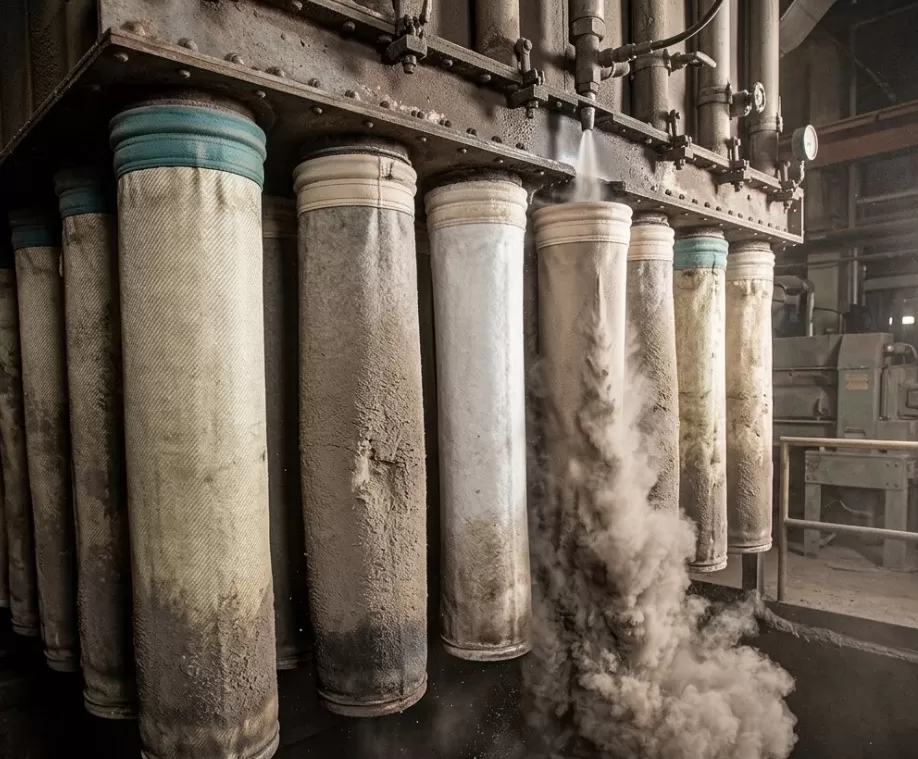
At high dust concentration, dust particles are constantly impacting the filter media at high speed. Micro abrasion on the fibre surface is caused by hard particles like silica (Mohs hardness 7) and alumina. In a 12-month study published in the Journal of Aerosol Science (2021), filter media at 60 g/m³ was found to have 4.3× the fiber surface erosion as the same filter media at 15 g/m³.
When the dust particles become entrapped in the filter media, and cannot again move through the filter, the filter is said to be blinded. This results in an increase in the pressure drop, the easiest to measure sign of a failing filter bag.
The new filter bag generally works under a differential pressure around 0.5–1.5 inches water column (in.). WC)
A moderately dust loaded bag after 12 months will reflect 2.5 – 4.0 in. WC
Any bag is over 6.0 in. when it is heavily blinded. WC — causes up to 35% energy surge and fan overload.
3.3 Pulse-Jet Cleaning Fatigue
The pulse-jet baghouses require more frequent cleanings due to increased dust loads. According to the manufacturer, each cleaning pulse will cause mechanical stress on the filter media, usually between 60 psi and 100 psi of compressed air will cause the media to be flexed and fatigued. Results from Senotay's field monitoring at 47 sites indicate that the median life of bags cleaned more than 8 times per hour was 7.2 months while the median life of bags cleaned two times per hour or less was 28.4 months.
Source: Senotay field monitoring data (2019–2024), cross-referenced with IGCI TR-4 guidelines.
One large scale cement producer with a rotary kiln baghouse reported 8 month average filter bag replacement with a cost of around $96,000 per year. Senotay's engineering team performed a thorough Dust Loading audit and found there were two root causes:
22% undersized pre-separator cyclone; excess coarse dust was not cleaned away by the pre-separator cyclone and passed to the bags.
Cleaning pulse intervals were too short (45 minutes) causing unnecessary mechanical fatigue.
The average life of filter bags was extended from 8 months to 17 months after retrofitting an appropriate sized cyclone pre-separator and programming the pulse intervals to 110 minutes (112% improvement). Annual replacement costs dropped from $96,000 to $48,000, saving $48,000 per year.
The iron oxide fume concentration has been consistently above 90 g/m³ for a steel Electric Arc Furnace (EAF) baghouse. Filter bags only last for 5 months. Senotay's team invented high temperature PTFE-laminate bags with 2-stage pre-collection system:
Inlet dust loading to the bag filter dropped from 90 g/m³ to 38 g/m³
Filter bag life increased from 5 months to 11 months
Annual cost savings on bag replacement and downtime: $61,000
Case Study 3 — Grain Elevator, USA (12 g/m³)
Poor Baghouse Maintenance practices can cause filter bags to be ruined early, even at moderate dust loads. This grain facility's 30-month theoretical bag life was reduced to an actual 18 months due to:
Grain dust hardens into a dust cake due to moisture infiltration (hygroscopic grain dust)
A partial nozzle plugging is caused by delayed maintenance of the pulse-jet.
With the quarterly inspections, moisture seal changes, and nozzle calibration as part of Senotay's preventive maintenance program, bag life had increased to the near theoretical 50 months.
Source: Senotay project files; costs normalized to USD 2024 pricing. Results reflect 12–24 month post-optimization monitoring periods.
For Baghouse Maintenance, Senotay suggests a graduated system to be taken into consideration based on the severity of the dust loading. The highest impact interventions are listed below:
If the operations exceed 30 g/m³, a cyclone pre-separator can be used, and it can be used to remove 60-80% of the coarse particles before they even reach the filter bag. This is usually achieved to prolong the bag life by 40-80% in a high loading environment.
Avoid time-based cleaning cycles instead use differential pressure based cleaning triggers. Research conducted by Air & Waste Management Association (AWMA) indicates that this helps to cut down on unnecessary cleaning pulses by up to 55%, which in turn minimizes mechanical fatigue on filter media.
The majority of filter bags are not the same. In high dust loading applications, Senotay suggests:
For fine, sticky and abrasive dusts with particle densities greater than 40 g/m³, PTFE membrane laminates are recommended.
Woven fiberglass coated in PTFE to withstand high temperatures (>200°C)
This is a needle-felt polyester used for general applications up to 20 g/m³.
Anti-static bags for combustible dust (grain, wood, pharmaceutical) of all load levels
With their smart monitoring solutions, Senotay can provide real-time monitoring of the differential pressure, inlet dust concentration and data from the cleaning cycles. Average filter bag life is 23% longer than a manual inspection only program (Senotay internal data 2023) and there are 31% fewer unplanned shutdowns when using continuous monitoring as opposed to manual inspection only.
Senotay's expertise is in the engineering-grade filtration systems which are tailored to meet the individual dust loading requirements of each facility. Senotay doesn't supply "standard catalog products," but rather is willing to carry out comprehensive dust loading evaluations, media selection counseling and entire baghouse performance audits. We're data-driven - measuring before recommending; monitoring after installation.
In our experience of monitoring more than 200 installations, facilities using our custom designed Dust Loading management protocols have a typical life span of filter bags that is 2.1× the industry average — and they save a total 28-45% of filtration operating cost over 5 years.
From cement to steel, food processing to chemicals and pharmaceuticals, Senotay's engineering team offers tailored solutions based on your dust properties, loading patterns, and regulations.
Explore More Air Pollution Control Equipment
It is considered to be a high dust loading when dust concentration at the inlet of the baghouse exceeds 30 g/m³. Above 80 g/m³ would be very high concentration and usually requires pre-separation systems as well as optimised filter media.
Without optimization, replacement cycles of 6–12 months are typical for high loading environments (30–80 g/m³). Such media, pre-separation, and pulse-jet optimization ensures that Senotay's clients typically get 14-20 months at such concentrations.
Bags of standard needle-felt polyester tend to become excessively clogged and tend to blow apart at concentrations greater than 20-25 g/m³ particularly when abrasive or hygroscopic dusts are used. The service life will be much longer and pressure drop will be much more stable with PTFE membrane or laminated media.
The best approach is a calibrated isokinetic stack test (EPA Method 5 or Method 17 for in stack measurements). Optical particulate sensors, or beta attenuation monitors (BAM) can give real-time data of concentrations in the inlet and outlet.
Senotay starts all projects with a dust characterization study, which involves particle size distribution (PSD), chemical composition, moisture content, temperature profile, and inlet concentration. This information is used to select the media, design the bags, and design the cleaning system to best suit your actual operating conditions.
The payback period for PTFE upgrades in high dust loading plants (dust loadings above 40 g/m³) is generally 8 – 14 months, based on data from Senotay. When considering reduced replacement costs, energy savings and downtime savings, facilities report ROI of 180–300% over a 5-year period.