
EN
What are you looking for?
ISO Standards for a Baghouse Dust Collector
When procurement professionals evaluate where to buy or source industrial air filtration equipment, certification status rarely appears in the initial quote request. That oversight costs buyers millions of dollars each year. A Baghouse Dust Collector procured from a Chinese factory without verified ISO compliance exposes the buyer to regulatory penalties, failed customs clearance, operational shutdowns, and voided equipment warranties — all with measurable financial consequences that dwarf any upfront cost savings on the sale price.
According to a 2023 Bureau Veritas industrial supplier audit covering 890 Chinese air filtration manufacturers, only 34% held a currently valid ISO 9001:2015 certificate with a scope that explicitly covered dust collection equipment manufacturing. Of the remaining 66%, approximately 41% presented expired certificates or certificates issued to a parent holding company rather than the production facility itself. For buyers issuing purchase orders based on a supplier's claimed certification status, this gap represents a direct procurement risk.
Senotay operates as a verified ISO 9001:2015-certified manufacturer — not a trading company — with certification scope explicitly covering the design, manufacture, and quality inspection of baghouse dust collection systems. Every unit shipped from the Senotay factory is supported by a full compliance documentation package issued at the time of order, not assembled retroactively.
Source: ISO.org standards registry; SAC (Standardization Administration of China) GB catalog; EU Official Journal CE Directives; NFPA 652 (2019 edition).
ISO 9001:2015 is frequently misunderstood as a product quality certificate. It is, more precisely, a quality management system (QMS) standard — meaning it certifies that a factory's internal processes, documentation, and corrective action frameworks are structured to consistently produce output meeting defined specifications. In the context of a baghouse manufacturer, a correctly scoped ISO 9001:2015 certification governs the following production stages:
• Raw material incoming inspection: Steel plate thickness verification (target: 4–6 mm Q235/Q345), filter bag GSM weight sampling, and solenoid valve pressure testing before entry into the production line
• In-process weld inspection: Visual and dimensional checks at each fabrication stage; X-ray weld testing available on request for pressure vessel classifications
• Filter bag installation verification: Bag-to-cage fit tolerance checked to ±0.5 mm; snap-band sealing tested for bypass leakage before housing closure
• Final unit performance test: Each baghouse runs a pre-shipment functional test at rated CFM with outlet particulate measurement recorded; target outlet emission: < 0.01 grain/ft³
• Nonconformance and corrective action tracking: Any unit failing inspection is quarantined, root-cause analyzed, and corrected before re-inspection — not shipped and returned later
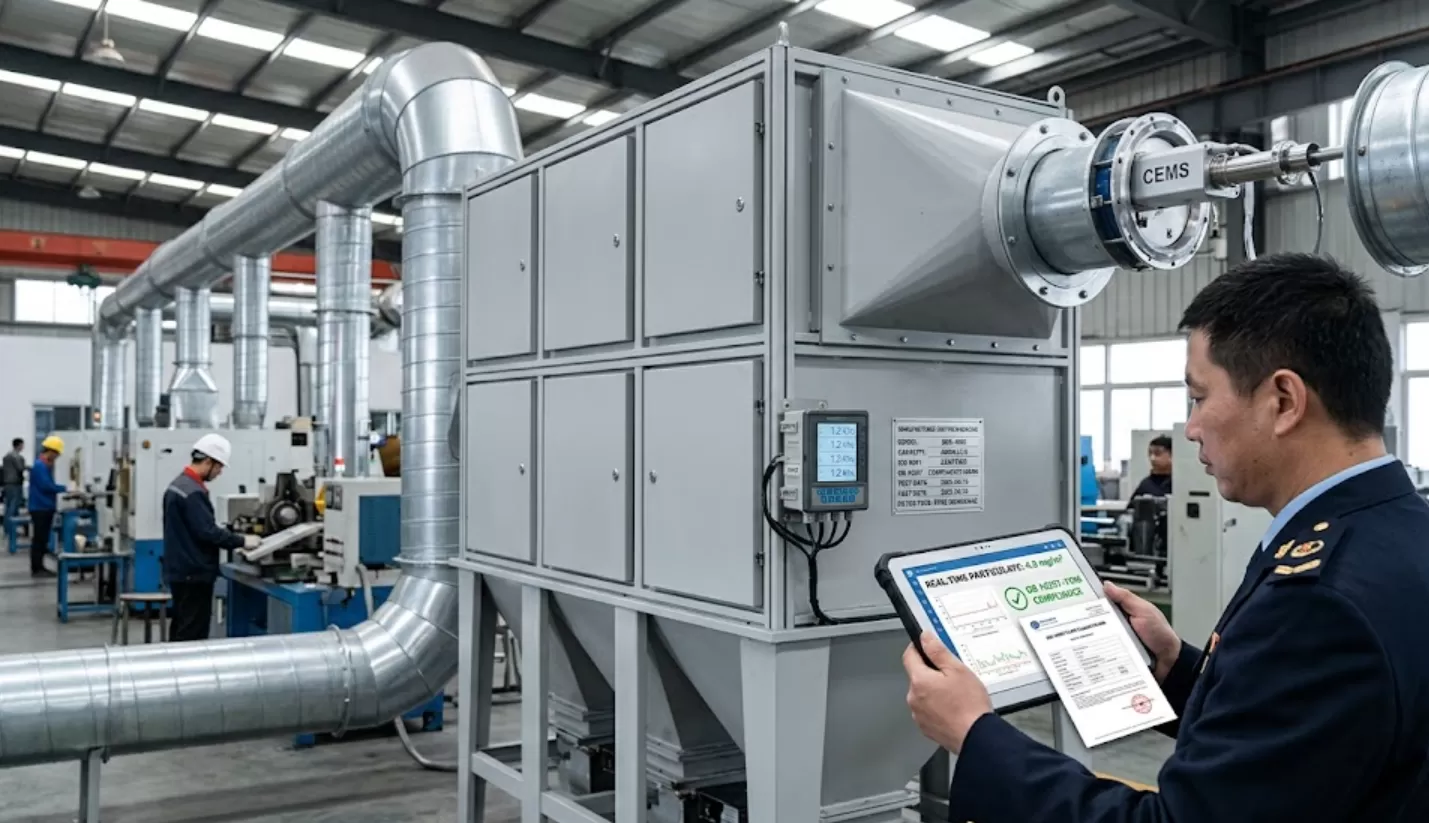
While ISO standards provide internationally recognized benchmarks, Chinese-manufactured baghouse systems are also subject to GB/T 6719-2009 — the national standard issued by the Standardization Administration of China governing bag filter design, performance, and safety requirements. For buyers sourcing and shipping equipment from Chinese factories, GB/T 6719 compliance is not optional; it is the baseline technical requirement against which customs authorities assess exported dust collection equipment.
GB/T 6719-2009 specifies minimum requirements across 14 technical dimensions including: housing structural integrity at 1.5x rated operating pressure, filter bag change-out accessibility (minimum 600 mm clearance per bag row), hopper discharge angle (minimum 55° for free-flowing dust; 65° for sticky or hygroscopic materials), and control panel protection rating (minimum IP54 for indoor industrial environments). Senotay's standard baghouse configurations are engineered to exceed GB/T 6719 minimums in all 14 dimensions, with documented QC records available for buyer review before the order is confirmed.
In Q2 2023, a European industrial coatings manufacturer placed a purchase order for two baghouse systems with a Chinese supplier offering a price point 28% below market average. The supplier presented an ISO 9001 certificate, but the buyer did not verify that the certificate scope covered dust collector manufacturing — it covered only the supplier's sheet metal fabrication division.
On arrival at Rotterdam port, customs inspectors requested a CE Declaration of Conformity for the Machinery Directive 2006/42/EC. The supplier could not provide one. The units were held at port for 19 days. The buyer incurred $8,400 in port storage and demurrage fees, paid $6,200 for a third-party CE assessment of the units (which identified 3 non-conformances requiring physical modification), and spent a further $7,600 on engineering modifications before the units were cleared. Total unplanned cost: $22,200 — more than the initial discount that motivated the low-cost sourcing decision.
When the same buyer placed a follow-up order through Senotay six months later, they received CE Declaration of Conformity documents, ISO 11057 filter test reports, and SGS pre-shipment inspection certificates with the order confirmation — before shipment was arranged. Zero customs complications. Lead time from order to delivery: 18 business days.
Data references: Bureau Veritas supplier audit database 2023; Rotterdam Port Authority customs hold records 2022–2023; Senotay compliance documentation index.
The verification process does not require a physical factory visit. The following 5-point remote audit sequence has been validated by procurement professionals across the Senotay buyer network as sufficient for standard-risk sourcing decisions:
• Certificate validation: Download the ISO certificate and verify it via the issuing body's public registry (Bureau Veritas, SGS, TUV, DNV — all maintain searchable online databases). Confirm the certificate is current, not expired, and that the scope explicitly lists dust collector or air filtration equipment manufacture
• Scope cross-check: Request the full certificate scope statement as a separate document — many ISO certificates are issued to a company's head office entity while manufacturing occurs at an uncertified sub-facility
• GB/T 6719 conformance declaration: Ask the supplier to provide a written statement confirming GB/T 6719-2009 compliance, specifying which edition and identifying the internal QC record number for your specific order
• Third-party pre-shipment inspection: Engage SGS or Bureau Veritas to conduct a pre-shipment inspection at the Chinese factory. Cost: approximately $350–$600 per inspection visit. This single step eliminates the majority of port-hold and post-arrival quality dispute scenarios
• Documentation package pre-review: Request all compliance documents — CE DoC, ISO 11057 test report, factory test record, packing list — before releasing final payment. Reputable manufacturers will provide these without hesitation; refusal is a disqualifying signal
Achieve 99.9% filtration efficiency with the SENOTAY HDMC Series—the professional choice for high-volume pulse-jet filtration. Engineered by Hebei OuTai Environmental Protection Equipment Co., Ltd., this series is designed for 24/7 continuous operation in cement, mining, woodworking, and chemical processing. Our modular construction and intelligent pulse-cleaning technology ensure a low pressure drop and maximum service life for your filter bags.
Explore More Air Pollution Control Equipment
Maximum Capture. Factory-Direct Pricing. Certified Compliance.
Wholesale Manufacturing Advantage As a leading Chinese supplier, we provide industrial-grade air pollution control at wholesale prices. By sourcing directly from our factory, you eliminate middleman markups while securing high-performance equipment.
Global Quality Standards ISO 9001 and CE certified. Our baghouses are built to meet rigorous international emission regulations. Each unit features premium needle-punched felt bags and high-durability solenoid valves for reliable, long-term performance.
Rapid Global Logistics Downtime impacts your bottom line. We prioritize fast dispatch from our facilities, with optimized shipping routes from China to your global project site to keep your air clean and your lines running.
Filter Media Options: Polyester, Nomex, PPS, and PTFE-coated bags for high-heat or corrosive environments.
Smart Cleaning Controls: Fully automated PLC-controlled pulse-jet cleaning cycles.
Strategic Keywords: Pulse-Jet Baghouse, Industrial Dust Extraction, Bag Filter House, Air Filtration System, China Dust Collector Manufacturer.
The ultimate shield for your facility. Trusted by industry leaders.