EN
What are you looking for?
Industrial dust collectors function as vital equipment which enables manufacturing facilities to sustain safe and clean operations throughout their entire working hours. The production processes of metal fabrication plants and woodworking facilities and cement production sites and pharmaceutical companies and food processing plants result in the emission of large quantities of airborne particles into the environment. The absence of filtration systems creates a hazardous situation that endangers worker safety while damaging equipment and violating environmental protection regulations.
Companies use industrial dust extraction systems together with industrial air filtration systems to address these problems which function by removing airborne pollutants from their production spaces.
China stands as the global leader in manufacturing industrial dust collectors because its factories combine advanced engineering expertise with large-scale production capabilities at economical prices. Chinese industrial dust collector manufacturers produce efficient filtration products which fulfill both international security requirements and environmental protection regulations.
Companies that demonstrate their reliability to businesses bring multiple benefits which include better workspace air quality and stronger equipment protection and continuous operational efficiency.
An industrial dust collector is a specialized industrial air filtration system which functions to capture all airborne particles together with dust and fumes and manufacturing process contaminants. The systems operate at industrial standards because they require continuous operation for extended periods while processing massive amounts of dust which differs from the function of home air purifiers.
Industrial dust collectors assist facilities with their particulate emission control efforts while they enhance ventilation systems and create safe environments for employees. The systems help factories control air pollution while enabling companies to achieve both environmental compliance and workplace safety regulations.
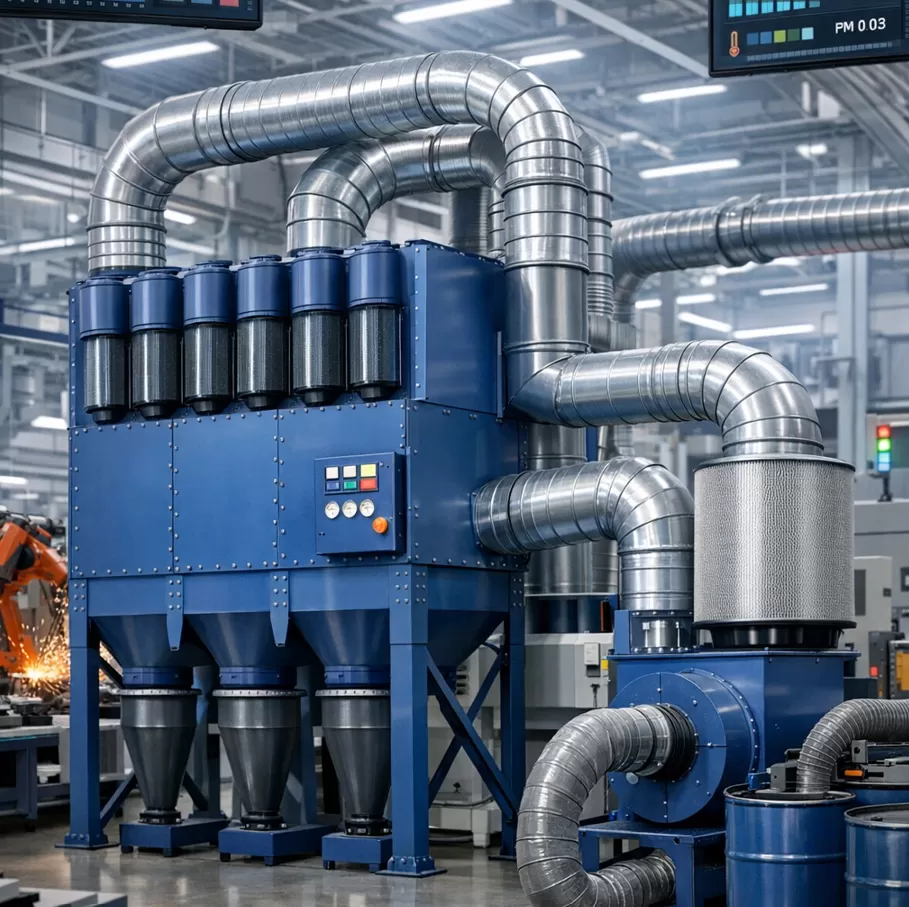
Most industrial dust collection systems operate through a multi-stage filtration process.
First, extraction hoods and arms which connect to ducting systems serve as tools to capture contaminated air directly from its source. The dust-laden air travels through ductwork into the dust collector unit.
The specialized filter media inside the filtration chamber function to capture both particles and contaminants.
Common filtration technologies include cartridge filters, baghouse filters,and cyclone separators.
The pulse jet dust collector system generates compressed air bursts to clean filters which helps restore airflow efficiency when dust accumulates on filter surfaces.
The collected dust finally falls into a hopper or container which enables safe disposal or recycling of the material.
Chinese manufacturers produce several types of dust collection equipment designed for different industrial environments.
Choosing the correct system depends on airflow requirements, dust characteristics, and industrial processes.
This comparison helps businesses understand which industrial dust extraction system best suits their production environment.
These benefits make industrial dust collectors a critical component of modern manufacturing facilities.
China has grown into one of the largest industrial equipment production capacities. Modern manufacturing plants create industrial air filtration systems through automated fabrication technologies and advanced production processes which handle large-scale production. Chinese manufacturers achieve both dependable equipment and affordable pricing through their international export logistics support system.
Different manufacturing environments produce different types of dust. Industrial dust collectors need customized engineering solutions because different manufacturing environments create different dust types.
Leading manufacturers provide airflow calculations, ducting design, and industry-specific filtration systems. Proper engineering provides effective dust removal solutions which decrease both energy usage and operational expenses.
Reputable dust collector manufacturers follow internationally recognized certifications and quality management systems such as ISO and CE standards. These certifications ensure that equipment meets strict safety, environmental, and performance requirements.
High-performance industrial dust collectors incorporate several advanced design features that improve efficiency and durability.
These features help maintain stable filtration performance even in demanding industrial environments.
The industrial dust collection systems provide essential safety protection for workplaces while safeguarding industrial equipment across multiple industry sectors. The fine wood particles emitted by woodworking factories create fire hazards and respiratory dangers to workers. The metal fabrication workshops create two types of hazardous materials through their grinding operations and welding processes which need specialized filtration systems for safe handling. The cement production plants need baghouse dust collectors because their operations generate ultrafine particulate matter which requires complete dust control for industrial-sized operations. Dust control measures in pharmaceutical manufacturing facilities serve two main purposes: they help maintain product purity and they prevent contamination from dust particles. Dust collection systems are necessary for food processing plants because they need to control the airborne particles that include flour, sugar, and spices.
Industrial dust collectors significantly improve workplace safety by removing airborne contaminants and protecting employees from respiratory hazards.
They also protect equipment from dust buildup, which reduces maintenance costs and increases machine reliability. In addition, effective filtration systems help companies meet environmental regulations and avoid regulatory penalties.
Before selecting a supplier, businesses should evaluate several important factors.
Search terms buyers commonly use include industrial dust collector manufacturer in China, industrial air filtration supplier, and industrial dust extraction systems.
Working with an experienced manufacturer ensures reliable performance and long-term system efficiency.
Explore More Air Pollution Control Equipment
Senotay operates as a professional manufacturing business which creates high-efficiency industrial dust collectors and advanced industrial air filtration equipment. The company focuses on delivering efficient and customized dust control solutions for global industries.
Senotay operates its business through strict quality control procedures which require compliance with international certification standards that include CE and ISO85. The engineering team offers system design services which include airflow analysis and equipment development and installation support and customer service after product delivery.
The systems developed by Senotay find their application across multiple industrial sectors which include metal fabrication and woodworking and cement production and pharmaceutical manufacturing and food processing.
Senotay uses advanced engineering methods together with energy-saving technologies to help industrial facilities achieve cleaner air conditions and dependable operational efficiency.
Ans:China offers advanced manufacturing infrastructure, scalable production capabilities, and competitive pricing while maintaining international quality standards.
Ans:Reliable manufacturers typically hold ISO certifications and comply with international environmental and safety standards.
Ans:Yes. Certified manufacturers using high-grade materials and strict quality control systems produce durable equipment designed for long-term industrial operation.
Ans:Yes. Many manufacturers offer customized airflow calculations, ducting system design, and industry-specific filtration solutions.
Ans:They capture airborne particulate matter generated during manufacturing processes, protecting worker health and improving workplace safety.
Ans:Yes. Senotay supports global customers with technical consultation, system guidance, and after-sales service.
High-Temperature Baghouse Systems: Material & Performance Data
How to ensure Maintenance of Bag Type Dust Collector | senotay