
EN
What are you looking for?
Compare micron rating filter specs against real filtration performance. Learn how nominal vs. absolute ratings affect industrial dust capture and filter media selection.
Choosing filter media by micron rating alone? You are probably leaving performance on the table. A low micron number does not guarantee better dust capture — real efficiency depends on media construction, dust characteristics, and operating conditions. This article compares micron rating against real filtration performance across the factors that determine how well a filter captures dust in industrial collectors and baghouse systems. Understanding this gap helps you pick the right medium — not just the one with the smallest number.
A micron rating is a manufacturer's stated particle size at which a filter captures a given percentage of contaminant. Standards divide ratings into two categories.
A nominal rating means the filter captures 85–95% of particles at or above a given size — a statistical value, not a hard cutoff. An absolute rating is tighter, with 98.7%+ capture per ISO 16889 testing. Both use standardized dust under lab conditions — useful for comparison but not a guarantee of real-world behavior.
A micron rating measures a filter medium in isolation with standardized test dust. Your dust collector operates with real dust — irregular shapes, electrostatic charges, moisture, varying loads. Those lab numbers shift significantly once the filter sees actual process air.
Standard test dusts like ISO 12103-1 have controlled size distributions. Your actual dust — cement, weld fume, flour, or pharmaceutical powder — behaves differently. Fine particles agglomerate or carry electrostatic charges that change how they deposit, shifting real capture efficiency away from the lab number.
Two filters with the same micron rating can perform very differently depending on whether the media is spun-bond, needle-felt, or membrane-laminated. Fiber diameter and density gradients affect real capture efficiency in ways a single number cannot express.
When evaluating dust capture performance, experienced engineers look beyond the micron label to a handful of more meaningful parameters.
A fractional efficiency curve shows capture percentage across a range of particle sizes, revealing the "most penetrating particle size" (MPPS) — typically 0.1–0.3 µm for many media — where efficiency dips lowest. Two filters with the same micron rating can behave very differently here.
A filter's real efficiency changes as dust accumulates. The dust cake becomes a filtering layer, improving fine-particle capture — but at the cost of higher pressure drop. Cleaning pulse timing and media permeability determine where on this curve you operate.
This is the air volume passing through each unit of the filter area. Higher ratios push more dust through — reducing effective efficiency — so matching this to your actual dust load often matters more than the micron number on the spec sheet.
The table below maps key selection criteria against what micron ratings promise versus what real-world experience delivers. Use it as a reference during your next media specification.
The takeaway: micron rating is a useful screening tool, but real performance data — efficiency curves, pressure drop behavior, and application-specific testing — should drive the final decision. Filters that look equivalent on paper often perform very differently on your equipment.
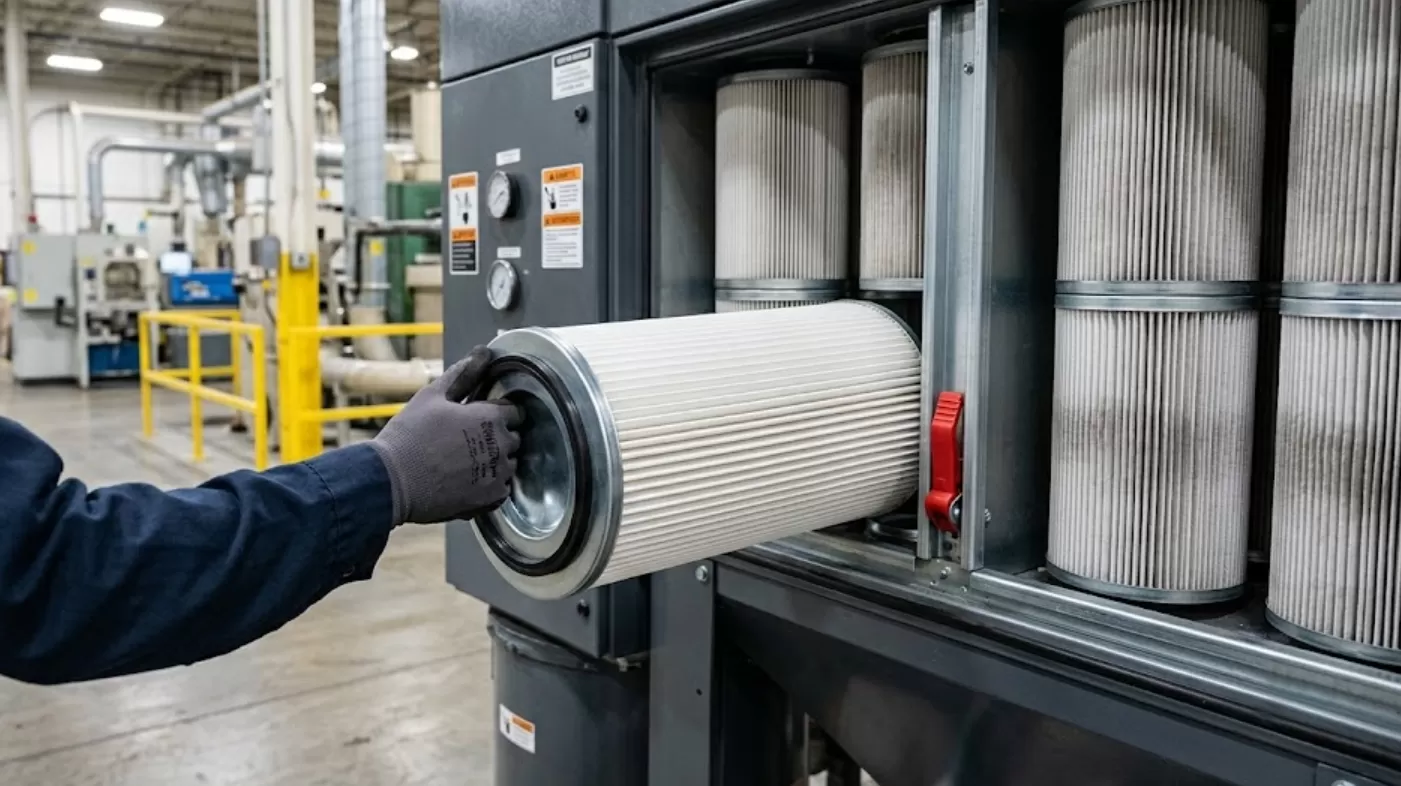
Rather than starting with "what micron do I need?", begin with your dust characteristics. Particle size distribution, moisture, temperature, and chemical composition point toward specific media types. A polyester needle-felt with a 5-micron nominal rating might be perfect for wood dust but fail quickly on cement kiln exhaust.
Coarse dusts (50+ µm) often work fine with low-cost woven media. Sub-micron fumes need membrane-laminated or high-efficiency needle-felt — regardless of what micron number is printed on the sheet. The dust dictates the media, not the other way around.
Pulse-jet collectors can use heavier media because cleaning energy is high. Reverse-air or shaker systems need lighter, more flexible media. A filter that performs well in one type may blind in another — regardless of its micron rating.
Mistake one: assuming a 1-micron filter catches everything below 1 µm. Even absolute-rated filters allow some fines near the MPPS zone. Mistake two: ignoring bypass leakage around gaskets or through damaged pleats — this can dwarf the filter's specified efficiency. Mistake three: treating the micron rating as a constant. Efficiency shifts with face velocity, dust load, and temperature — the rating on the box is just a starting point.
A supplier who only quotes micron numbers is selling a commodity. One who asks about your dust type, duct velocity, and cleaning cycle is selling a solution. Senotay matches industrial dust collectors and media to real operating conditions with application engineering that bridges the gap between the micron rating on paper and the capture performance you actually get.
Ans: Nominal indicates 85–95% capture at a stated size; absolute means 98.7%+ capture under standard test conditions.
Ans:Yes — advanced media such as membrane-laminated or gradient-density structures capture fines more effectively in real conditions than a lower-rated but simpler medium.
Ans:Most Penetrating Particle Size is the particle size where a filter is least efficient. Knowing it tells you the weakest point in the media's performance range.
Ans:Ask for fractional efficiency curves, pressure drop vs. face velocity data, and application case studies. These give a much clearer picture of real capture performance.
Ans:Not always. Higher efficiency usually means higher pressure drop and more cleaning, which increases energy cost. Match efficiency to your emission limit and dust type.
Ans:No. Replace based on measured pressure drop, emissions monitoring, or visual inspection. A filter meeting its micron rating can still fail if the media is blinded or damaged.
Micron rating filter numbers are a useful starting point, but they do not define real filtration performance. To control emissions and keep pressure drop manageable, look at efficiency curves, dust characteristics, and system parameters — not just the micron label. Senotay engineers industrial filtration solutions matched to real dust loads, not catalog specs. Contact Senotay for a media recommendation based on your actual process conditions.