
EN
What are you looking for?
Cartridge filter efficiency measures how well a filter captures airborne particles while maintaining airflow. Three factors determine real-world performance: MERV rating (capture efficiency), pressure drop (airflow resistance), and ROI (lifetime cost versus value). Understanding how these interact separates a well-chosen filter from one that costs more to operate than it saves. This article breaks down each factor, how they relate to one another, and what to look for when evaluating cartridge filters for industrial dust collection systems.
Cartridge filter efficiency is the percentage of particles a filter removes from an air stream at a given particle size. Unlike flat-panel filters, cartridge filters use pleated media to pack more surface area into the same footprint, improving both efficiency and airflow. Efficiency is measured under ASHRAE 52.2 (for MERV) and ISO 16890 standards, but real-world results depend heavily on dust loading and operating conditions.
MERV stands for Minimum Efficiency Reporting Value. It rates filters on a 1–16 scale based on composite average efficiency across three particle size ranges: E1 (0.3–1.0 µm), E2 (1.0–3.0 µm), and E3 (3.0–10.0 µm).
A MERV 8 captures coarse dust well but passes most sub-micron particles. MERV 14+ filters capture a significant fraction of sub-micron particles and are standard in pharmaceutical, food, and precision manufacturing environments where emissions limits are strict.
MERV is the dominant standard in North America. Europe and Asia increasingly use ISO 16890 (ISO ePM1, ePM2.5, ePM10). For applications requiring near-zero emissions, HEPA (MERV 17+) is specified. When comparing filters across standards, ask for the fractional efficiency curve rather than converting ratings — it gives the real capture profile across particle sizes.
Pressure drop is the resistance air encounters passing through the filter. It starts low on a clean filter and rises as dust accumulates. A higher pressure drop means higher fan energy consumption — every extra inch can raise operating cost by 5–10%. The goal is media that meets your efficiency target while keeping pressure drop within the collector’s design range.
Manufacturers quote three numbers: initial (clean filter), recommended change-out (typically 4–6 in. w.g. for cartridge collectors), and maximum (structural limit). Operating between initial and recommended is normal — exceeding the maximum damages media and wastes energy. Media with a lower initial pressure drop at the same MERV level directly improves lifetime ROI.
Here is where the tradeoff lives. Higher MERV filters use finer fibers and denser media, capturing more particles but creating more airflow resistance. That resistance increases energy cost. The question is: does the efficiency gain justify the added operating expense? The table below maps how media selection, MERV level, and pressure drop interact in practice.
Cellulose is low-cost but limited in moisture and temperature resistance. Polyester handles higher temperatures and releases dust better during pulse cleaning. Nanofiber coatings add a fine-fiber layer on a substrate, achieving high efficiency at moderate pressure drop. PTFE membrane provides the highest surface capture but at the highest cost per filter.
Start with your emission limit — that sets the minimum MERV. Then match pressure drop to your fan capacity. Consider your dust: abrasive particles wear media faster, sticky dust blinds pores, and hot or moist air limits media options. Finally, calculate total cost — purchase price plus annual energy plus replacement labor over a three- to five-year period.
If your dust is mostly above 5 µm (sawdust, cement powder), MERV 8–11 is usually adequate. If it includes sub-micron fractions (weld fume, pharmaceutical fines, carbon black), you need MERV 13+ media regardless of what the emission limit says — coarse media will blind quickly from fine particle penetration into the media depth.
A filter running at twice its design pressure drop leaks more dust and consumes significantly more energy. Pulse cleaning frequency, compressed air quality, and pre-filtration all affect how long a cartridge maintains its rated performance. A well-maintained system keeps pressure drop stable and can extend media life by 30–50%.
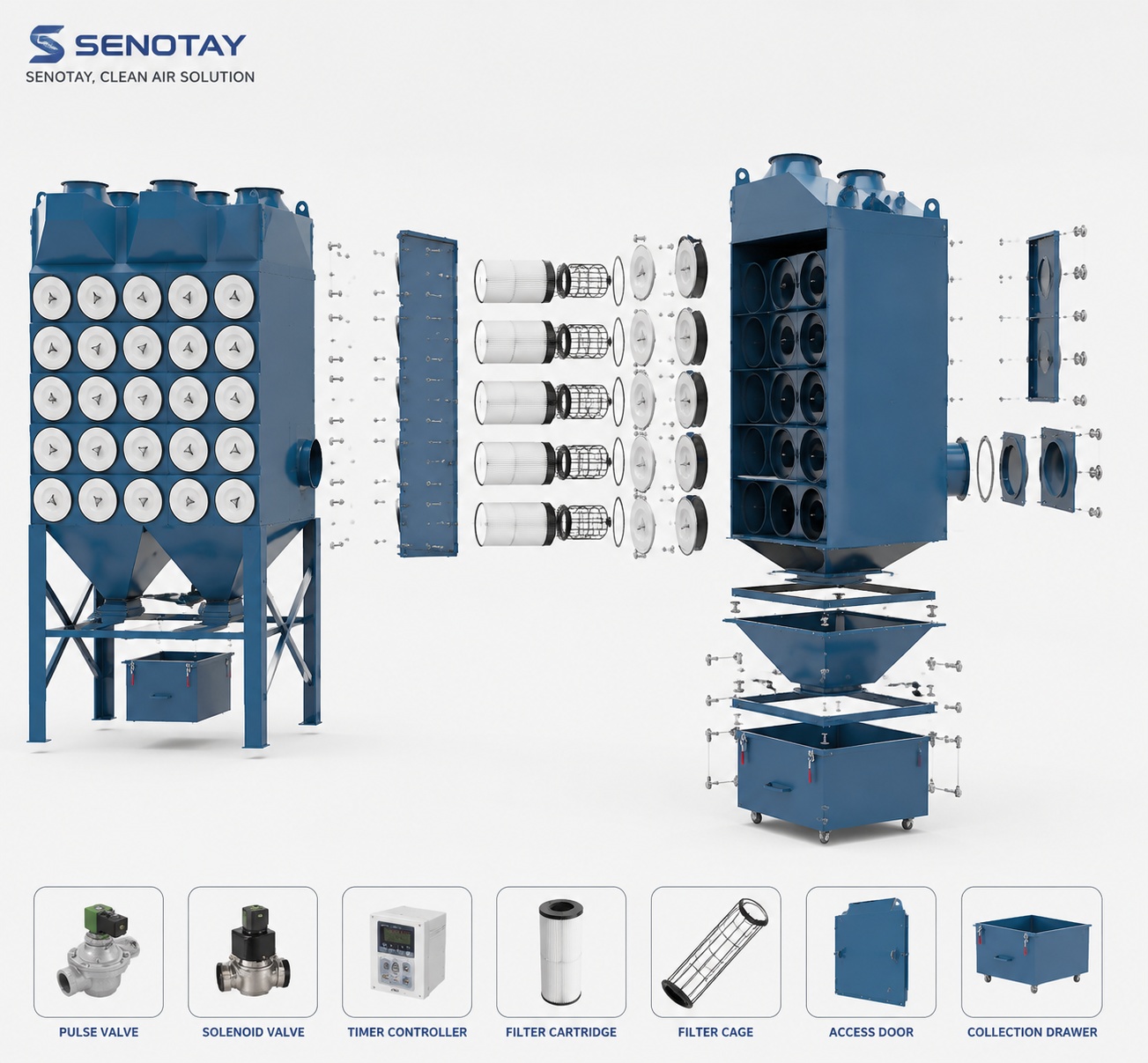
MERV 11–14 covers most industrial applications. MERV 15–16 is needed for toxic or fine particulates where emissions limits are strict.
Not necessarily. Higher MERV means better lab efficiency, but real-world capture depends on your specific particle size distribution, dust loading, and operating conditions.
Compare purchase price plus annual fan energy at operating pressure drop plus replacement labor over 3–5 years for each option you are considering.
Clean pressure drop typically ranges from 1.0 to 2.5 in. w.g., depending on media type and pleat density. Check the manufacturer’s spec sheet for your specific filter.
Replace when pressure drop reaches the manufacturer’s maximum or when emissions exceed permitted limits — typically every 6 to 24 months depending on dust load.
Cartridge filter efficiency comes down to MERV, pressure drop, and ROI working together — not in isolation. The right filter matches its capture efficiency to your emission requirement and its flow resistance to your fan system, balancing first cost against long-term energy and replacement expense. Senotay designs cartridge filters and dust collection systems around these real-world operating conditions. Contact Senotay for a filter recommendation matched to your dust, airflow, and budget.