
EN
What are you looking for?
Senotay’s LDMC low-pressure pulse jet baghouse dust collector delivers reliable industrial filtration for mining, cement, chemical, and power generation industries. ISO 9001 certified.
An LDMC is a low-pressure pulse jet filtration system that captures airborne particulate from industrial exhaust streams. Dust-laden gas passes through fabric filter bags, where particles collect on the outer surface. A controller initiates short compressed air bursts at 0.3–0.5 MPa into each row of bags in sequence, flexing the bags to release the dust cake into a hopper below. This allows continuous filtration without taking compartments offline. LDMC systems are widely used across heavy industries that generate high dust loads.
Low-pressure pulse jet technology reduces compressed air consumption by 30–50% compared to high-pressure systems
Modular construction enables customization for airflow rates from 5,000 to 500,000 m³/h
Filtration efficiency exceeds 99.9%, meeting stringent environmental standards
Continuous online cleaning eliminates downtime for filter maintenance
An LDMC is a low-pressure pulse jet filtration unit that removes dust from industrial exhaust gases. LDMC stands for Low-pressure Dust Collector with Modular Construction — a design optimized for energy-efficient, continuous operation across a range of process conditions.
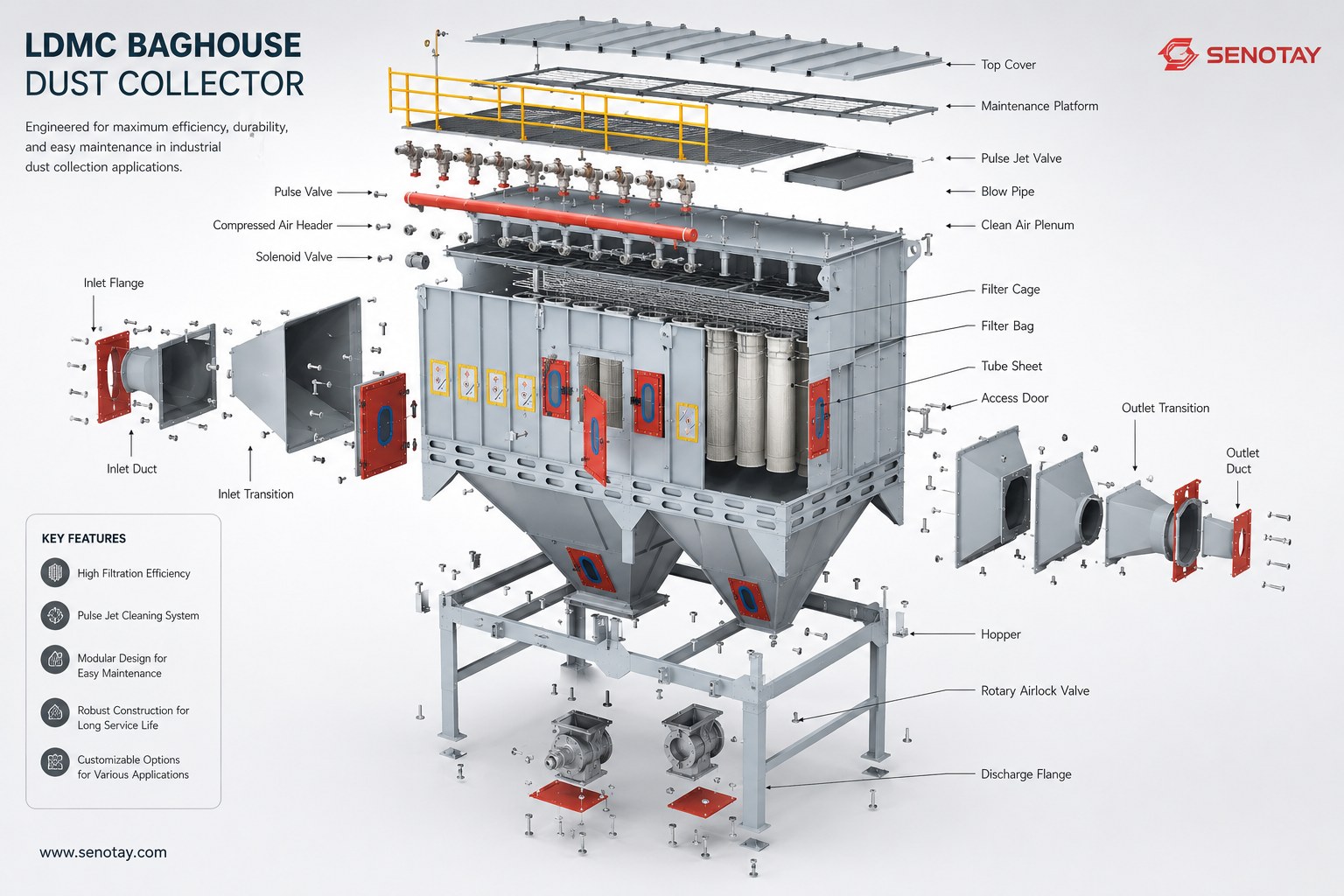
Unlike reverse-air or mechanical shaker systems, the LDMC uses compressed air pulses at low pressure (0.3–0.5 MPa) to clean filter bags. A solenoid valve opens momentarily — typically 0.1–0.3 seconds — releasing a pulse into a blowpipe above a row of bags. The pulse propagates down each bag, flexing the fabric and dislodging the dust cake. The cleaning sequence cycles through all rows while others continue filtering, ensuring uninterrupted operation.
The filter bag is the core filtration element. LDMC systems use cylindrical needle-punched felt bags — polyester, Nomex, PTFE, or PPS — selected based on gas temperature and chemical composition. Each bag is supported by a wire cage that prevents collapse during operation.
Pulse valves — typically diaphragm valves — deliver controlled air bursts to each blowpipe. A programmable logic controller (PLC) manages the cleaning sequence, adjusting pulse frequency based on differential pressure across the filter, minimizing compressed air usage while maintaining stable emissions.
In mining and mineral processing, LDMC systems control dust from crushers, conveyors, and mills. Cement plants use them for kiln and raw mill exhaust — high-dust, high-temperature applications. Chemical and pharmaceutical facilities deploy LDMC collectors to capture fine powders and reactive dusts. Power generation plants use them for fly ash collection and emission compliance.
Low-pressure operation — 0.3–0.5 MPa versus 0.6–0.8 MPa for conventional systems — reduces compressed air consumption by 30–50%, directly lowering operating costs. The PLC-optimized cycle pulses only when differential pressure reaches a set point, further minimizing waste. Gentler cleaning extends bag life, and LDMC systems consistently achieve outlet emissions below 10 mg/Nm³ — or below 5 mg/Nm³ with high-efficiency membranes.
The table below shows representative specifications across Senotay’s LDMC baghouse series. All systems operate at 0.3–0.5 MPa with outlet emissions ≤ 10 mg/Nm³.
Specifications are indicative. Senotay customizes each system to the application.
The air-to-cloth (A/C) ratio — the volume of gas per square meter of filter media per minute — is the primary performance parameter, typically ranging from 1.0 to 1.5 m/min. Operating temperature dictates bag material: polyester up to 130°C, Nomex up to 200°C, PTFE up to 260°C. Pressure drop across a clean system ranges from 500–800 Pa and rises to 1,200–1,800 Pa before cleaning initiates.
Installation requires a level foundation near the dust source to minimize duct length. During commissioning, each pulse valve is tested for timing and pressure, and the housing and duct seals are checked for leaks. Routine maintenance includes monitoring differential pressure, checking compressed air quality (moisture and oil damage diaphragm valves), and inspecting bags through access doors. Most LDMC systems require bag replacement every 2–4 years depending on operating conditions.
Start by characterizing the exhaust stream: airflow volume (m³/h), gas temperature, dust composition, and required outlet emission limit. The A/C ratio is determined by dust fineness — fine cement kiln dust demands a lower ratio (~1.0 m/min) than coarser minerals (1.3–1.5 m/min). Select bag fabric for temperature and chemical compatibility, and specify housing construction — carbon steel for standard use, stainless steel for corrosive dusts. Senotay’s engineering team provides sizing and layout drawings as part of the quotation process.
Since 2005, Senotay has designed and manufactured industrial dust collection, air filtration, and pneumatic conveying equipment in China. The company holds ISO 9001, ISO 14001, and ISO 45001 certifications, ensuring consistent product quality and responsible manufacturing. Senotay offers customized LDMC configurations with responsive after-sales support. Each system is tested before shipment, and technical documentation accompanies every delivery.
LDMC stands for Low-pressure Dust Collector with Modular Construction — a design focused on energy efficiency and scalable industrial dust control.
Filter bags typically last 2–4 years depending on gas temperature, dust abrasiveness, and cleaning frequency.
Yes. Nomex handles up to 200°C, PTFE membranes up to 260°C, and ceramic or metal filters are available for higher temperatures.
LDMC systems achieve outlet dust concentrations below 10 mg/Nm³, and below 5 mg/Nm³ with high-efficiency filter media.
Low-pressure systems (0.3–0.5 MPa) reduce compressed air consumption by 30–50% versus high-pressure (0.6–0.8 MPa), with gentler cleaning that extends bag life.
Yes — Senotay provides technical documentation, remote commissioning guidance, and can arrange on-site supervision.
The LDMC baghouse dust collector is a proven low-pressure pulse jet filtration solution for reliable emission control and energy-efficient operation. Its modular design, intelligent cleaning controls, and high filtration efficiency address the core challenges of industrial dust management — compliance, operating cost, and equipment life. If your facility needs a robust dust collection system, explore Senotay’s LDMC series at senotay.com or contact their team for a tailored proposal.