
EN
What are you looking for?
Discover industrial electrostatic air cleaners from Senotay — an expert OEM since 2005. High-efficiency electrostatic dust collection and air filtration for demanding industrial environments.
An electrostatic dust collector uses high-voltage ionization to charge airborne particles and collect them on oppositely charged plates — capturing fine dust, smoke, oil mist, and bacteria. Unlike conventional filters, electrostatic precipitators (ESPs) create minimal airflow resistance, cutting energy costs while delivering above 99% efficiency on submicron particles.
For welding shops, processing plants, and factories, the choice of industrial electrostatic air cleaner affects air compliance, equipment life, and worker safety. These systems excel where baghouses or cartridge collectors struggle — capturing sticky, oily, or ultrafine particulates without frequent filter changes.
Electrostatic dust collectors use ionization to capture submicron particles at 99%+ efficiency
Low pressure drop means significant energy savings vs. conventional baghouse or HEPA filtration
Ideal for oily, sticky, or fine particulates that clog standard filters within days
Modular designs scale from single-machine source capture to whole-facility air management
Inside an electrostatic dust collector, a high-voltage discharge electrode creates a corona that charges incoming particles — dust, smoke, oil droplets — as air passes through. These charged particles then migrate to oppositely charged collection plates, where they adhere until the next wash cycle.
Single-stage (Cottrell type): Ionization and collection share one zone. Common in heavy industry — power plants, cement kilns.
Two-stage (plate type): Separate ionizer and collector sections. Preferred for indoor air cleaning and manufacturing because they generate less ozone and offer finer control. Senotay specializes in these industrial electrostatic air cleaners, optimized for production environments where reliability matters most.
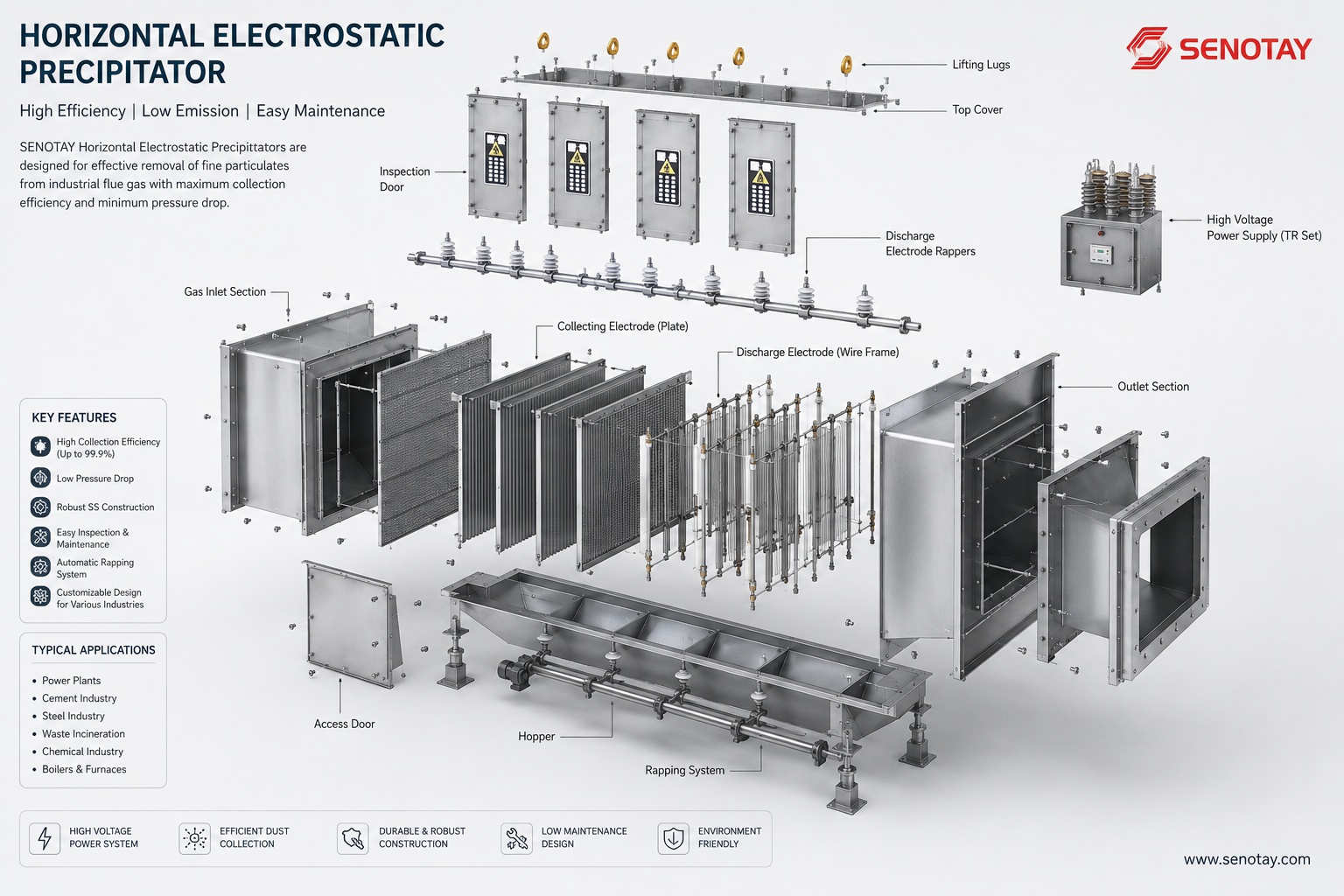
Electrostatic precipitators offer several advantages over conventional filtration:
Lower energy use — ESPs operate at 50–150 Pa pressure drop vs. 500–1500 Pa for baghouse or HEPA, cutting fan energy significantly
No consumable filters — collection plates are washed and reused; no cartridges to buy or dispose of
Consistent performance — efficiency does not drop as media loads, unlike bags or cartridges
Three sectors where electrostatic industrial dust removal systems deliver the most value:
Welding and metal fabrication — captures fine metal oxides and flux particulates at the source without the pressure-drop penalty of baghouses
Food processing and pharma — handles oil mist, steam, and fine powders; stainless steel plates meet hygiene requirements with no rotting media
Laser and plasma cutting — removes dense submicron plumes while protecting downstream HVAC and keeping lines running at full speed
The table below compares electrostatic dust collectors with the two most common alternatives across factors that matter to plant managers — efficiency, cost, and maintenance.
Electrostatic technology wins where loads are fine, oily, or sticky, and where operating cost matters more than upfront price. For welding, cutting, or food lines, TCO over three to five years favors ESPs.
Start by characterizing what you are capturing:
Dry dust (wood, cement, grain) — standard ESP with manual plate wash
Oil mist / coolant mist — ESP with self-cleaning or automatic wash system
Welding fume — ESP with spark arrestor and high-efficiency ionizer section
Hybrid streams — ESP with pre-filter or post-HEPA polishing for recirculated air
Determine required airflow (CFM or m³/h) and choose between source-capture hoods, ducted returns, or ceiling-mounted units. Senotay offers modular industrial dust removal systems from 1,000 to 100,000+ m³/h, with customized ionizer and plate spacing for your particulate profile.
ESPs require two simple maintenance tasks:
Plate washing — every 2–8 weeks depending on dust load; plates are removed, washed with hot water and degreaser, dried, and reinstalled
Ionizer wire inspection — check discharge electrodes during each wash; worn wires reduce efficiency and are easily replaced via quick-release frames
Industrial ESPs should comply with CE, UL/CSA, ISO 13857, and — for combustible dust — ATEX or NFPA 68 explosion relief [verify]. Senotay manufactures under ISO 9001, ISO 14001, and ISO 45001 certified processes, providing full traceability from material to final test.
Senotay has manufactured industrial air quality equipment since 2005, operating under ISO 9001, ISO 14001, and ISO 45001 certified systems. Their engineers customize cell size, plate spacing, voltage, and housing material to match each application — not a catalog product.
As a direct OEM, Senotay offers competitive pricing on industrial electrostatic air cleaners without compromising on CE and UL-compliant electrical design. Clients across metalworking, food processing, pharma, and general manufacturing rely on them for cost-effective, custom-engineered air quality solutions.
A: ESPs charge and precipitate particles without a filter medium; HEPA relies on dense fiber mats. ESPs have lower airflow resistance and are washable; HEPA filters are consumable.
A: Some designs handle it with explosion-relief vents and spark detection. For high-risk combustible dust, baghouse or wet scrubber may be more appropriate.
A: Yes — two-stage ESPs generate minimal ozone, within OSHA and WHO limits. With a carbon post-filter, recirculated air exceeds workplace quality requirements.
A: From 0.01 µm to over 100 µm, including respirable PM2.5 and PM10. Submicron efficiency exceeds most baghouse and cartridge systems.
A: Every 2–8 weeks depending on dust load. Automatic wash systems can extend intervals or eliminate manual cleaning entirely.
A: Yes — fan energy is 50–70% lower than equivalently sized baghouse or HEPA systems. For a 20,000 m³/h system on two shifts, annual savings reach $5,000–12,000.
Electrostatic dust collectors are the most energy-efficient, low-maintenance solution for fine, oily, or sticky industrial particulates. By charging and precipitating rather than trapping in disposable media, they deliver 99%+ efficiency at a fraction of the operating cost of conventional filters.
Whether equipping a new line or upgrading ventilation, partnering with an experienced OEM ensures the design fits your application. Explore Senotay’s industrial electrostatic air cleaners at senotay.com for custom-engineered solutions backed by two decades of manufacturing expertise.