
EN
What are you looking for?
A combined cyclone dust collector is a high-capacity industrial dust separation system that groups multiple cyclone tubes in a single housing. Unlike a single large cyclone, this design handles higher air volumes while maintaining separation efficiency across a wide range of particle sizes. It is widely used in heavy industries where reliable, low-maintenance air pollution control is essential.
Senotay (senotay.com), an ISO 9001 / ISO 14001 / ISO 45001 certified manufacturer since 2005, produces combined cyclone dust collectors for applications in mining, cement, chemicals, grain processing, and power generation. These systems use multiclone technology to achieve high separation efficiency with minimal pressure drop.
Combined cyclone dust collectors group multiple cyclones in one housing for high-volume dust separation
They achieve 95–99%+ efficiency on particles above 10 µm with no moving parts in the gas stream
Common in mining, cement, power generation, grain, and chemical processing industries
Lower operating cost than baghouses or cartridge filters due to minimal maintenance requirements
A combined cyclone dust collector (also called a multiclone dust collection system) is an industrial air pollution control device that arranges numerous small-diameter cyclone tubes inside a single pressure vessel. Each tube creates its own vortex, and the collective action separates particulate matter from a gas stream with high efficiency.
The design solves a fundamental trade-off: smaller cyclones are more efficient but handle less air. By combining many smaller tubes in parallel, the system achieves both high efficiency and high throughput — a key advantage for heavy industrial processes.
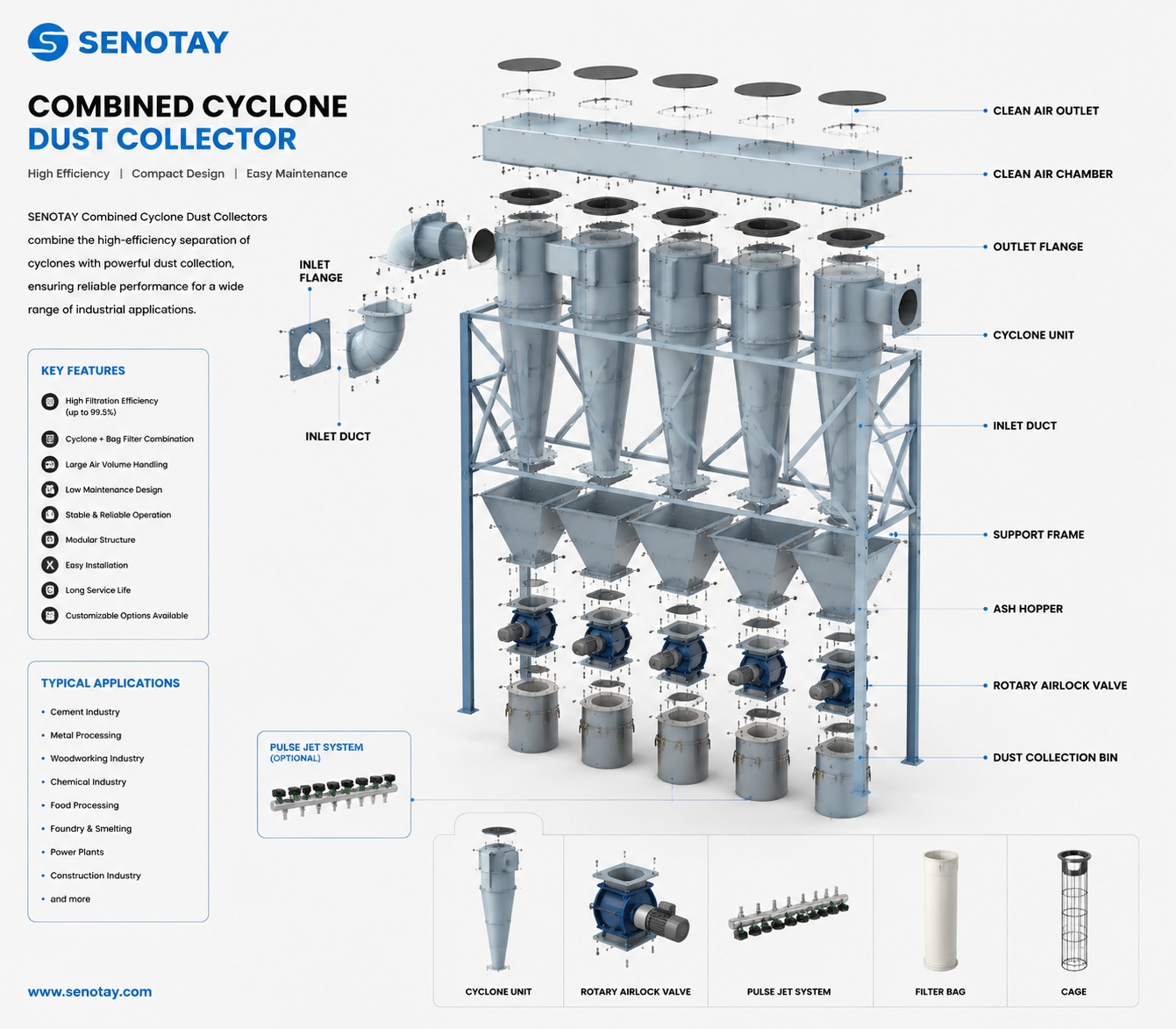
The operating principle of a combined cyclone dust collector relies on centrifugal separation:
Dirty gas enters a distribution chamber above the cyclone tubes
Gas is directed into each tube through stationary vanes that spin the flow into a vortex
Centrifugal force throws dust particles outward against the tube wall
Separated particles spiral downward into a collection hopper
Clean gas reverses direction upward through an inner outlet tube and exits the system
This design uses no moving parts in the gas stream — no filters to replace and no motors beyond the system fan. The result is a dust collector with exceptionally low ongoing maintenance compared to baghouses or cartridge filters.
Performance of a combined cyclone system depends on several design parameters:
Tube diameter — smaller tubes capture finer particles but reduce individual capacity
Number of tubes — determines total air volume capacity (typical range: 4 to 48+ tubes)
Inlet velocity — higher velocity improves separation but increases pressure drop
Pressure drop — typically 500–2,000 Pa; lower drop reduces fan energy cost
Operating temperature — standard designs handle up to 350°C with appropriate materials
A well-designed multiclone achieves 95–99% separation efficiency on particles larger than 10 µm, and can operate continuously with minimal attention between planned shutdowns.
Combined cyclone dust collectors are specified wherever large volumes of dusty gas need continuous, low-maintenance treatment:
Mining & Minerals — Ore crushing, screening, conveying dust control
Cement & Lime — Kiln exhaust, raw mill ventilation, clinker cooling
Power Generation — Biomass and coal-fired boiler fly ash collection
Chemical Processing — Catalyst recovery, powder handling, reactor venting
Grain & Agriculture — Grain drying, feed milling, silo ventilation dust
Metalworking — Grinding dust, shot blast exhaust, furnace off-gas
Choosing the right dust collection technology depends on particle size, temperature, moisture content, and operating cost priorities. The table below compares combined cyclone systems with the three most common alternatives.
Combined cyclone collectors occupy a clear niche: they offer the lowest operating cost and highest reliability for high-volume, high-temperature applications where fine particulate efficiency is not the primary concern. When sub-5 micron capture is needed, a cyclone is often installed as a pre-collector ahead of a baghouse or cartridge filter.
Facilities that choose a combined cyclone dust collector gain several practical advantages:
No consumable filters — no bags or cartridges to replace, no disposal cost
High-temperature capability — handles gas streams up to 350°C without cooling
Low pressure drop — reduces fan energy consumption compared to filter-based systems
Handles moisture and sticky dust — no filter blinding or media degradation
Compact footprint — multiple cyclones in one housing saves floor space
Minimal maintenance — inspection access, no routine parts replacement
Selecting the correct combined cyclone system starts with three data points:
Gas volume (m³/h) determines the number and diameter of cyclone tubes needed. Particle size distribution tells you whether a standalone cyclone will meet emission limits or needs to serve as a pre-collector. Temperature and moisture content dictate material selection — carbon steel for standard service, stainless for corrosive or high-temp streams.
Senotay offers engineering support to size and configure combined cyclone collectors based on site-specific conditions. Factory testing and performance guarantees are available for custom configurations [verify with Senotay].
Installation of a combined cyclone dust collector typically requires a structural support frame, inlet and outlet duct connections, and a discharge hopper with rotary valve or screw conveyor for dust removal. Most units arrive as a single assembled vessel or in modules for field assembly.
Daily maintenance is minimal: check rotary valve operation, inspect for tube plugging, and verify pressure drop across the system. Annual shutdowns allow internal inspection and wear assessment of cyclone tubes. There are no filter bags, cartridges, or moving parts in the gas stream to replace.
It removes particulate matter from industrial gas streams in applications like mining, cement production, power generation, chemical processing, and grain handling.
A well-designed multiclone achieves 95–99% efficiency on particles larger than 10 µm and 40–70% on sub-5 µm particles.
A cyclone uses centrifugal force with no moving parts; a baghouse uses fabric filters cleaned by pulse jets. Cyclones tolerate higher temperatures and moisture but are less efficient on fine particles.
Yes. Standard designs operate up to 350°C with carbon steel; higher temperatures are possible with alloy construction or refractory lining.
Check the rotary valve daily for smooth operation and verify pressure drop. Inspect tubes annually for erosion. No filter bags or cartridges to replace.
You need gas volume (m³/h), temperature, particle size distribution, and target emission level. Senotay provides sizing support and performance guarantees.
A combined cyclone dust collector delivers reliable, low-maintenance particulate control for high-volume industrial processes. Its multiclone design achieves high separation efficiency at elevated temperatures without consumable filters, making it the most cost-effective choice for many heavy industries.
If you are evaluating dust collection for a mining, cement, power, or chemical facility, contact Senotay (senotay.com) or request a quote on their combined cyclone dust collector page. Their engineering team can recommend a configuration matched to your gas conditions and emission targets.