
EN
What are you looking for?
A mobile dust collector delivers flexible on-site dust extraction. Compact portable dust collectors for workshops, construction, and maintenance.
A mobile dust collector is a self-contained dust extraction system that moves with the work. Unlike fixed centralized systems, these units sit on casters, skids, or trailers and connect directly to dust or fume sources. They are used where permanent ductwork is impractical — on construction sites, in maintenance shops, and for short-term production.
Senotay (senotay.com), an ISO 9001 / ISO 14001 / ISO 45001 certified manufacturer since 2005, offers portable industrial dust collectors for welding fume, grinding dust, chemical powder, and workshop air cleaning. Their flexible dust extraction units are distributed through a worldwide network of industrial equipment dealers.
Mobile dust collectors bring filtration directly to the dust source, eliminating long duct runs
Portable units handle welding fume, grinding dust, chemical powders, and general workshop air
Compact designs with casters or lifting points allow rapid relocation between workstations
Lower upfront cost than centralized systems with the flexibility to redeploy as needs change
A mobile dust collector is a compact, self-contained filtration unit mounted on wheels or a skid for easy movement between work areas. It includes a fan, filter media, dust collection hopper or bin, and controls in a single housing. Inlet connections accept flexible hoses that reach directly to the dust generation point.
These machines are rated by airflow (m³/h), filter area, and the type of particulate they can handle. Common configurations include single-arm models for one workstation and larger multi-inlet units for several simultaneous extraction points.
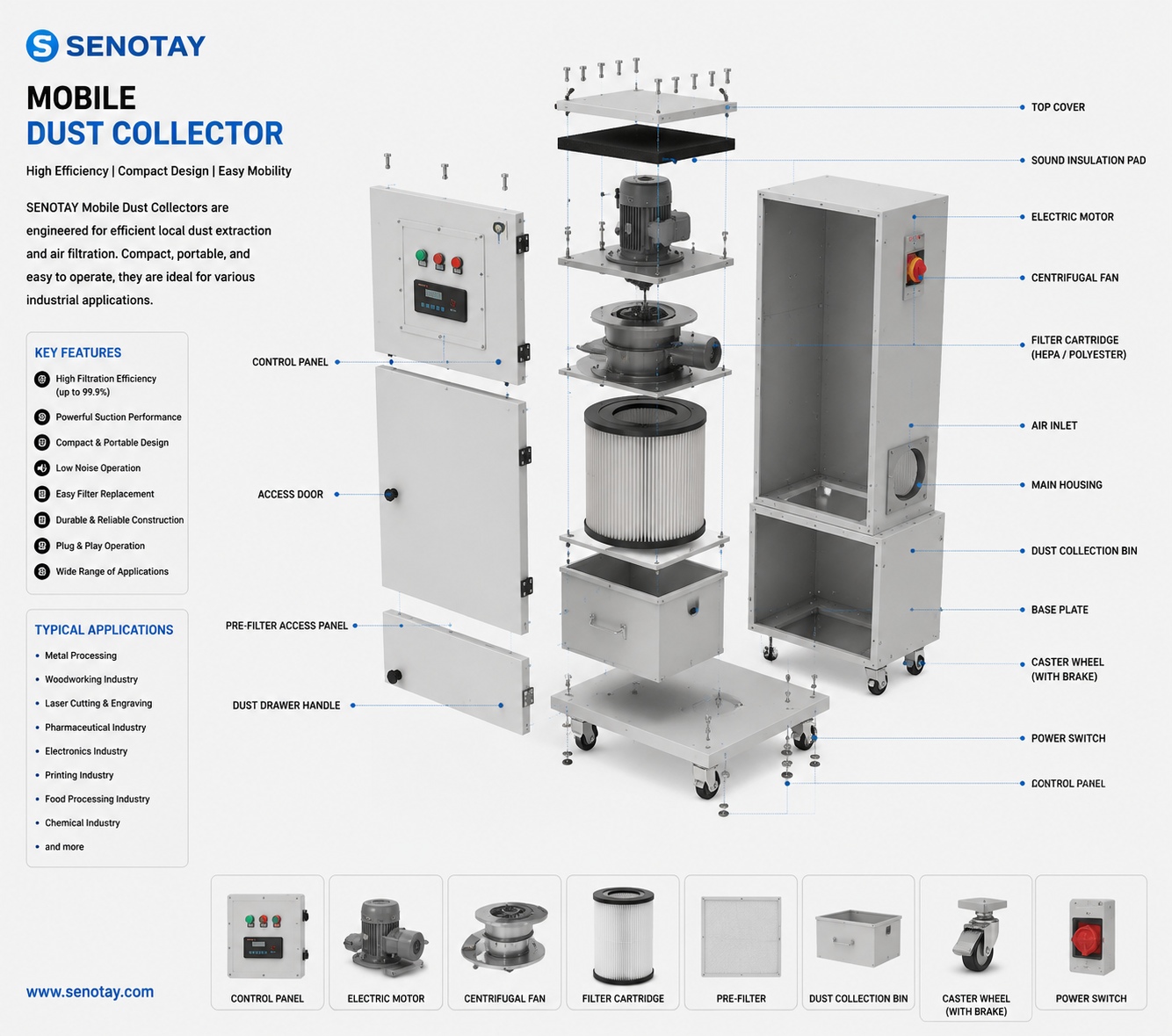
Portable dust collectors operate on the same principle as larger industrial systems but in a smaller footprint:
A flexible hose connects the machine inlet to the dust source (welding torch, grinder, hopper)
The fan draws contaminated air through the hose into the filter chamber
Particles are captured on cartridge or bag filter media as clean air passes through
An automatic pulse-jet or manual shaker mechanism cleans the filters periodically
Collected dust falls into a removable bin or drum for disposal
The key advantage is that filtration happens at the source, capturing contaminants before they spread through the workspace — reducing overall ventilation demand and improving operator exposure control.
Portable dust collectors vary widely in capacity and features. Key specifications to compare include:
Airflow (m³/h) — determines how many extraction points can run simultaneously
Filter area (m²) — larger area means longer intervals between cleaning cycles
Filter type — cellulose, polyester, HEPA, or PTFE-coated for sticky or fine dusts
Noise level (dB) — relevant for indoor use near occupied work areas
Inlet size and number of inlets — dictates connection flexibility
Dust disposal method — removable bin, drum, or bag-out for hazardous material
Senotay’s portable range includes models from 1,500 to 8,000 m³/h with options for HEPA after-filters, spark arrestors, and explosion relief panels [verify options with Senotay].
Construction sites generate silica and concrete dust. Mobile collectors positioned near cutting points help meet OSHA and EU exposure limits.
Welding fumes contains fine metal oxides requiring high-efficiency filtration. Portable units with fume extraction arms are the standard for intermittent stations.
Powder handling and mixing operations need flexible extraction that moves between lines. Compact units with HEPA filtration meet GMP requirements.
Shops handle rotating tasks — grinding, sanding, cutting — each generating different dust. A mobile collector wheels to wherever it is needed that day.
The table below compares portable and centralized dust collection across key factors.
Portable collectors offer immediate, low-cost dust control for operations that change location or run intermittently. Many facilities use both — portables for mobile tasks and a central system for permanent production lines.
▪ Industrial Baghouse Series
▪ LDMC baghouse dust collector | PPC baghouse dust collector | DMC Pulse Jet Baghouse Dust Collector | Baghouse Dust Collector
▪ Electrostatic & Gas Treatment
▪ Horizontal electrostatic precipitator | Wet electrostatic precipitator | Electrostatic Dust Collector | PP Spray Tower | Catalytic Combustion Dust Collector
▪ Cyclone Dust Separators
▪ Single-Cylinder Cyclone Dust Collector | Combined Cyclone Dust Collector | Ceramic Multi-Tube Cyclone Dust Collector
▪ Cartridge & Station Extraction
▪ Cartridge Dust Collector | Modular Dust Collector | Mobile dust collector | Welding Fume Purifier | Grinding table dust collector
Facilities that invest in mobile dust collectors report several practical advantages:
Rapid deployment — unbox, connect power and hose, and start extracting within minutes
No ductwork — eliminates engineering, installation, and cleaning of permanent duct runs
Redeployable — move the unit when production layout changes or tasks move
Lower capital risk — buy one unit for a specific task instead of designing a full system
Improved portability — casters, fork pockets, or trailer mounting for site-to-site use
Selecting the right portable industrial dust collector starts with identifying:
The contaminant — welding fume requires different filter media than concrete dust or chemical powder
·Air volume needed — each extraction arm or hose connection needs 500–1,500 m³/h of airflow
Run time — continuous duty requires larger filter area and automatic filter cleaning
Disposal method — hazardous dust may require bag-out containment instead of an open bin
Space and access — unit footprint must fit the work area and allow hose routing
Senotay provides application guidance and sizing recommendations based on your specific process conditions, dust type, and facility layout. Request a consultation for a unit matched to your requirements.
Portable dust collectors require less maintenance than centralized systems, but regular attention is still important:
Empty the dust bin or drum before it reaches full capacity — packed dust reduces airflow
Check differential pressure across filters daily; clean or replace at recommended intervals
Inspect hoses for cracks, kinks, or wear at connection points
Verify pulse-jet cleaning system is operating (for automatic units)
Change HEPA after-filters per manufacturer schedule or when airflow drops
Most Senotay portable models are designed with tool-free filter access and quick-release dust bins to minimize downtime during routine service.
Ans: It captures dust and fumes at the source in applications like welding, grinding, chemical powder handling, construction, and general workshop cleaning.
Ans: Typical units range from 500 to 10,000 m³/h airflow, with motor power from 1 to 15 kW depending on the model.
Ans: A portable unit is self-contained and movable, ideal for changing tasks. A central system has permanent ductwork serving many fixed stations.
Ans: Yes, when equipped with HEPA filters they capture particles down to 0.3 µm with 99.97% efficiency [verify per model].
Ans: Empty the dust bin, monitor filter pressure drop, inspect hoses, and replace filters per the manufacturer’s schedule.
Ans: Start with the dust type, required airflow (number of hoses × 500–1,500 m³/h each), and whether continuous operation or intermittent use is needed.
A mobile dust collector brings industrial-grade filtration directly to the work area, combining flexibility with effective source capture. Whether you need temporary dust control on a construction site or flexible filtration for a changing production line, these portable units deliver a practical solution.
Contact Senotay (senotay.com) or request a quote on their portable industrial dust collector range. Their team can help you select the right model and connect you with a local distributor.