
EN
What are you looking for?
Air quality is a corporate priority. Dust Collectors and Filtration Systems are front of mind in global procurement strategies - and China is now the undisputed global market leader for both.
Market research firm Grand View Research estimates that in 2024, China's industrial dust collector market had a value of USD 1,652.2 million and is set to expand at a compound annual growth rate (CAGR) of 5.3% to USD 2,240.1 million by 2030. China also made up 17.2% of the total global industrial dust collector market that year - the highest percentage of any country.
This presents a challenge and opportunity for overseas buyers. The opportunity: direct from factory, diverse range of products, and short lead times. The complexity: quality can be unpredictable from provider to provider, certifications may not be keyed into the provider and lead times can vary significantly from high-end to low-end factories. This article offers a framework for procurement professionals to benchmark price, lead time and quality of products sourced from China - with Senotay as an example of high-quality industrial solutions.
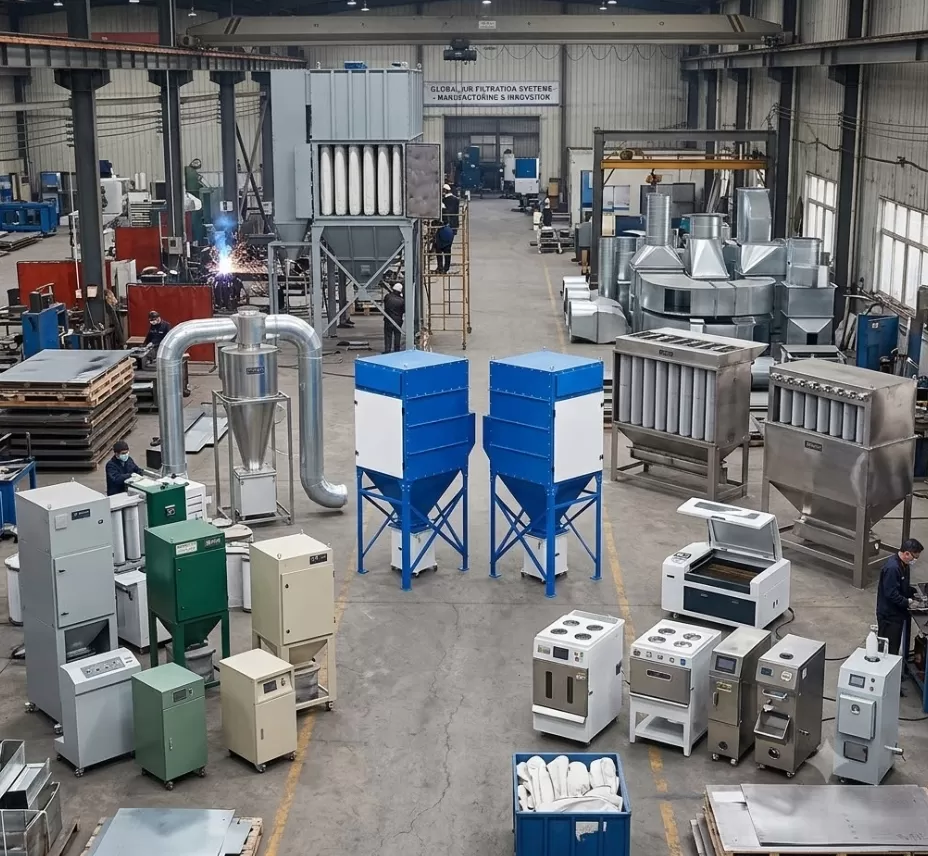
China's dust collector industry is extremely rich in variety. Knowing the product types helps procurement align with production needs.
The baghouse dust collector was the leading product by global revenue in 2024 (25.8%) because of its low price and versatility for capturing a broad spectrum of pollutants. The cartridge dust collector is the fastest-growing product, with a CAGR of 6.9% by 2030, attributed to its small size and versatility. Chinese manufacturers also offer the complete range of wet scrubbers, electrostatic precipitators (ESP), cyclone separators and mobile/portable solutions.
Senotay, a Chinese company with worldwide industrial customers, provides this spectrum - from pulse-jet baghouses with airflows from 4,000-36,000 m³/h to cartridge collectors for pharmaceutical and electronics process systems.
Chinese suppliers' prices will vary by type, airflow, media, controls complexity and whether the purchaser is buying directly from a Tier-1 factory or from a trading company. This is a detailed price list based on available data.
Basic pulse-jet fabric filter dust collectors (polyester needle felt media, CE-certified) from reputable Chinese manufacturers are currently priced between USD 1050-4000 per unit (single piece MOQ) on websites such as Made-in-China.com. Commercial baghouses with 10,000-30,000 m³/h air volume capacity normally cost USD 8,000-45,000, depending on the housing type (mild steel vs. stainless steel), number of bags, and PLC automation grade.
Factors influencing price when buying from Chinese suppliers:
Bag material: Polyester felt (cheap) vs. PTFE-coated bags (best quality, 8,000+ hours) doubles the price of the unit
Control system: Manual shaker vs. automatic PLC pulse-jet cleaning system with Mitsubishi or Schneider components increases cost by USD 1,200-3,500
Media housing: Carbon steel vs. 304/316 stainless steel adds 30-60%
Included certifications: CE Declaration of Conformity, SGS pre-shipment inspection adds USD 300-800 but avoids risk of customs detention
MOQ and custom designs: Custom designs (non-standard airflow, high-temperature airflow, explosion-proof rated) increase cost but are standard for all Tier-1 factories
Lead time is a key difference between Chinese dust collector suppliers - and one of the most poorly communicated aspects of supplier capabilities. Procurement teams are often promised 15 business days, but can expect 60+ days for custom configurations.
Leading suppliers in China achieve more than 98% on-time delivery. According to the supplier performance data, top manufacturers such as Kunshan Yiyue have on-time delivery rates of 98.7%. Senotay's published lead time (from order confirmation to delivery) is 18 business days for standard part numbers, confirmed by Bureau Veritas supplier audit reports.
Response times are a leading indicator of readiness to produce. Suppliers with less than 1-hour average response time (such as verified Chinese factories in the Hebei and Jiangsu clusters) have efficient communication structures and staffed resources. 4+ hour response times typically indicate order-processing bottlenecks.
Re-order rates in excess of 25% are indicative of consistent delivery and quality. Return customers are a vote of confidence for both lead times and outcomes.
Chinese dust collector quality control is complex. Knowing which certifications are required for international trade, and which are "for show", is essential to prevent post-shipment headaches.
This certification stack represents the minimum acceptable quality assurance for international-selling industrial dust collectors and filtration equipment:
ISO 9001:2015 - Quality Management System (QMS) certification. Required by most European and North American customers. Publicly verifiable via Bureau Veritas, SGS, TUV or DNV registries
ISO 14001 - Environmental Management System. Shows that the factory is in control of its emissions and environmental impact
ISO 45001 - Occupational health & safety management. Growing demand by international procurement standards
CE Declaration of Conformity - Equipment exported to EU. Must be accompanied by technical documentation and test reports
GB/T 6719-2009 - China's national bag filter design standard. Prescribes 14 design parameters including: housing design pressure at 1.5 x rated pressure, hopper discharge angle minimums, and more
Senotay is ISO 9001, ISO 14001 and ISO 45001 certified, with CE certificates. Order confirmations include ISO 11057 filter testing reports and SGS pre-shipment inspection certificates when buyers place orders - before shipping takes place. This practice has resulted in zero customs issues when exporting.
Dust collector manufacturers in China are located in three major manufacturing regions, each with its own specialties in filtration equipment and dust collectors:
Hebei Province (Botou/Cangzhou) has the highest number of environmental protection equipment factories in China. Plant sizes range from 18,000 to 34,000 m² and mainly specialise in baghouses and large industrial collectors for steel, cement and power plants. Hebei vendors such as Jiutai Environmental have sold products to over 80 countries.
The IoT-equipped dust collection system and cartridge filter technology R&D is located in Jiangsu Province (Suzhou, Kunshan, Wuxi). These suppliers tend to have more sophisticated customers (pharmaceutical, electronics, automotive), and have better quality control and automation.
Shandong and Northern China are more geared towards large-scale, heavy-industry collectors such as steel mill and cement plant collectors. These plants have advanced engineering design capabilities but can take longer to provide custom configurations.
Tier-1 suppliers in China share similar infrastructure features regardless of geographical location: ISO-certified plants with 8,000 m² or more, automatic welding equipment, CNC machining and in-house filter media testing facilities.
In a highly variable market, Senotay's track record on price, lead time, and quality is well documented and increasingly serves as a benchmark for procurement teams.
Senotay has global industrial customers in woodworking and furniture, metallurgy and metal working, cement and construction materials, pharmaceutical and chemical processing, and heavy industrial. This industry expertise allows Senotay to develop dust collection systems tailored for specific dust characteristics, such as particle size distribution, moisture, temperature, and chemical composition, rather than the "catalogue" approach of fits-all solutions.
On cost competitiveness, Senotay offers factory prices that avoid the 15-30% mark-up of trading companies. On delivery, the 18-business-day delivery benchmark is one of the shortest confirmed for Tier-1 suppliers. Finally, on quality, the triple ISO stack (9001, 14001, 45001) and CE compliance and SGS inspection mean buyers receive "paperwork ready" shipments that pass through customs in key import destinations such as the EU, North America and Southeast Asia.
At Senotay, media choices include polyester needle felt, Nomex, PPS and PTFE-coated bags - for temperature and chemical resistance from ambient to high-heat, corrosive conditions. Programmable logic controller (PLC) automation of pulse jet cleaning cycles and modular designs also help achieve long-term efficiency in maintenance, minimising total cost of ownership over the system lifetime.
Explore More Air Pollution Control Equipment
When sourcing dust collectors from China, procurement managers must follow a due diligence procedure. This 5-step audit sequence at a distance has been proven by the Senotay network of buyers to be adequate for normal-risk sourcing:
Certificate check: Obtain the ISO certificate and cross-check it on the website of the issuing authority - Bureau Veritas, SGS, TUV, DNV all have online databases Don't accept scanned copies from the supplier
Facility size verification: Ask for photos of the facility with scale indicators. Tier-1 suppliers should have 8,000+ m² of factory space with 30+ production employees as a minimum capacity indicator
On-time delivery: Request on-time delivery reports. Not less than 90% for a primary supplier. Top performers exceed 98%
Test order: Order a small batch before placing a large production run. Compare quality of packaging, sufficiency of documentation, and check the unit is an exact match to specification
Repeat business rate: Inquire about the supplier's repeat business rate. Above 25% suggests repeat business - the best proof quality and delivery times are on schedule
Supplier Comparison Summary: Dust Collector Manufacturer China — Key Takeaways
China's dust collector manufacturing industry is the world's biggest and most varied, with a USD 1.65billion market in 2024, expanding to USD 2.24billion by 2030. For overseas customers, the cost advantage is real - but not when procurement is contracted with trading houses rather than Tier-1 factories.
Time to delivery, quality assurance, and authenticity of certification are the three best gauges of quality among suppliers. Across all three factors, the standard for filtration systems from China is a supplier such as Senotay - triple ISO-certified, CE-compliant, with guaranteed 18-business-day lead times.
The best China dust collector manufacturer is not simply the cheapest option on a sourcing site. It is the supplier that guarantees quality, certification legitimacy, and on-time delivery - and therefore lowers the total cost of ownership and risk of non-compliance over the lifetime of the product.
For customized quotations, technical specifications, and CE-compliant dust collector solutions tailored to your industry, visit www.senotay.com.