
EN
What are you looking for?
Filter Bags, Cartridges and Media are the front line in controlling harmful particulate emissions in industrial air pollution control. These filtration devices are installed within baghouse dust collectors and pulse-jet filter systems in power plants, cement factories, steel mills, chemical processing units and waste incinerators throughout the world. A 10–15°C difference in the choice of filter material can cut bag life by up to 40%, increase maintenance costs by thousands of dollars per year, and jeopardize non-conformity to environmental regulations.
At Senotay, we design and manufacture high temp filter bags of industrial quality, specific to the temperature profiles and chemical conditions of the operation of each particular client. The article presents a science-based comparison of PPS vs Aramid vs PTFE materials to enable the procurement engineer, plant manager and environmental compliance officer to make confident, data-driven decisions.
1. PPS (Polyphenylene Sulfide) — The Balanced Performer
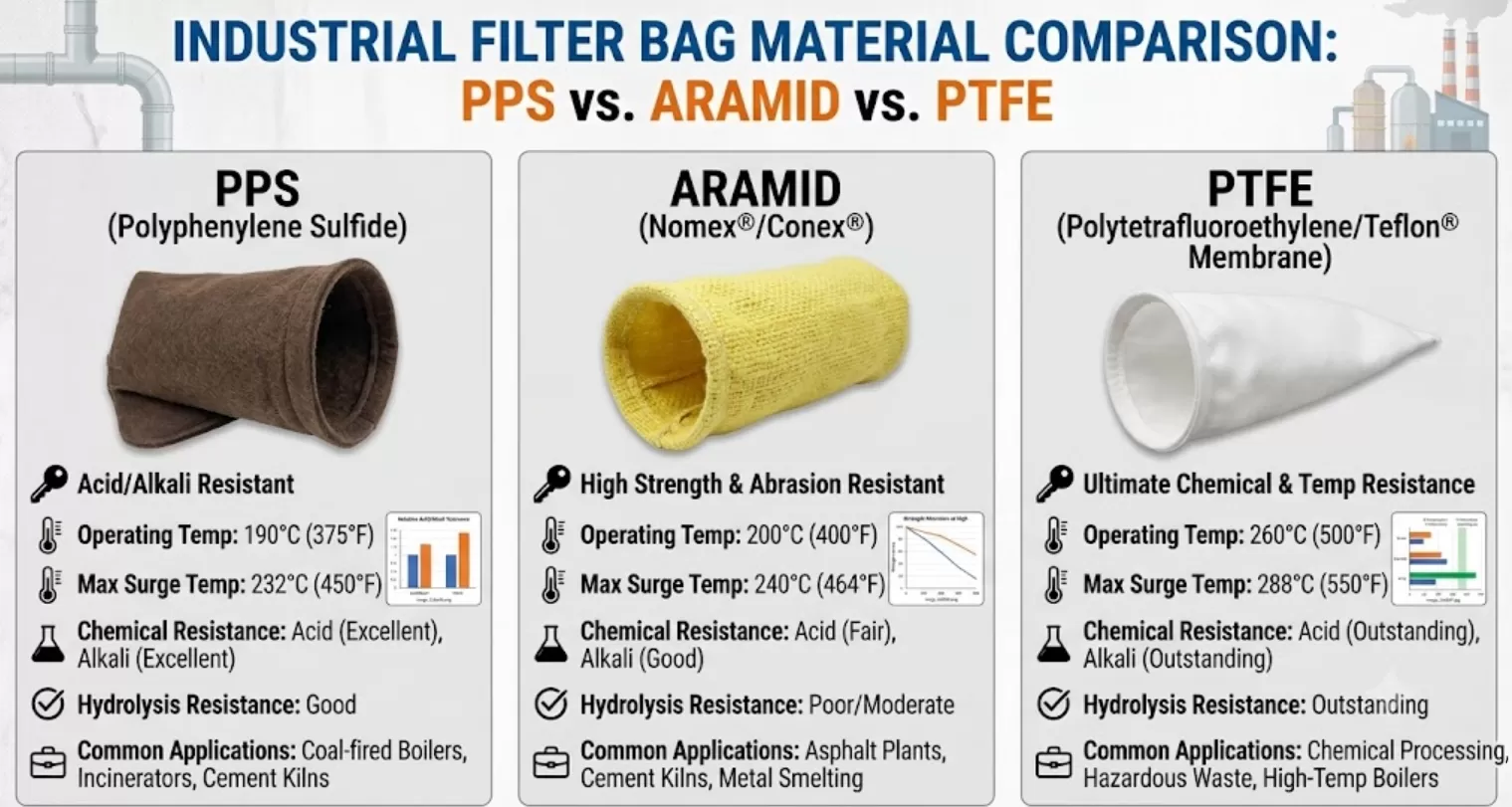
PPS filter fabric is a semi-crystalline thermoplastic polymer that is well known due to its outstanding chemical resistance and dimensional stability. PPP, developed in the 1970s, has become one of the most widely-used materials in high temp filter bags in coal-fired power generation.
The PPS Performance data:
Continuous operating temperature: up to 190°C.
Maximum surge tolerance: as high as 232°C (short-term)
Hydrolysis resistance: Excellent - does well in humid flue gas conditions.
Chemical resistance: High - resists SO₂, NO₂, and most acid gases.
Mean life in coal generation stations: 18-24 months.
Relative cost index: 1.0x (base point against which to compare)
A 2022 industry benchmark study of 14 coal-fired power plants in Asia found that PPS filter bags in service after 20 months had more than 99.5% particulate collection efficiency and less than 0.3% fiber degradation.
2. Aramid (Nomex®) — The Mechanical Powerhouse
Aramid fiber, also referred to as Nomex, is an aromatic polyamide that is designed to provide excellent tensile strength as well as thermal stability. It is the choice in high-abrasion application such as cement kilns and steel smelting where mechanical stress is as imperative as heat resistance.
The performance data of the Aramid key performance:
Constant operating temperature: to 204°C.
Peak surge tolerance: to 230°C.
Tensile strength: High - 30% stronger than PPS at the same load.
Resistance to hydrolysis: Poor - During humid conditions (above 160°C) the resistance to hydrolysis decreases rapidly.
Mean life in cement industry: 24-30 months.
Relative cost index: 1.3x (compared to PPS baseline)
A documented case study of a cement plant in Southeast Asia reported that a change to PPS to Aramid filter bags decreased bag replacement frequency (previously 16 months per bag) to 26 months per bag.
3. PTFE (Polytetrafluoroethylene) — The Premium Performer
Teflon is a brand name of PTFE, which is the highest in filtration performance. To the extent that only very intense chemical inertness is considered, and the maximum continuous temperature level of the three materials is the highest, PTFE high temp filter bags are the gold standard in the waste incineration industry, pharmaceutical manufacturing, and high-energy chemical processing industries.
PTFE key performance information:
Constant operating temperature: up to 260°C.
Peak surge tolerance: to 280°C.
Chemical resistance: Excellent - resists HCl, HF, dioxins and furans.
Filter efficiency (PM2.5): 99.97% - the same as the performance of HEPA filters.
Average life expectancy of waste-to-energy facilities: 36-48 months.
Relative cost index: 2.5x (compared to PPS baseline)
As of 2023 with PTFE-membrane filter bags installed in municipal solid waste incinerators, the level of particulate emissions was below 5 mg/Nm³ - well below EU Industrial Emissions Directive (IED) levels of 10 mg/Nm³.
The following table is a consolidated comparison of materials over eight key performance parameters. All the data is based on the standardized ISO 11057 and VDI 3926 standard testing protocol of filtration which is supplemented with internal quality assurance guidelines provided by Senotay.
Table 1: PPS vs Aramid vs PTFE — Temperature & Performance Comparison (Senotay Reference Data, 2024)
The selection of the appropriate high temp filter bag is not all about the maximum temperature rating but also depends on the chemical environment, mechanical stress, regulatory requirements and the total cost of ownership (TCO). The table below will map each material to actual industrial use.
Table 2: Industry Application Matrix — PPS vs Aramid vs PTFE (Senotay Industry Reference Guide, 2024)
Material incompatibilities in filtration systems are not the exception as most plant managers accept. The following three scenarios are documented and demonstrate the financial and operational impact:
Case Study 1 — Coal Power Plant, Eastern Europe
A plant that used Aramid filter bags under conditions of high humidity of the flue gas (moisture content greater than 18% ) experienced disastrous hydrolysis failure after 18 months -8 months earlier than anticipated. Complete replacement and downtime value: $62,000. The ultimate cause was the use of Aramid (poor hydrolysis resistance) instead of using PPS (excellent hydrolysis resistance) in a moisture-heavy environment. When the same plant switched to the Senotay PPS filter bags, the plant extended the bag service to 24 months with no hydrolysis incidents occurring during the three subsequent replacement cycles.
Case Study 2 — Municipal Waste Incinerator, Western Europe
A plant that had been using PPS rated filter bags at 210°C flue gas temperatures - 20°C above PPS rated limits -was experiencing quarterly bag failures and particulate emissions of more than 15 mg/Nm³. After Senotay's engineering team conducted an on-site audit, PTFE filter bags were specified. Subsequent post-upgrade testing of emissions showed a reduction to 4.2 mg/Nm 3 and the bag replacement intervals were improved by a factor of three between 38 months and 4.2 mg/Nm³ and a year ago the company paid 74 percent less in annual filtration maintenance.
Case Study 3 — Cement Kiln, South Asia
A cement manufacturer used two separate production lines to compare the 5-year total cost of ownership between PPS and Aramid filter bags. Although the Aramid bags cost an extra 1.3x at initial cost, resulting in a 5-year analysis period, the longer service life (26 vs. 18 months average) and reduced failure rate led to a net saving of 27,500 per kiln in the 5-year period of analysis.
Senotay has more than twenty years of experience in supplying precision-engineered filtration solutions to industries in Asia, Europe and Middle East. In each material recommendation, our technical advisory team incorporates real operating data, regulatory compliance, and process specific engineering parameters.
When you work with Senotay on a PPS vs Aramid vs PTFE evaluation, our process includes:
Free process temperature and chemical profile analysis.
Comparative TCO modeling of 2, 3 and 5-year horizons.
EPA, EU IED, and local emission standards Compliance mapping against the standards.
On-site installation service and post-commissioning performance verification.
Availability of the ISO-certified production facility, and quality assurance data of Senotay.
The filter bags produced by Senotay are based on the ISO 9001:2015 standard and tested according to VDI 3926 Part 1 & 2 protocols of pulse-jet filtration applications. In third-party comparative trials, our PTFE membrane filter bags have achieved an average reduction in emission of 68 percent in comparison to standard woven fabric options.
Explore More Air Pollution Control Equipment
Q1: What is the maximum temperature that a PTFE high temp filter bag can handle?
PFLE filter bags have a rating of continuous operation at temperatures to a maximum of 260°C and can withstand short-term spikes in temperature, up to 280°C. This makes PTFE the only appropriate material to be used in applications like waste incineration and aggressive chemical process where the temperature of the flue gases is frequently above 240°C.
Q2: Can PPS filter bags handle acid gas environments?
Yes. PPS has an excellent resistance to sulfur dioxide (SO₂), nitrogen oxides (NOₓ), and dilute hydrochloric acid (HCl). It has an outstanding performance in coal-fired power plant applications where acid dew point condensation is a chronic risk. Nevertheless, continuous service should not exceed 190°C, nor should PTFE be used in locations with high concentration of HF (hydrofluoric acid) since these conditions are not recommended.
Q3: Why is Aramid not recommended for high-moisture flue gas?
The Aramid (Nomex®) fiber is subjected to hydrolysis - a degradation process in a chemical reaction caused by moisture at high temperatures. Above 160°C and where the moisture content of the flue gases is greater than 15% Aramid fibers may lose up to 50 percent of their tensile strength in 12 months. Humid or steam-filled environments are to be covered with PPS or PTFE so as not to fail prematurely.
Q4: Is PTFE worth the higher cost compared to PPS or Aramid?
Yes in high temperatures or chemically hostile conditions. Even though the PTFE filter bags cost about 2.5x higher than PPS on a unit basis, their 36-48 months of service life as compared to 18-24 months of PPS oftentimes results in a lower 5-year total cost of ownership. Furthermore, in controlled sectors like waste incineration or pharmaceuticals, the economic feasibility of PTFE in terms of emission compliance benefits, reduced downtime risk, makes the economic analysis of PTFE the economically sound choice.
Q5: How do I know which material is right for my application?
The three most important parameters to be considered are: (1) continuous flue gas temperature, (2) chemical composition of the gas stream (especially acid gases, moisture and oxidizing agents), and (3) mechanical stress levels in your filtration system. Senotay provides a free material selection consultation - our engineers apply a process compatibility matrix that is well structured to recommend the best filter bag material to use under your specific operating conditions.
Q6: What industries does Senotay supply filter bags to?
Senotay sells high temp filter bags and filtration media to the 30+ countries coal-fired power generation, cement and lime production, steel and non-ferrous metal smelting, waste-to-energy and municipal incinerators, chemical and petrochemical processing, pharmaceutical manufacturing, and food processing industries.