
EN
What are you looking for?
Ceramic multi-tube cyclone dust collectors clean high-temperature boiler flue gas. See how Senotay's ceramic cyclone technology cuts dust, cost, and downtime.
Coal- and biomass-fired boilers push hot, abrasive flue gas toward the chimney — loaded with fly ash that eats through ordinary equipment and tests tightening emission limits.
The workhorse that handles the first, hardest stage of that job is the Ceramic Multi-Tube Cyclone Dust Collector. Built to survive heat that would warp steel and ash that would grind it down, it pulls a large share of dust from boiler flue gas before it ever reaches a baghouse or the stack.
In this guide, we'll cover how ceramic cyclone technology works, where a boiler flue gas cyclone dust collector earns its keep, and what to ask when comparing suppliers. You'll also see why Senotay, a manufacturer in Hebei, China, has specialized in rugged high-temperature dust separation since 2005.
A cyclone is one of the oldest ideas in industrial gas cleaning: spin dirty gas fast, and centrifugal force flings the heavier dust outward, where it falls into a hopper. No filters to clog, no moving parts — just physics.
The ceramic multi-tube version makes that idea practical in extreme conditions. Small ceramic tubes sit in parallel inside a steel housing. Dirty gas enters through an inlet box, is guided into each tube by helical vanes, and spins — dropping particles into an ash hopper — before clean gas rises through a central outlet pipe to the next stage or the stack.
Why many small tubes instead of one big cyclone? Collection efficiency improves as diameter shrinks, so a bank of small cyclones separates fine dust better than a single large one — while keeping pressure drop low enough for existing boiler fans.
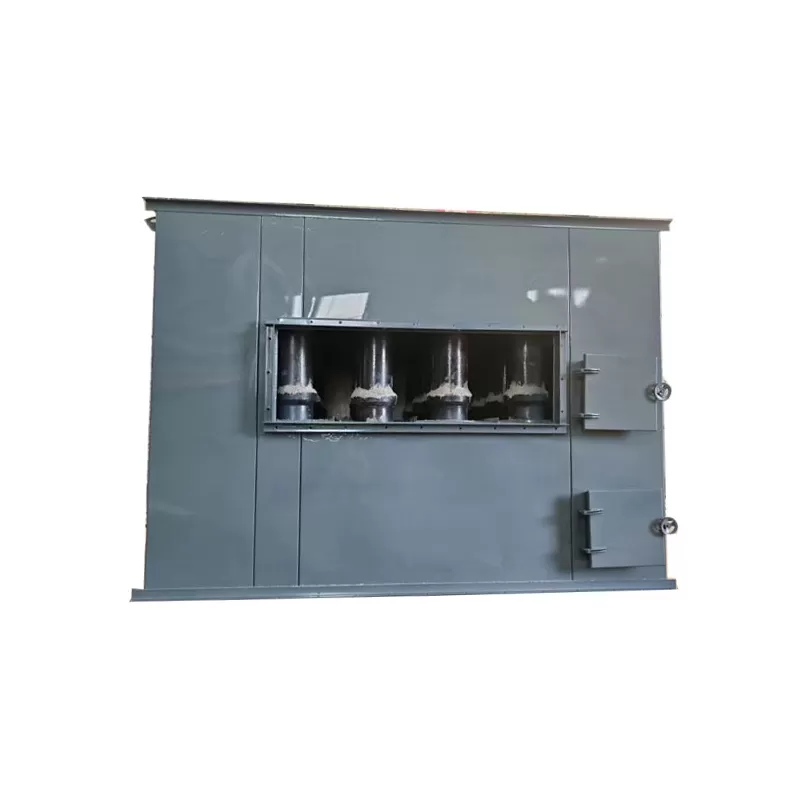
In a boiler application, tube material is everything. Steel cyclones struggle above a few hundred degrees and wear quickly under abrasive fly ash. Ceramic tubes — fired at over 1,200°C from cordierite, alumina-silica fiber, and fire clay — shrug off both, running reliably from about −20°C to 500°C, with special grades going higher. Ceramic also resists abrasion and corrosion about three times better than stainless steel across a pH range of 2–12.
Boiler flue gas is hostile — hot, abrasive, and often corrosive, especially after burning coal or biomass. It punishes equipment in ways a conventional filter never faces. The common pain points:
Heat. Flue gas from a chain-grate or pulverized-coal boiler often leaves the economizer above 200°C.
Abrasion. Fly ash is essentially ground rock that erodes metal at elbows and impingement points.
Spark risk. Unburned embers ride with the gas and can ignite filter bags downstream.
Emission rules. Tighter particulate limits mean you can't let coarse ash travel to the stack.
A boiler flue gas cyclone dust collector answers all four at once. It runs dry, with no moving parts, capturing a large share of the ash — often 85–95% by mass — while acting as a natural spark arrester. Ahead of a baghouse or ESP, it takes the coarse fraction off the table so the downstream filter lasts far longer. Don't need the last few percent? Two stages in series push removal past 98%.
High-temperature dust separation is a balancing act. Efficiency wants small cyclones; small cyclones want to plug. The ceramic multi-tube design sidesteps the trade-off with geometry and material science.
Each tube holds helical guide vanes — commonly angled around 25° — that turn incoming gas into a tight spiral. The swirl does the separating; the vanes deliver it consistently. Getting the vane angle and inlet geometry right is where engineering experience shows — or quietly loses five to ten points of efficiency.
The cyclone bodies come from a ceramic blank — roughly half cordierite, with alumina-silicate fiber and fire clay — extruded and sintered at 1,200–1,300°C. The result is a tube that resists erosion and corrosion, with a wear-resistant wall several millimeters thick. Above 400°C, the steel shell gets an internal insulation layer so the housing stays cool enough for the induced-draft fan.
The performance of a cyclone in harsh boiler flue gas conditions is largely determined by its material. This table compares the key properties of different ceramic materials used in cyclone linings and components.
These systems fit wherever high-temperature gas carries abrasive dust:
Coal-fired boilers, from small chain-grate units around 4 t/h to pulverized-coal and fluidized-bed installations of 75 t/h and beyond.
Biomass and waste-fuelled boilers, where the ash is especially abrasive and embers a real fire risk.
Cement plants, cleaning kiln tail gas before it reaches a filter.
Metallurgical processes, including converter gas, producer gas, and sintering flue gas.
As a pre-collector ahead of bag filters, desulfurization towers, or ceramic membrane filters — removing 40–95% of the dust load and shielding the expensive equipment downstream.
That flexibility is why engineers reach for cyclones first — they're cheap to run, forgiving of load swings, and they protect everything behind them.
Here are the numbers that matter when comparing collectors:
Removal efficiency: typically 92–95% on a single stage, above 98% with two stages in series.
Pressure drop: 700–900 Pa, compatible with most existing boiler fans.
Temperature range: −20°C to 500°C standard, higher with special ceramic grades.
Capacity: modular designs from a few tubes up to 130 per unit, roughly 3,000 m³/h to over 100,000 m³/h.
Cost: about a third of the installed cost of an electrostatic precipitator doing the same job.
Because the dust comes out dry, you can often recover and reuse it — a quiet bonus in cement and metallurgy, where collected ash has real value.
This table provides a quick reference for the performance characteristics and design parameters common to ceramic multi-tube cyclone dust collectors in boiler flue gas applications .
The specification is only half the decision — the supplier is the other half. Ask:
What temperature will my flue gas reach at peak load, and is the ceramic grade rated for it?
What removal efficiency do you guarantee at my particle size distribution, not a lab standard?
Can you confirm the pressure drop against my existing fan curve?
Do you provide an insulation layer for gas above 400°C?
What does the maintenance schedule look like, and what spares do you stock?
A manufacturer with real in-house capability — mixing and firing its own ceramic components, welding its own housings, pre-shipment testing every unit — is a partner. Senotay brings design, build, test, and support under one roof, backed by ISO 9001, 14001, and 45001 certification.
▪ Industrial Baghouse Series
▪ LDMC baghouse dust collector | PPC baghouse dust collector | DMC Pulse Jet Baghouse Dust Collector | Baghouse Dust Collector
▪ Electrostatic & Gas Treatment
▪ Horizontal electrostatic precipitator | Wet electrostatic precipitator | Electrostatic Dust Collector | PP Spray Tower | Catalytic Combustion Dust Collector
▪ Cyclone Dust Separators
▪ Single-Cylinder Cyclone Dust Collector | Combined Cyclone Dust Collector | Ceramic Multi-Tube Cyclone Dust Collector
▪ Cartridge & Station Extraction
▪ Cartridge Dust Collector | Modular Dust Collector | Mobile dust collector | Welding Fume Purifier | Grinding table dust collector
Q. What's the difference between a cyclone and a ceramic multi-tube cyclone?
Ans: A single cyclone is one large spinning chamber — simple, but limited in how fine a particle it catches. A ceramic multi-tube cyclone uses many small ceramic tubes in parallel; smaller diameter means better separation, catching more fine dust at low pressure drop.
Q. Can these really handle my boiler's flue gas temperature?
Ans:Standard units run reliably from −20°C to about 500°C, which covers most boiler flue gas. Hotter gas needs special ceramic grades that extend the range further. Tell your supplier your peak load temperature and they'll match the grade.
Q. Does a cyclone replace a baghouse or electrostatic precipitator?
Ans: Often it comes before them rather than replacing them. As a single stage, a cyclone handles the bulk of the ash cheaply; as pre-dedusting, it removes 40–95% of the dust load so the downstream filter works less and lasts longer. In some applications the cyclone alone is enough.
Q. How much maintenance do these systems need?
Ans: Very little — no moving parts in the gas stream, no filter media to change. Typical practice is an inspection every six to eight months, checking the ceramic tubes for wear and clearing the ash hopper.
Q. How do I get a quote from Senotay?
Ans: Send your flue gas data — temperature, volume, dust type and loading, and emission target — through senotay.com. Senotay's engineers will size a system for your application, confirm performance, and pre-shipment test every unit before it ships.
Ans: High-temperature flue gas is the hardest job in dust control, and it rewards equipment built for exactly that. A ceramic multi-tube cyclone dust collector combines proven physics with materials that refuse to wear out — cutting dust load, protecting downstream equipment, and lowering cost.
If you're sizing emission control for a boiler, kiln, or furnace, start with the first stage done right. Contact Senotay for a custom-engineered quote — and let two decades of high-temperature dust separation experience work for your plant.