Energy-Saving VOC & HAP Destruction System
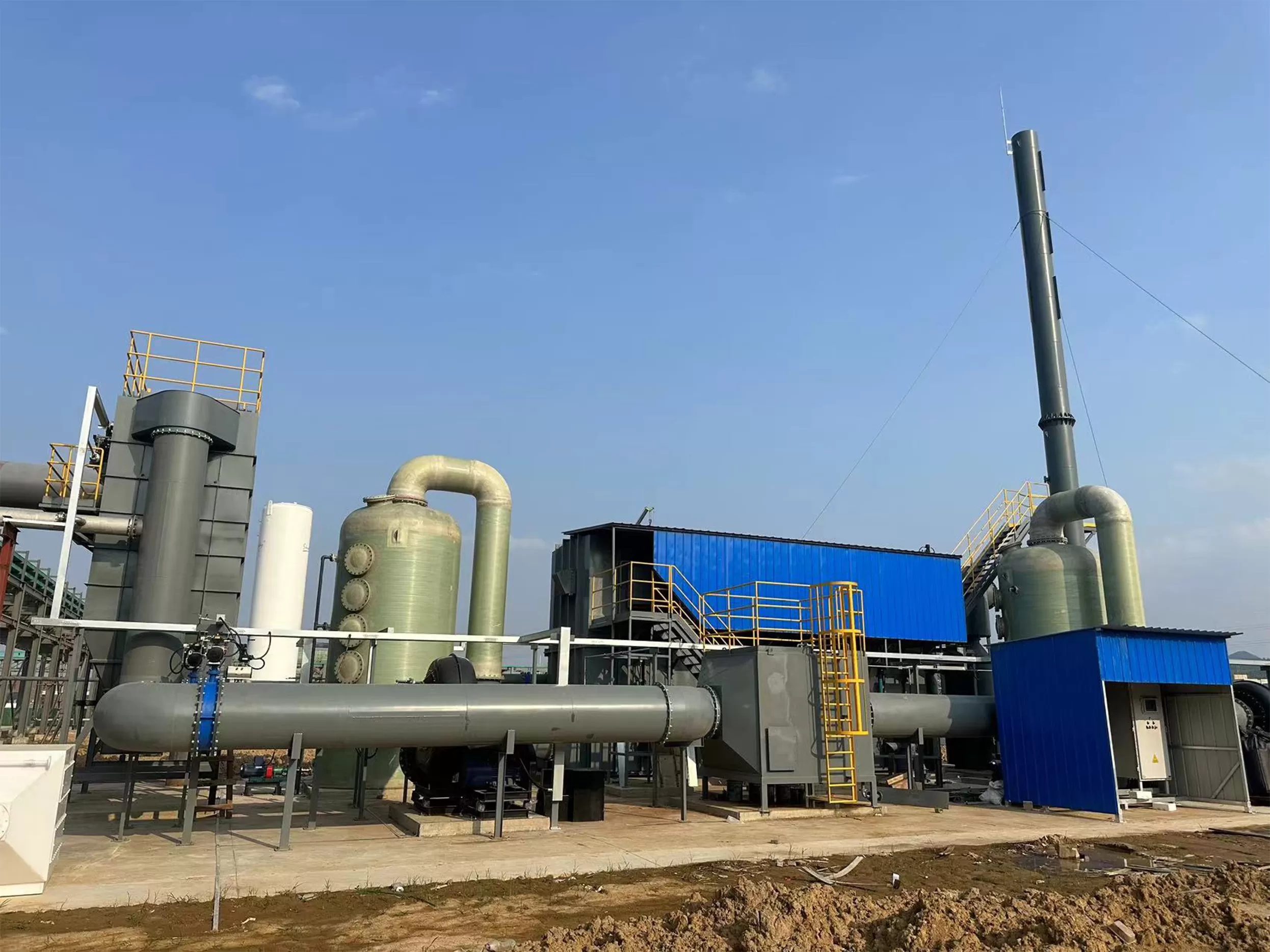
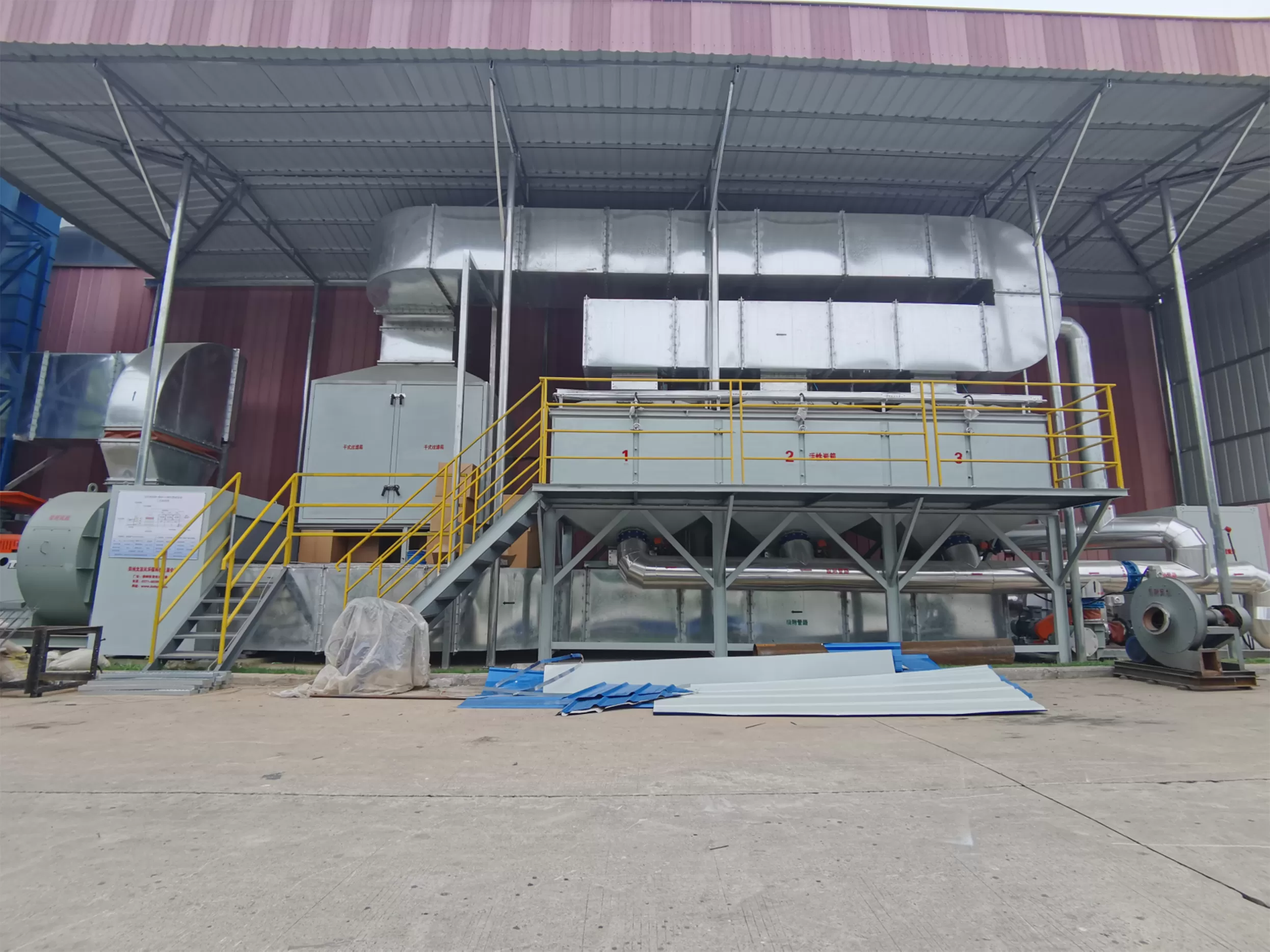
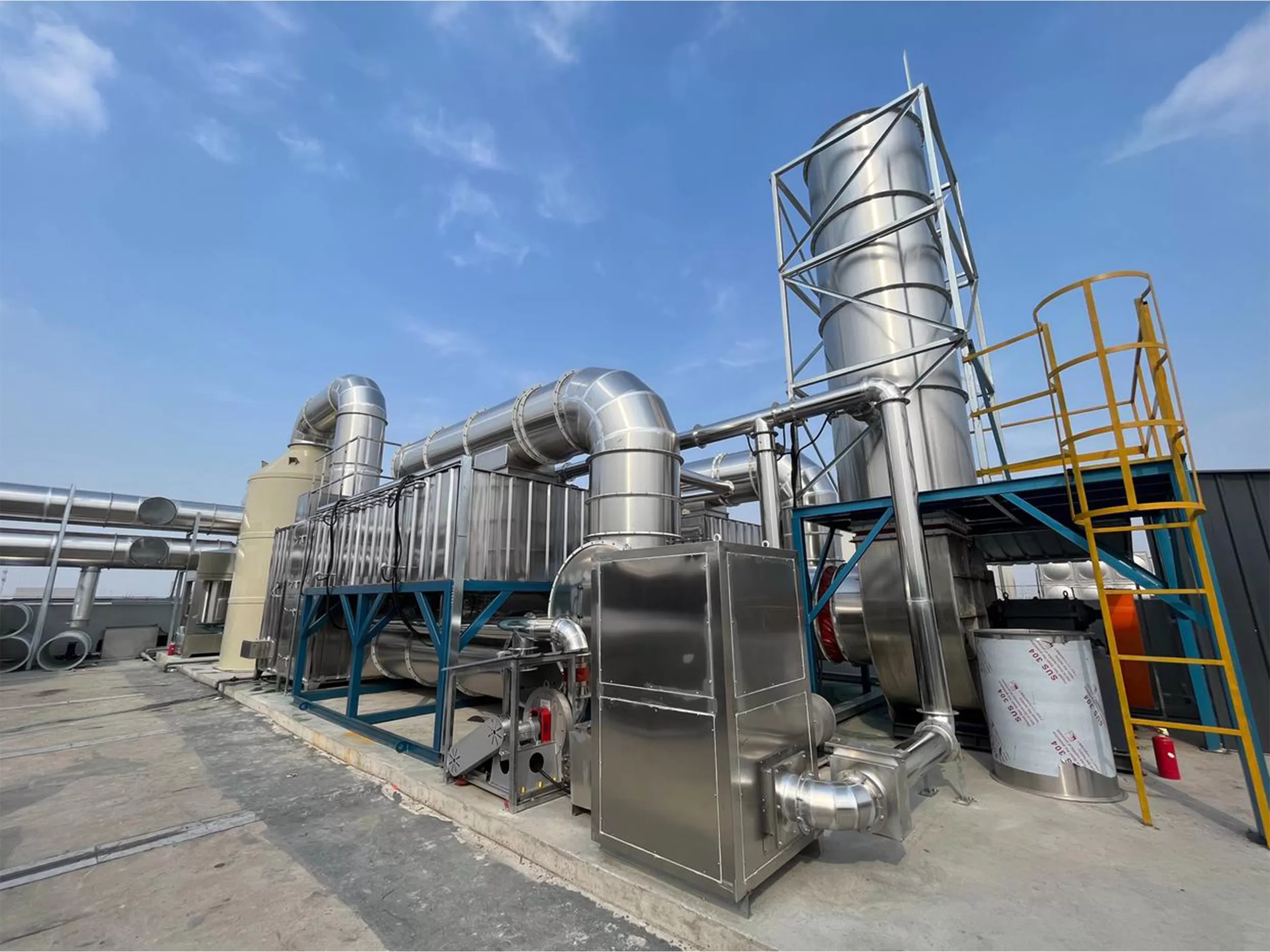
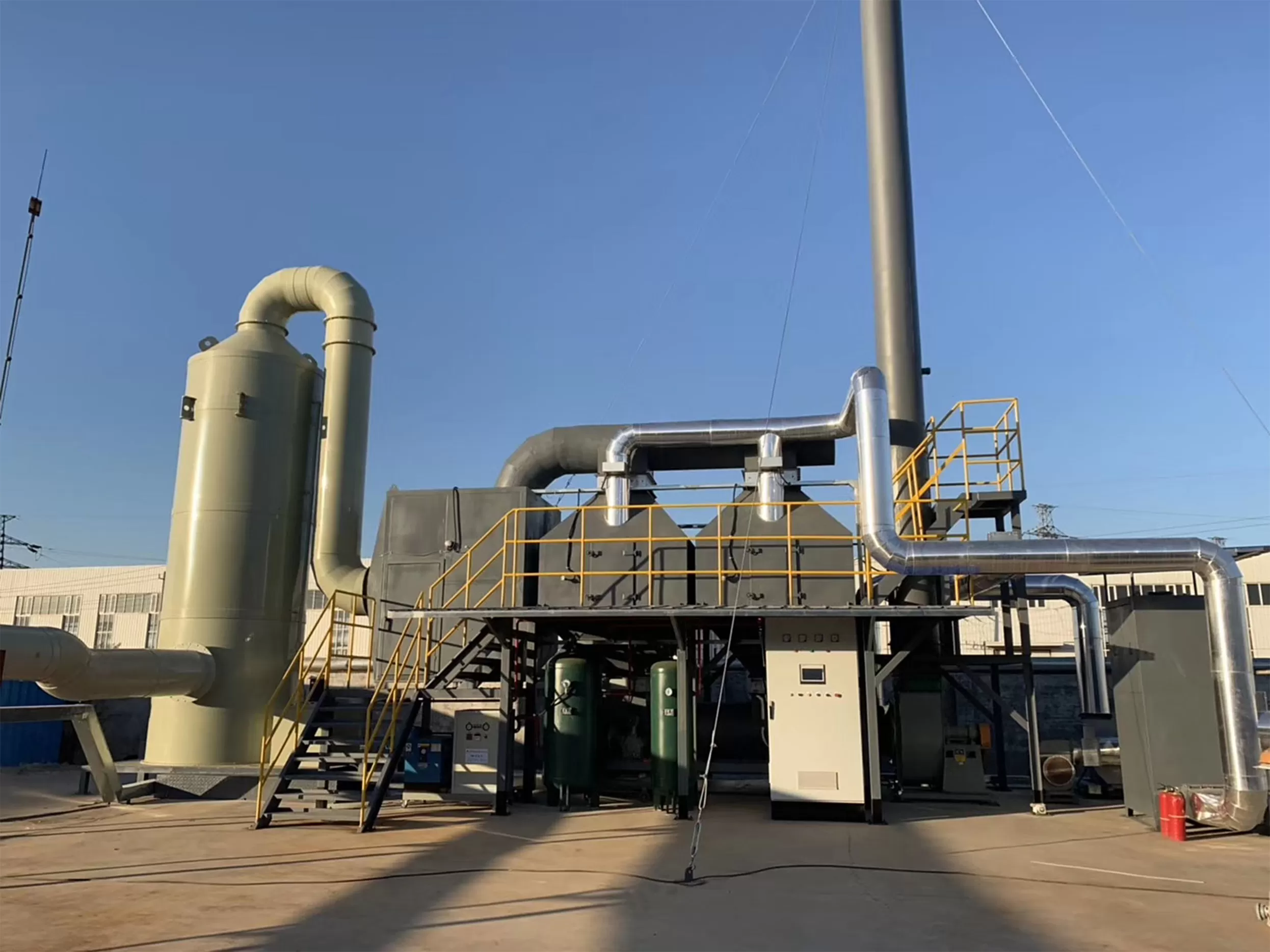
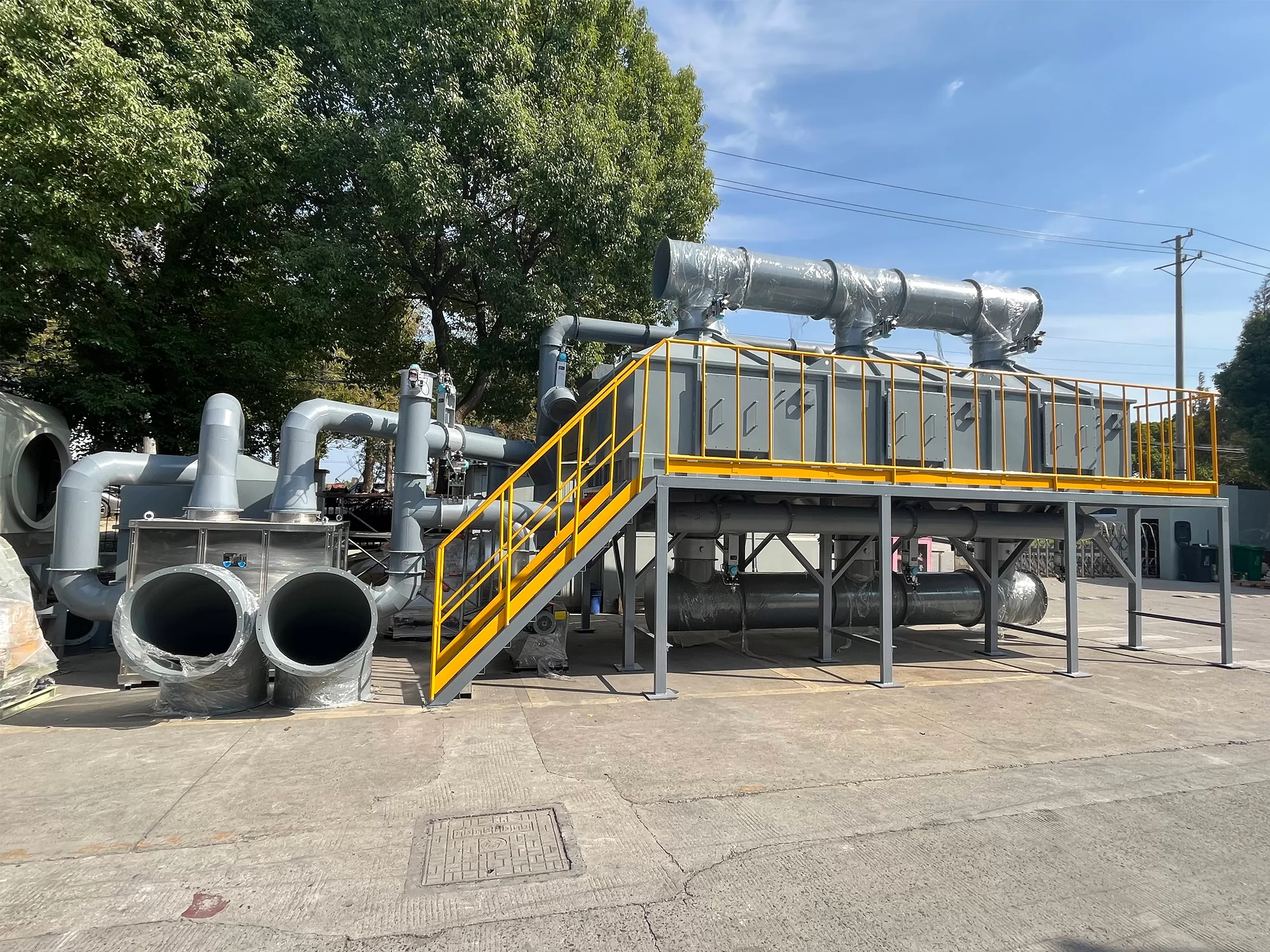
The Regenerative Catalytic Oxidizer (RCO) is an advanced air pollution control system engineered to remove volatile organic compounds (VOCs) and hazardous air pollutants (HAPs) from industrial exhaust streams. By integrating regenerative ceramic heat recovery with a precious metal or metal oxide catalyst bed, the RCO achieves up to 99% VOC destruction efficiency at significantly lower temperatures (250–350°C) than a traditional Regenerative Thermal Oxidizer (RTO). This makes it a highly economical and energy-efficient solution for industries with continuous, stable VOC loads.
Core System Advantages
Low-Temperature Oxidation: Utilizes specialized catalysts to break down VOCs at just 250–350°C—nearly half the temperature required by traditional thermal oxidizers (750–850°C). This dramatically reduces fuel consumption.
Regenerative Heat Reuse: Ceramic heat storage beds capture and reuse thermal energy from purified exhaust air to pre-heat incoming polluted air, ensuring ultra-low ongoing operational costs.
Fast Startup & Reliability: The lower operating temperature limits thermal stress on internal components, preventing burner burnout and extending the equipment's overall lifespan while enabling faster startup times.
Featured Model Configurations
RCO-800 | Chemical & Adhesives Production
Airflow: 50,000 m³/h | Catalyst: Metal Oxide | Heat Recovery: ≥ 93%
Engineered to handle heavy, continuous VOC off-gassing from adhesives, resins, and rubber manufacturing.
RCO-1000 | Mega-Flow Central VOC Treatment
Airflow: 80,000+ m³/h | Catalyst: Mixed Catalyst | Heat Recovery: ≥ 95%
High-capacity system built for centralized facility exhaust, large-scale petrochemical processing, and major printing operations.
Why Choose the SENOTAY Regenerative Catalytic Oxidizer
Ultra-Low Operating Temperature: Oxidizes VOCs at just 250–350°C (nearly half the temperature of traditional RTO systems), which drastically cuts fuel consumption while maintaining up to 99% destruction efficiency.
Maximum Energy Recovery: Features regenerative ceramic beds that capture and reuse heat between cycles, making it a highly economical and energy-saving solution for stable, continuous VOC streams.
Fast Startup & Longer Lifespan: The lower operating temperatures reduce thermal stress and burnout risks, extending the equipment's lifespan and allowing for much faster startup times compared to thermal-only oxidizers.
Tailored Catalyst Technology: Utilizes high-quality noble metal or metal oxide catalyst beds specifically matched to your facility's VOC concentration and required destruction efficiency.
Massive Scalability: Available in ten distinct models capable of handling airflow capacities from 5,000 to over 80,000 cubic meters per hour, ideal for coating booths, electronics manufacturing, printing, and automotive plants.
Why Leading Plants Choose SENOTAY RCO
Factory-Direct Pricing. Certified Quality. Dedicated Support.
Best Price Guarantee
Certified & Compliant
Fast, Reliable Delivery
Types of Regenerative Catalytic Oxidizer – Specification Analysis
Below is a unique comparative table (10 rows × 7 columns) analyzing RCO types:
Type No. | Airflow Capacity (m³/h) | Operating Temp (°C) | Heat Recovery Efficiency | Catalyst Type | Fuel Type | Typical Application |
RCO-100 | 5,000 | 300 | ≥90% | Noble Metal | NG/LPG | Printing Lines |
RCO-200 | 10,000 | 280 | ≥92% | Noble Metal | NG | Electronics |
RCO-300 | 15,000 | 320 | ≥90% | Metal Oxide | NG/LPG | Packaging |
RCO-400 | 20,000 | 300 | ≥93% | Noble Metal | NG | Coating Booths |
RCO-500 | 25,000 | 270 | ≥90% | Metal Oxide | LPG | Wood Finishing |
RCO-600 | 30,000 | 320 | ≥94% | Noble Metal | NG | Automotive Plants |
RCO-700 | 40,000 | 300 | ≥92% | Noble Metal | NG | Petrochemical |
RCO-800 | 50,000 | 310 | ≥93% | Metal Oxide | NG/LPG | Adhesives |
RCO-900 | 60,000 | 330 | ≥95% | Noble Metal | NG | Chemical Industry |
RCO-1000 | 80,000+ | 300–350 | ≥95% | Mixed Catalyst | NG | Large-Scale VOC Treatment |
Why Regenerative Catalytic Oxidizer?
· Industries choose Regenerative Catalytic Oxidizers because they offer:
· Lower Operating Temperature
· VOC oxidation occurs at 250–350°C, nearly half the temperature of traditional RTO systems.
· Ultra-High VOC Destruction Efficiency
· Up to 99% VOC removal, meeting global emission standards.
· Energy-Saving Operation
· The regenerative ceramic beds capture and reuse heat, drastically reducing gas consumption.
· Long-Term Reliability
· Fewer thermal stresses and lower burnout risks extend equipment lifespan.
· Compliance With Environmental Regulations
· Ideal for facilities needing continuous clean air solutions, carbon reduction, and regulatory compliance
Regenerative Catalytic Oxidizer (RCO) — Technical Specification Table
Physical Dimensions | Performance Ratings | Material & Construction | Operational Data | Certifications & Lifecycle |
Model Range: 5,000–120,000 m³/h | 95–99% | Q235 / SS304 / SS316L | −2,000 to +2,000 Pa | 8–15 years |
Length: 3,800–16,500 mm | 85–97% | Pt/Pd noble metal honeycomb | 40–450 kW | 12–24 months |
Width: 2,400–9,200 mm | 260–380 °C | Cordierite / Ceramic | 850–1,900 Pa | ISO 9001 / CE / EN 376 |
Height: 3,900–12,000 mm | 450 °C | Ceramic Saddles / Honeycomb | 7.5–200 kW | GB 31572 / EN 14181 |
Inlet Flange Size: DN300–DN1800 | ≤ 0.2% | 100–200 mm | 8–36 holes (Ø18–Ø28 mm) | 18,000–28,000 h |
Outlet Flange Size: DN350–DN1800 | ≤ 75 dB(A) | Epoxy 120 μm + PU 150 μm | NG / LPG / Diesel | ≥ 500,000 cycles |
Door Panel Thickness: 6–12 mm | 25–45 min | Fiberglass, Graphite, PTFE | 4–12 points | IP55 / IP65 |
Weight: 5,200–42,000 kg | < 20 mg/m³ | High-temp Ceramic Fiber | PLC + HMI | C3–C5 |
.
Product Description
Senotay’s Regenerative Catalytic Oxidizer system is designed for stable performance, economic energy usage, and high VOC elimination.
Key features include:
Modular design and simple installation.
Low NOx formation.
Intelligent PLC automatic control.
Low maintenance ceramic beds.
Durable catalyst with long service life.
Safety interlocks and emergency bypass system.
This RCO system efficiently processes medium-to-high-concentration VOC emissions with consistent long-term performance.
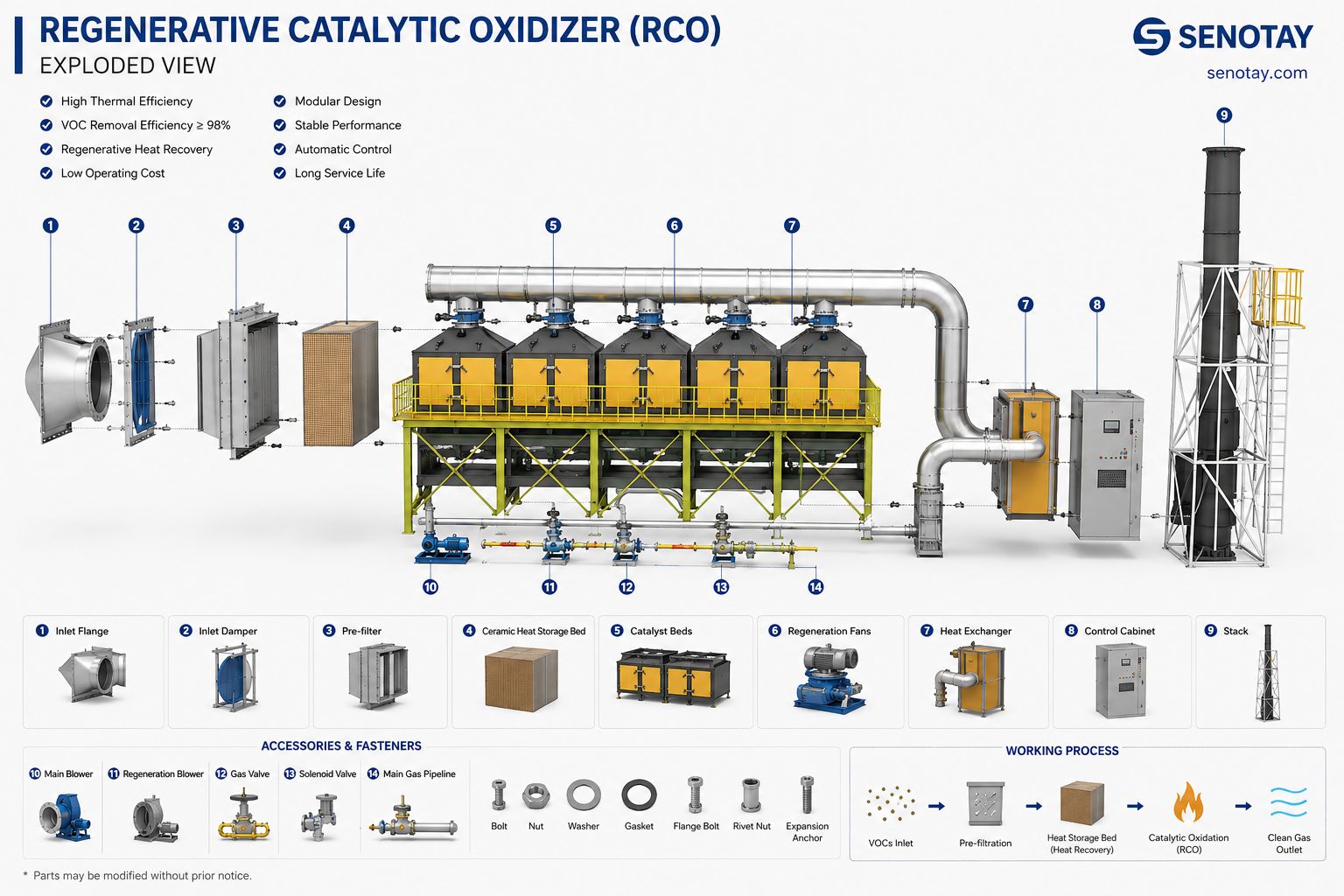
Core Components
A complete RCO system from Senotay includes:
Primary Heat Exchanger / Ceramic Heat Storage Beds.
Catalyst Reaction Chamber.
VOC Exhaust Fan & Piping System.
Burner and Temperature Control System.
Automated Switching Valves.
PLC Control Panel & Safety Interlocks.
Insulation Layer & Structural Housing.
Pre-filters / Dust Removal Units (optional).
Regenerative Catalytic Oxidizer Installation Method
Installation follows international engineering practices:
Site Preparation – Analyze airflow, emission volume, and environmental requirements.
Foundation Construction – Reinforced concrete base to support system weight.
Module Assembly – Install ceramic beds, reaction chamber, piping, and supports.
Electrical & Control Wiring – Connect PLC, sensors, motors, and safety circuits.
Gas Line Installation – Configure burners and fuel control systems.
Commissioning & Testing – Temperature calibration, airflow testing, and catalyst activation.
Senotay provides full installation support, including on-site guidance and technical training.
How It Works – RCO Working Mechanism
VOC-laden air enters the ceramic heat storage chamber, absorbing heat from previously purified air.
The preheated air passes into the catalytic reaction chamber, where catalysts accelerate VOC oxidation at low temperatures.
VOCs convert into harmless CO₂ and H₂O.
Purified air releases heat into the ceramic bed, significantly reducing fuel usage.
Switching valves alternate airflow direction for continuous regenerative heating.
This cycle dramatically minimizes energy consumption and ensures high VOC destruction efficiency.
Difference Between RTO and RCO
Feature | RTO | RCO |
Operating Temperature | 750–850°C | 250–350°C |
Catalyst Requirement | Not required | Required |
Fuel Consumption | High | Low |
VOC Concentration Range | Wide | Medium / Stable |
Maintenance | Low | Moderate (catalyst maintenance) |
Startup Time | Longer | Faster |
Energy Efficiency | High | Very High |
Conclusion:
If the VOC concentration is stable and energy efficiency is critical, RCO is the superior choice.
Technical Advantages of Senotay (Hebei OuTai Environmental Protection Equipment Co., Ltd.)
Over 15 years of experience in VOC purification systems.
Certified quality management and strict production standards.
Independent R&D and patented valve switching technology..
International-grade catalysts with long service life.
Energy-saving design achieving ultra-low operational cost.
Customization for complex emission conditions.
24/7 technical support and on-site service.
Senotay is recognized as a leading RCO system supplier in China, trusted by top-tier industrial brands.
Applications
Senotay RCO systems serve industries such as:
Automotive.
Coating & painting.
Petrochemical.
Electronics.
Packaging.
Printing.
Plastics & rubber..
Textile & leather.
Pharmaceutical.
Adhesives & resins.
▪ Industrial Blower Series
▪ Y5-47 Industrial Blower | 4-72 Industrial Blower | 4-68 Industrial Blower | 9-19 Industrial Blower | 9-26 Industrial Blower
▪ Cycloid Reducer Series
▪ Horizontal Cycloid Reducer | Cycloid Vertical Reducer | Bipolar Cycloid Reducer XWE
▪ XLED Type Cycloid Reducer | XW Type Cycloid Reducer | Planetary Cycloid Reducer
▪ VOC Purifier Series
▪ Oil Fume Purifier | UV Light Oxygen Purifier | Activated Carbon Adsorption Box | Cyclone Mixing Spray Tower
▪ Cyclone Mixing Spray Tower | Regenerative Catalytic Oxidizer | Regenerative Thermal Oxidizer | Catalytic Oxidizer | Thermal Oxidizer
Frequently Asked Questions (FAQs)
1. What is the typical lifespan of an RCO system?
Answer:10–15 years with proper maintenance.
2. How often should the catalyst be replaced?
Answer:Typically every 3–5 years depending on VOC type.
3. Is an RCO suitable for high-concentration VOC emissions?
Answer:Yes, but it performs best with stable, medium-concentration VOC streams.
4. What fuels can an RCO operate on?
Answer:Natural gas, LPG, diesel, or electric heating.
5. Does Senotay provide installation and after-sales service?
Answer:Yes, full technical support, installation guidance, and maintenance service.
6. Can the RCO system be customized?
Answer:Absolutely yes Senotay specializes in designing custom VOC oxidation systems for unique industrial needs.