
EN
What are you looking for?
Volatile organic compounds (VOCs) rank among the most tightly controlled industrial emissions in the world. Regulators from China's air-quality programs to the EU's Industrial Emissions Directive and the EPA's National Emission Standards for Hazardous Air Pollutants (NESHAP) now expect plants in the coating, chemical, printing, electronics, and petrochemical sectors to reach destruction efficiency of 95–99% across their exhaust streams.
For procurement teams buying on a global scale, this regulatory push has turned VOC abatement into a must-have line item. Facilities that miss the mark face shutdowns, fines, and lasting damage to their reputation. Whatever system they choose has to offer proven destruction efficiency, energy-efficient operation, and long-term reliability—without blowing the budget.
That is why Catalytic Combustion and Regenerative Catalytic Oxidizer (RCO) technology has become the go-to option in many facilities. And for buyers who want a supplier they can trust, Senotay (senotay.com) — a Chinese manufacturer holding ISO 9001, ISO 14001, ISO 45001, and CE certifications — offers factory-direct solutions built for global compliance.
Catalytic combustion is a purification process that breaks harmful VOCs down into harmless carbon dioxide (CO₂) and water (H₂O) through low-temperature oxidation. Whereas thermal oxidizers have to incinerate VOCs at 750–850°C, catalytic systems rely on a precious metal catalyst (usually platinum or palladium) that drives oxidation at 250–400°C — roughly half the temperature.
The Catalytic Combustion Dust Collector bundles pre-filtration, heating, catalytic oxidation, and heat recovery into a single system:
The Regenerative Catalytic Oxidizer (RCO) is the next step forward in catalytic technology. It pairs catalytic oxidation with regenerative heat recovery — ceramic beds capture and reuse heat from the cleaned exhaust, which cuts fuel consumption dramatically.
Unlike conventional thermal oxidizers, which have to run at 750–850°C, RCO systems work at 250–350°C, with up to 99% VOC removal and 85–97% heat recovery efficiency.
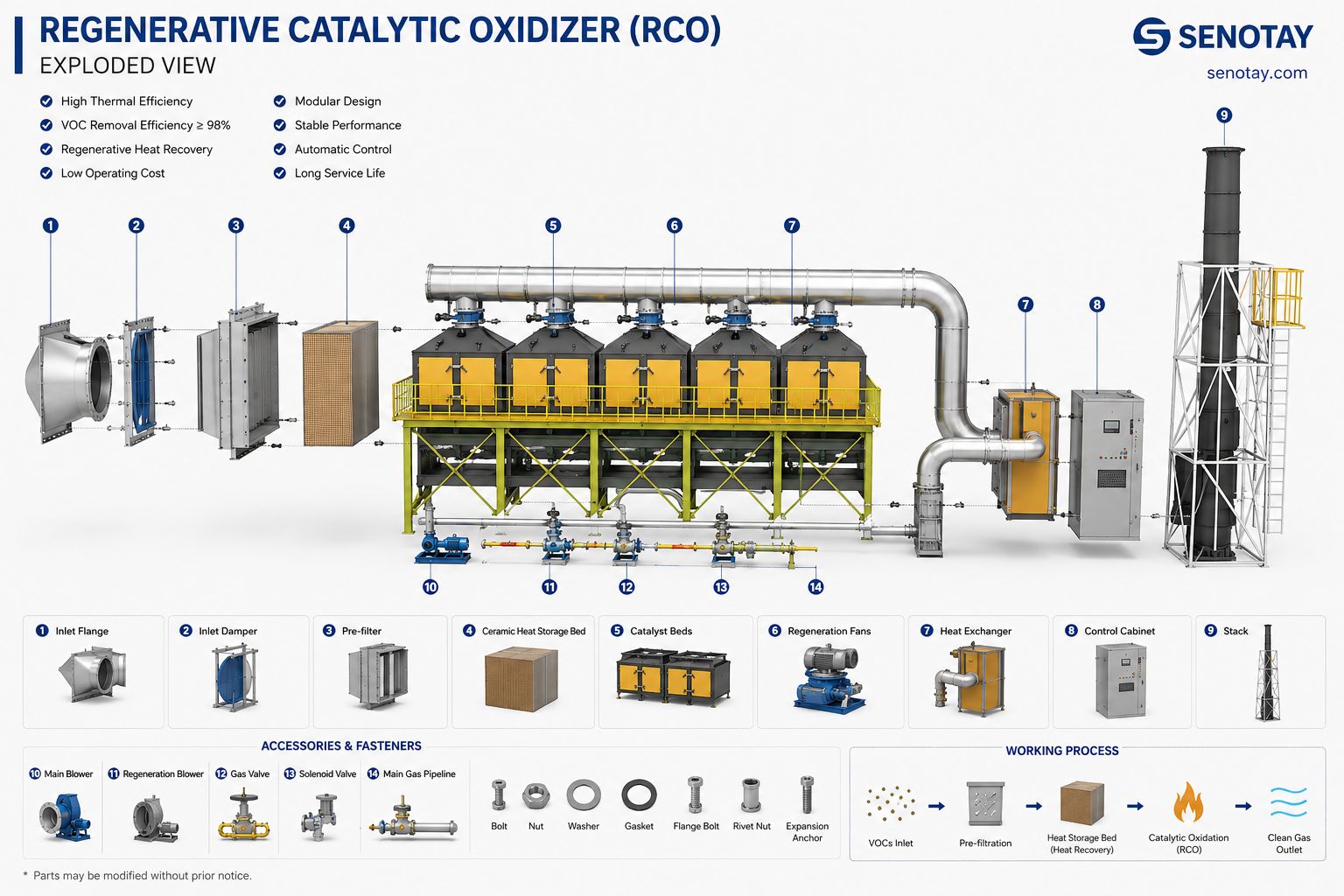
For procurement teams comparing VOC abatement technologies, the choice has real cost and compliance consequences:
The RCO advantage is clear: it runs at lower temperatures, so it burns less fuel; its regenerative heat recovery reclaims 85–97% of the thermal energy; and because the catalyst lets destruction happen at lower temperatures, NOx formation stays minimal.
Senotay (Hebei OuTai Environmental Protection Equipment Co., Ltd.) has built industrial dust collectors and air purification equipment since 2005, working out of a 15,000+ m² facility in Botou, Hebei. The company supplies 30+ industries across multiple continents, backed by factory-direct pricing and certified quality.
Senotay's RCO lineup covers 10 models with airflow from 5,000 to 80,000+ m³/h:
When a job demands simultaneous particulate filtration and VOC destruction in the same system, the HCC Series delivers:
VOC destruction efficiency >98%
Particulate removal >99.9%
Operating temperature 300–500°C
Degradation rate >99%
Explosion-proof construction and PLC-automated controls
For medium-concentration, steady VOC streams where an RCO's extra heat recovery would be overkill, the CO Series is a cost-effective alternative:
10 model sizes handling 3,000 to 40,000+ m³/h
VOC destruction 95–99%
Heat recovery 70–85%
Lower equipment cost and footprint
No middlemen, no markups. Because Senotay builds its RCO catalytic combustion equipment in-house, factory-direct pricing typically lands 30–50% below what Western and Japanese suppliers charge.
ISO 9001, ISO 14001, ISO 45001, and CE certifications mean every system meets international quality and safety standards. Each unit is engineered to satisfy EPA, EU, and local emission standards.
Most systems ship out within 48 hours from regional warehouses, with free shipping to most locations.
Lifetime technical support
Replacement catalysts and filters available
Remote troubleshooting included
8–15 year equipment lifespan
China's industrial equipment manufacturing ecosystem, especially in Hebei Province, allows integrated design, fabrication, and assembly under one roof. Easy access to major ports means rapid export fulfillment is never a bottleneck.
▪ VOC Purifier Series
▪ UV Light Oxygen Purifier | Activated Carbon Adsorption Box | Cyclone Mixing Spray Tower
▪ Cyclone Mixing Spray Tower | Regenerative Catalytic Oxidizer | Regenerative Thermal Oxidizer | Catalytic Oxidizer | Thermal Oxidizer
Q: What is the difference between RCO and RTO?
RCO relies on a catalyst to oxidize VOCs at 250–350°C, nearly half the temperature an RTO needs (750–850°C). That cuts fuel use considerably while holding ≥99% destruction efficiency.
Q: What VOC destruction efficiency can Senotay RCO systems achieve?
Senotay RCO systems reach up to 99% VOC removal and stay well within global emission standards.
Q: What is the typical lifespan of an RCO catalyst?
Senotay's noble metal honeycomb catalysts are documented to last 8–15 years.
Q: What airflow capacities are available?
Standard Senotay RCO systems cover 5,000 to 120,000 m³/h, and custom engineering handles anything larger.
Q: What certifications does Senotay hold?
Senotay is ISO 9001:2015, ISO 14001, ISO 45001, and CE certified, and its systems meet GB 31572 and EN 14181 emission standards.
Q: How does Senotay compare to Western RCO manufacturers?
Senotay delivers comparable quality and performance — think noble metal catalysts, ≥99% destruction efficiency, and 85–97% heat recovery — at factory-direct pricing that typically runs 30–50% below what Western suppliers charge.
Q: What industries use Senotay RCO equipment?
Coating, chemical, printing, electronics, petrochemical, automotive, pharmaceutical, packaging, and wood finishing, to name the main ones.
Around the world, VOC regulations are landing on the same target: 95–99% destruction efficiency. For plants in the coating, chemical, printing, and electronics sectors, the Regenerative Catalytic Oxidizer (RCO) and the Catalytic Combustion Dust Collector have become the technologies most teams turn to, and for good reason — they combine low-temperature operation, high-efficiency heat recovery, and proven compliance.
Senotay brings two decades of manufacturing experience to this technology. From its ISO-certified plant in Botou, China, the company ships RCO catalytic combustion equipment and Catalytic Combustion Dust Collectors that pair factory-direct pricing, certified quality, and comprehensive after-sales support. With airflow from 5,000 to 80,000+ m³/h and VOC destruction up to 99%, every Senotay system is engineered around the actual process conditions it will face — in industrial air pollution control, a one-size-fits-all approach simply doesn't work.
Ready to discuss your VOC abatement requirements?
Head to senotay.com or talk to Senotay's engineering team about a custom RCO or Catalytic Combustion setup built around your process conditions and emission targets.