
SENOTAY
PP Spray Tower Acid Mist Capture: Specification Guide
Specify acid-gas and acid-mist duties separately. Covers PP assembly compatibility, collection stages, HCl/NaOH stoichiometry, gas velocity, water boundaries and measurable acceptance criteria.
Acid-gas and acid-mist specification summary
PP spray tower acid mist capture starts with a clear description of the exhaust, not a general removal percentage. A process stream may contain dissolved-acid droplets, gas-phase contaminants, or both. Each requires an appropriate collection mechanism and a defined outlet test.
For buyers asking how to specify a PP scrubber for acid mist, the practical starting point is a pollutant-by-pollutant schedule. Establish the inlet conditions, distinguish absorption from aerosol capture, and ask suppliers to connect their proposed equipment to measurable acceptance criteria.
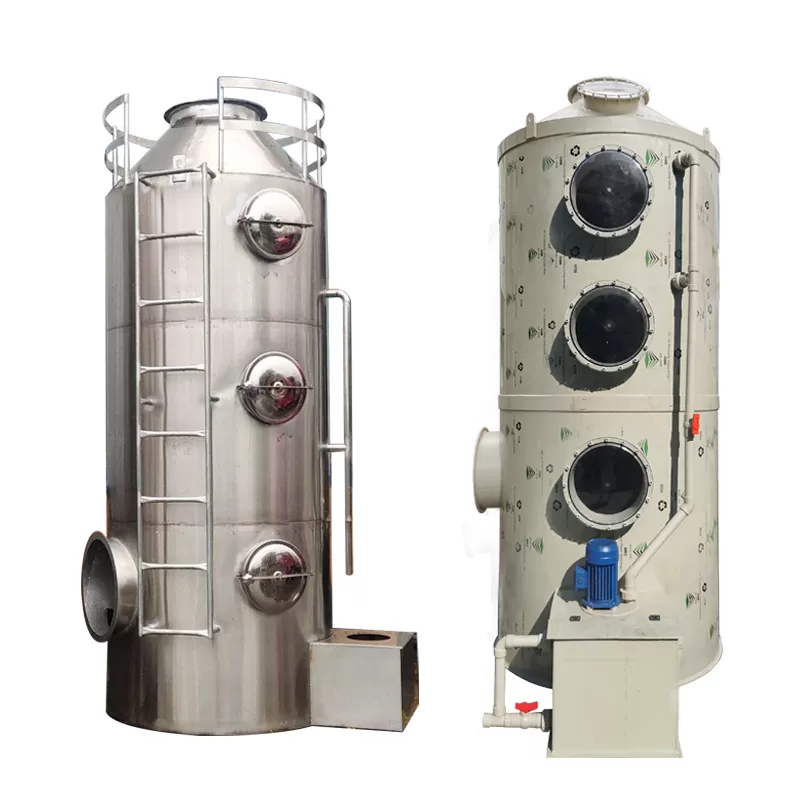
Two vertical scrubber vessels with different exterior finishes. The image does not establish either vessel’s polymer grade, internal collection stages or acid-mist performance.
1. Define the PP spray tower acid mist capture duty
A useful specification identifies what reaches the scrubber during normal production, peak loading, startup and cleaning. Include simultaneous contaminants and credible temperature excursions. A single acid name cannot describe every condition a tower will encounter.
Separate acid mist from gas-phase pollutants
Gas-phase hydrogen chloride can transfer into an absorbing liquid, where an alkaline reagent may neutralize the dissolved acid. The EPA guidance on gaseous wet scrubbing describes this absorption mechanism and the importance of gas–liquid contact.
Acid mist consists of suspended liquid droplets. These droplets must be collected from the gas stream. Their size distribution matters, including any fine or submicron fraction. A high HCl gas-removal result does not establish equivalent performance for an acid aerosol.
This distinction is central to acid gas versus acid mist removal. Ask whether the inlet analysis and proposed guarantee describe gas, mist or a method-defined total. Where both phases occur, specify how the test will account for them rather than combining unrelated performance figures.
Record the inlet and outlet measurement basis
Provide minimum, normal and maximum gas flow, temperature, pressure, moisture and contaminant loading. State whether flow is actual or referenced to specified standard conditions. Give the reference temperature and pressure rather than relying on “normal cubic metres” alone.
Likewise, identify wet or dry concentration basis and any required oxygen correction. Pair concentration with flow on a consistent basis when calculating mass loading. Agree on sampling locations, methods, process conditions and reporting limits before comparing quotations.
The applicable permit or project specification supplies the outlet requirement. There is no single concentration limit that applies to every acid, process and jurisdiction.
2. Specify the collection stages in PP spray towers
PP describes the construction material, while the internal arrangement determines the contact process. Commercially described PP spray towers may have open spray sections, packing, liquid distributors and one or more droplet-separation stages. Request a sectional drawing identifying the actual configuration.
In a packed absorber, liquid spreads over packing to provide contact area for soluble gases. The EPA packed-bed scrubber fact sheet explains the role of wetted packing and notes that particulate loading can constrain packed-bed applications through clogging.
Use the Senotay PP spray tower product page to discuss equipment options, then require a proposal tied to the specified duty. Descriptions of PP spray towers alone do not establish gas absorption, aerosol collection or material suitability for a particular exhaust.
Match aerosol collection to the droplet distribution
The EPA particulate wet-scrubber guidance distinguishes low-energy spray collection from systems intended for finer particles. Do not assume that an ordinary spray section will reliably collect a demanding submicron acid mist.
Ask for the collection basis across the relevant droplet sizes and loadings. If the proposed tower cannot meet that duty, the supplier should identify the additional collection stage or alternative process that needs evaluation. Any resulting guarantee must cover the complete treatment train.
An outlet demister removes entrained liquid droplets within its design envelope. It does not dry the gas, remove water vapor or guarantee collection of every fine aerosol. Request its type, design velocity range, drainage arrangement, expected pressure drop and access for inspection.
Also identify where the collection boundary ends. If cooling after the tower can form new aerosol, sampling location and downstream conditions need explicit treatment in the design review.
3. Check the complete wetted assembly
A PP shell designation is not a chemical-compatibility review. Require the proposed PP grade and written assessment of the actual chemical mixture, concentrations and temperatures, including cleaning fluids and excursions. Strongly oxidizing mixtures or unexpected contaminants deserve specific review rather than an assumption of universal resistance.
The review should cover shell, welds, packing, supports, distributors, nozzles, pump components, seals, gaskets, instruments, pipework and demister. Include gas-side components exposed to condensation. One unsuitable seal or instrument connection can limit an otherwise compatible assembly.
Ask the supplier to state the design temperature and pressure or vacuum conditions, together with the supporting material and mechanical design basis. Evaluate outdoor exposure, freezing risk, structural support and thermal movement where relevant. Do not translate a general polymer temperature rating into an allowable temperature for the assembled tower.
For a replacement installation, document the previous equipment's failure locations and operating history. Corrosion, abrasion, mechanical stress and poor drainage can require different corrective actions. Specify inspections and maintainable access rather than relying on a universal service-life estimate.
Before approval, obtain a marked-up wetted-parts schedule showing accepted materials and unresolved items. Assign responsibility for closing each item before manufacture. This makes compatibility a reviewable deliverable rather than a marketing description.
4. Screen loads without turning examples into guarantees
Preliminary calculations can expose inconsistent assumptions and help suppliers scope an inquiry. They cannot replace pollutant-specific design, hydraulic assessment or performance testing. Keep every assumed input visible so that an illustrative calculation is not mistaken for a selected operating condition.
A hypothetical HCl and NaOH mass balance
Consider an exhaust containing gas-phase HCl only for this calculation. Assume a gas flow of 10,000 m³/h and an inlet HCl concentration of 500 mg/m³. Both values use the same temperature, pressure and moisture basis. Assume 98% gas-phase capture solely to illustrate the arithmetic.
Inlet HCl load: 10,000 × 500 ÷ 1,000,000 = 5.0 kg/h.
Assumed captured HCl: 5.0 × 0.98 = 4.9 kg/h.
Reaction basis: HCl + NaOH → NaCl + H₂O, with one mole of NaOH per mole of HCl.
Theoretical pure NaOH equivalent: 4.9 × 40.00 ÷ 36.46 = approximately 5.376 kg/h.
This is a stoichiometric screening result, not a reagent dosing instruction or prediction of acid mist collection. The assumed 98% capture is neither a measured result nor a performance promise. The calculation also does not determine commercial solution flow, storage capacity or control settings.
Real reagent demand depends on the complete chemistry and operating conditions. Other acids consume alkalinity. Carbon dioxide absorption can convert hydroxide to carbonate, changing the liquor's alkalinity composition and control response. Reagent strength, salt accumulation, blowdown and the required control margin also need engineering evaluation.
A qualified designer should establish the chemical system, instrumentation, safeguards and operating procedure from the actual duty. A theoretical mass balance should never be used alone to set a chemical feed rate.
For a separate geometry check, 12,000 actual m³/h through a 1.8 m internal diameter gives an empty cross-sectional area of π × 1.8² ÷ 4 = 2.5447 m². The corresponding superficial velocity is 12,000 ÷ 3,600 ÷ 2.5447, or approximately 1.31 m/s.
This velocity is an illustration, not a recommendation. It uses actual flow at the section being assessed and the full empty cross-section, not the local velocity between packing elements. The selected diameter still requires checks against the chosen internals, liquid loading, pressure drop, flooding margin and droplet carryover.
5. Write a measurable purchase and acceptance schedule
A useful quotation links each outlet target to its inlet envelope and test basis. List gas-phase pollutants and mist requirements separately where the measurement method supports that distinction. State the production conditions during testing, the responsible testing party and the action required if acceptance criteria are not met.
Define the supply boundary: extraction connections, ductwork, fan, tower, circulation equipment, chemical system, instruments, drains and wastewater interfaces. Also identify who verifies capture at the process source. A scrubber outlet test does not establish that the upstream hood collects the full emission stream.
Request a proposed monitoring schedule tied to commissioning results. Relevant measurements may include pressure drop, circulating-liquid flow, gas flow, liquid chemistry and makeup or blowdown. Alarm limits and responses should follow the selected design and operating procedures; they should not be copied from an unrelated installation.
Keep circulating-liquid flow separate from freshwater demand. Ask for a water balance covering evaporation, carryover, makeup and blowdown, with a defined wastewater route. Recirculation alone does not establish a fixed water-saving percentage or eliminate waste treatment.
For operating questions about liquid distribution and flow balance, use the separate wet-scrubber liquid-to-gas ratio guide. This specification should establish the design envelope and acceptance evidence before operating adjustments are considered.
Send the inlet schedule, proposed outlet requirements and installation constraints through Senotay technical help. Ask for a documented selection and a list of missing information before final design approval.
Key takeaways
Separate gas absorption from acid-droplet collection.
Describe droplet sizes, pollutant loading and the full operating envelope.
Verify the PP grade and every exposed component against the chemistry.
Treat calculations as screening examples, not operating instructions.
Require testable outlet criteria and a complete water and waste boundary.
6. Frequently asked questions
What is the main distinction in acid gas versus acid mist removal?
A gas-phase pollutant is absorbed into a suitable liquid. Acid mist requires collection of suspended liquid droplets. A mixed exhaust may need both functions, with performance demonstrated for the relevant phases and sampling method.
Can PP spray towers guarantee submicron acid mist capture?
The material name cannot establish that capability. Require evidence for the actual droplet distribution and selected collection stages. A standard spray section or general-purpose demister should not be assumed to satisfy a demanding submicron duty.
What information explains how to specify a PP scrubber for acid mist?
Start with contaminant identities and phases, droplet-size information, gas flow and measurement basis, temperature, moisture, inlet loading and outlet requirements. Add chemical compatibility, utilities, layout, wastewater responsibilities and an agreed acceptance-test schedule.
Does the theoretical NaOH calculation determine operating consumption?
No. It calculates a pure-reagent equivalent for an assumed gas-phase HCl load and capture rate. Actual consumption and control settings require the full chemistry, reagent properties and engineered operating basis. The calculation provides no acid aerosol efficiency rating.
Request a quote
Discuss your project with SENOTAY
Send your application and equipment requirements through our contact page.