
EN
What are you looking for?
A municipal waste-to-energy plant in Southeast Asia was sliding toward a compliance crisis. Its dry electrostatic precipitator (ESP) handled coarse particulates well enough, but it could not capture the sub-micron ash, acid mist, and sticky aerosols that saturated its flue gas stream.
Three problems stacked up. First, the flue gas emerged from the wet flue gas desulfurization (FGD) system fully saturated with moisture, exactly the condition that makes a dry ESP spark, foul, and lose efficiency. Second, the sulfuric acid mist (H₂SO₄) and ammonium salt aerosols, byproducts of combustion, were far too fine for the mechanical rapping system to handle effectively. Third, the sticky, corrosive nature of the particulate caked onto the collection plates, and the rappers could not dislodge it, so the plant shut down every month for manual cleaning.
Outlet dust kept running above the 10 mg/Nm³ regulatory limit, putting the operating permit at risk. The plant needed a solution that could capture sub-micron particles and acid mist, operate reliably in saturated gas, and deliver consistent, ultra-low emissions without the maintenance burden of a dry ESP. That meant a wet electrostatic precipitator (WESP), and a partner who could engineer, fabricate, and commission one around their process.
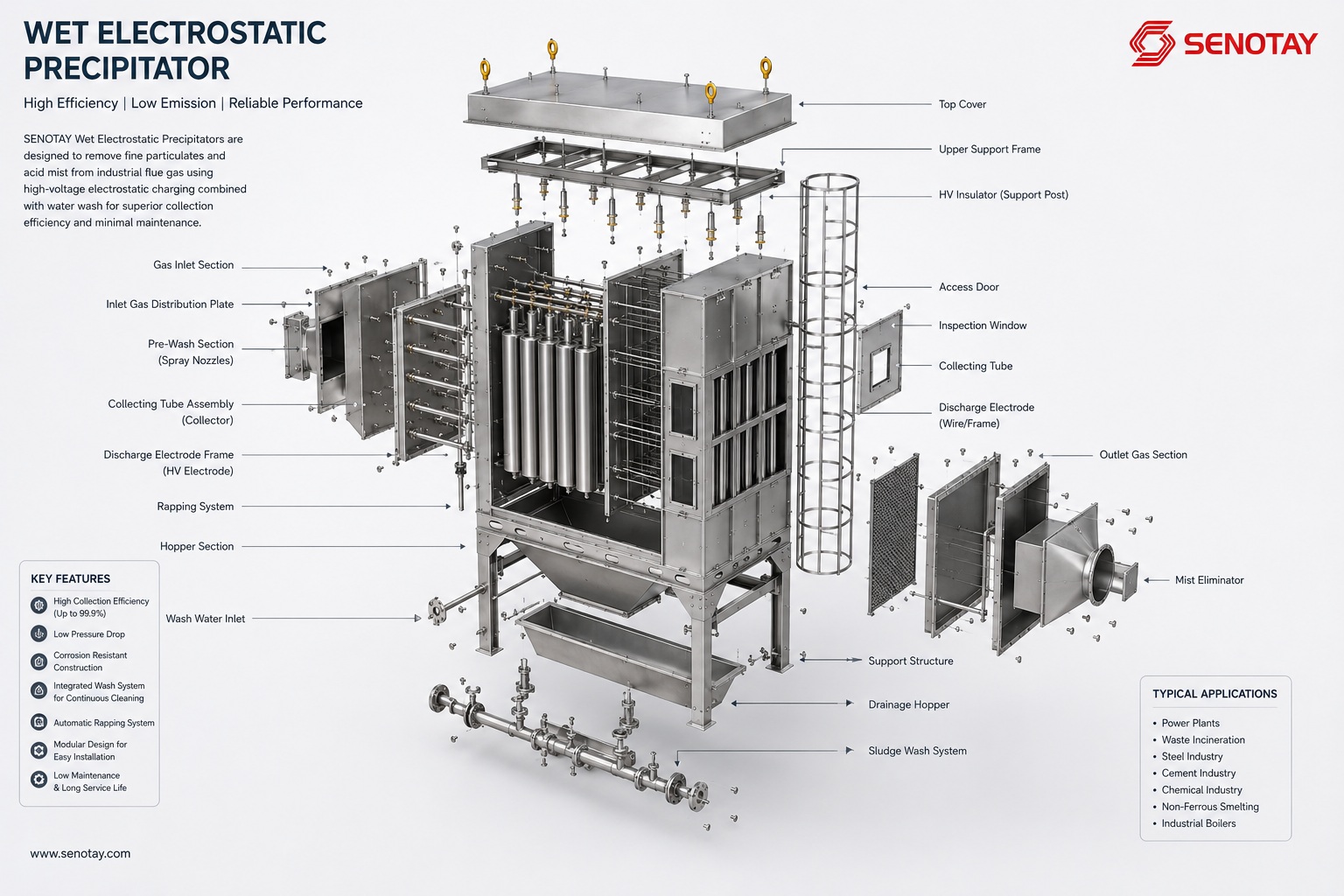
Senotay (senotay.com), a Chinese manufacturer of industrial dust collectors and air filtration equipment since 2005, proposed a complete WESP system. The key difference from a dry ESP is simple: instead of mechanical rappers, the collection surfaces stay under a continuously maintained water film that washes captured particulate away. That water wash keeps the electrodes clean even when the gas is sticky, corrosive, or already saturated with moisture.
The Senotay WESP operates through a precisely controlled four-stage process:
Ionization: high-voltage discharge electrodes running at 30–110 kV ionize the gas molecules as flue gas flows through. The corona discharge creates a flow of electrons that collide with and charge the particulate matter.
Collection: charged particles migrate through the electric field toward grounded collection plates or tubes. The field intensity, typically maintained between 2 and 5 kV/cm, determines collection efficiency.
Washing: a thin film of water continuously washes the collection surface, carrying captured material to a drain or recycle loop. The flushing water pH, conductivity, and chemical composition are controlled; for acid mist applications, alkaline flushing water at pH 8–9 neutralizes the captured acids.
Recovery: the collected slurry is dewatered or treated, and clean gas exits with outlet concentrations consistently below regulatory limits.
Senotay WESP control system integrates three interconnected layers:
High-Voltage Control System: manages the transformer-rectifier (T/R) unit, regulating voltage and current to maintain optimal corona discharge while suppressing sparking. Constant-current power supplies ensure stable operation even under fluctuating gas conditions, and the spark control can rapidly and completely extinguish an arc discharge, protecting the electrodes and maintaining collection efficiency.
Low-Voltage Control System: oversees the auxiliary equipment, including the flushing pump, water treatment system, and rapper where applicable. The flushing cycle is programmed to the process, typically every 30–120 minutes, with high-flow flush cycles at 2–5 L/m²·min.
Monitoring & Diagnostics: continuously tracks the key parameters, secondary voltage, secondary current, gas flow rate, pressure drop, and outlet dust concentration. The system raises real-time alerts on any deviation and keeps a complete operational log for regulatory compliance.
The plant received its Senotay WESP within the agreed timeline, and commissioning and performance testing confirmed the results:
The Senotay WESP now operates continuously, with automated flushing cycles keeping the collection surfaces clean without operator intervention. The plant has achieved full regulatory compliance, eliminated unplanned shutdowns, and reduced maintenance costs by over 60%.
Senotay, operating as Hebei OuTai Environmental Protection Equipment Co., Ltd., has been manufacturing industrial dust collectors and air filtration equipment for over 15 years. Its 15,000+ m² facility in Botou, Hebei Province, produces the full spectrum of dust removal equipment:
Pulse Jet Bag Filters (standard, high-temperature, anti-static)
Electrostatic Precipitators (ESP), dry and wet configurations
Cyclone Dust Collectors
Wet Dust Collectors (scrubbers)
Filter Cartridge Collectors
VOC Purifiers
ISO 9001:2015, Quality Management System
ISO 14001, Environmental Management
ISO 45001, Occupational Health & Safety
CE Certified, European market compliance
Every Senotay collector goes through a rigorous process that begins with an engineering analysis of the specific process conditions and ends with a documented pre-shipment test record. Senotay does not produce generic catalogue units; every system is sized for the actual gas volume, temperature, pollutant load, and emission limit it will face.
Senotay serves 30+ industries across multiple continents, including:
Power generation (coal, biomass, waste-to-energy)
Cement manufacturing
Steel and iron production
Chemical and petrochemical processing
Waste incineration
Metallurgical processing
Q: What is a wet electrostatic precipitator (WESP)?
A WESP is an air pollution control device that removes sub-micron particulate, acid mist, and aerosols from industrial exhaust using electrostatic forces and continuous water flushing. Unlike dry ESPs, it uses a water film to clean the collection surfaces, which makes it effective for sticky, corrosive, or saturated gas streams.
Q: How does a WESP differ from a dry ESP?
A dry ESP uses mechanical rapping to knock collected dust off the collection plates; a WESP washes the surfaces with water instead. Wet wins whenever the dust is sticky, moist, or corrosive, conditions that cause dry ESPs to foul.
Q: What emission levels can Senotay WESP systems achieve?
Senotay WESP systems achieve outlet dust concentrations below 10 mg/Nm³, with removal efficiencies exceeding 95%. Advanced configurations can reach 99%+ efficiency.
Q: What industries benefit most from WESP technology?
Power generation (coal, biomass, waste-to-energy), cement, steel, chemical processing, waste incineration, and metallurgy, especially where the flue gas is saturated or contains acid mist.
Q: What certifications does Senotay hold?
ISO 9001:2015, ISO 14001, ISO 45001, and CE certified.
Q: Can Senotay customize WESP systems for specific applications?
Yes. Every Senotay WESP is custom-engineered for the actual gas volume, temperature, pollutant type, and emission limits.
The wet electrostatic precipitator is the premier solution for capturing sub-micron mist, acid droplets, and ultra-fine aerosols that slip past conventional dry ESPs and baghouses. When gas streams are saturated, sticky, or corrosive, and emissions standards demand sub-10 mg/Nm³ performance, a WESP is not optional; it is essential.
Senotay brings two decades of manufacturing excellence to this critical technology. From its ISO-certified facility in Botou, China, the company delivers WESP systems that combine custom engineering, certified quality, and comprehensive control systems, including PLC automation, V-I power control, and programmable flushing cycles.
Every Senotay WESP is sized for the specific process conditions it will face, because in industrial air pollution control, one size does not fit all.
Ready to discuss your WESP requirements? Visit senotay.com or contact Senotay's engineering team for a customized solution engineered to your process conditions and emission targets.