
EN
What are you looking for?
In industrial air pollution control, efficiency is the one number that decides regulatory compliance, operating cost, and environmental impact. For power generation, cement manufacturing, steel production, and chemical processing, the electrostatic dust collector (ESP) is still the go-to technology for removing high volumes of particulates.
But not every ESP system performs the same. The gap between 99.5% and 99.9% collection efficiency can look trivial on paper. In real-world emissions, however, that 0.4% difference is an 80% reduction in particulate emissions, from 0.5% down to 0.1% of total PM. With global emission standards tightening and targets moving toward 10 mg/Nm³ and below, that difference is the line between staying compliant and being shut down.
Senotay (senotay.com), a Chinese manufacturer of industrial dust collectors and air filtration equipment since 2005, has built a global reputation by mastering this efficiency equation. Working from a 15,000+ m² ISO 9001:2015, ISO 14001, and ISO 45001 certified facility in Botou, Hebei, Senotay engineers electrostatic dust collectors that reach 99.7% to 99.9% collection efficiency, with outlet concentrations consistently below 10 mg/Nm³.
This guide digs into the science behind ESP dust collector efficiency, the factors that drive performance, and why Senotay's HES and HWES Series stand out in global supply and engineering expertise.
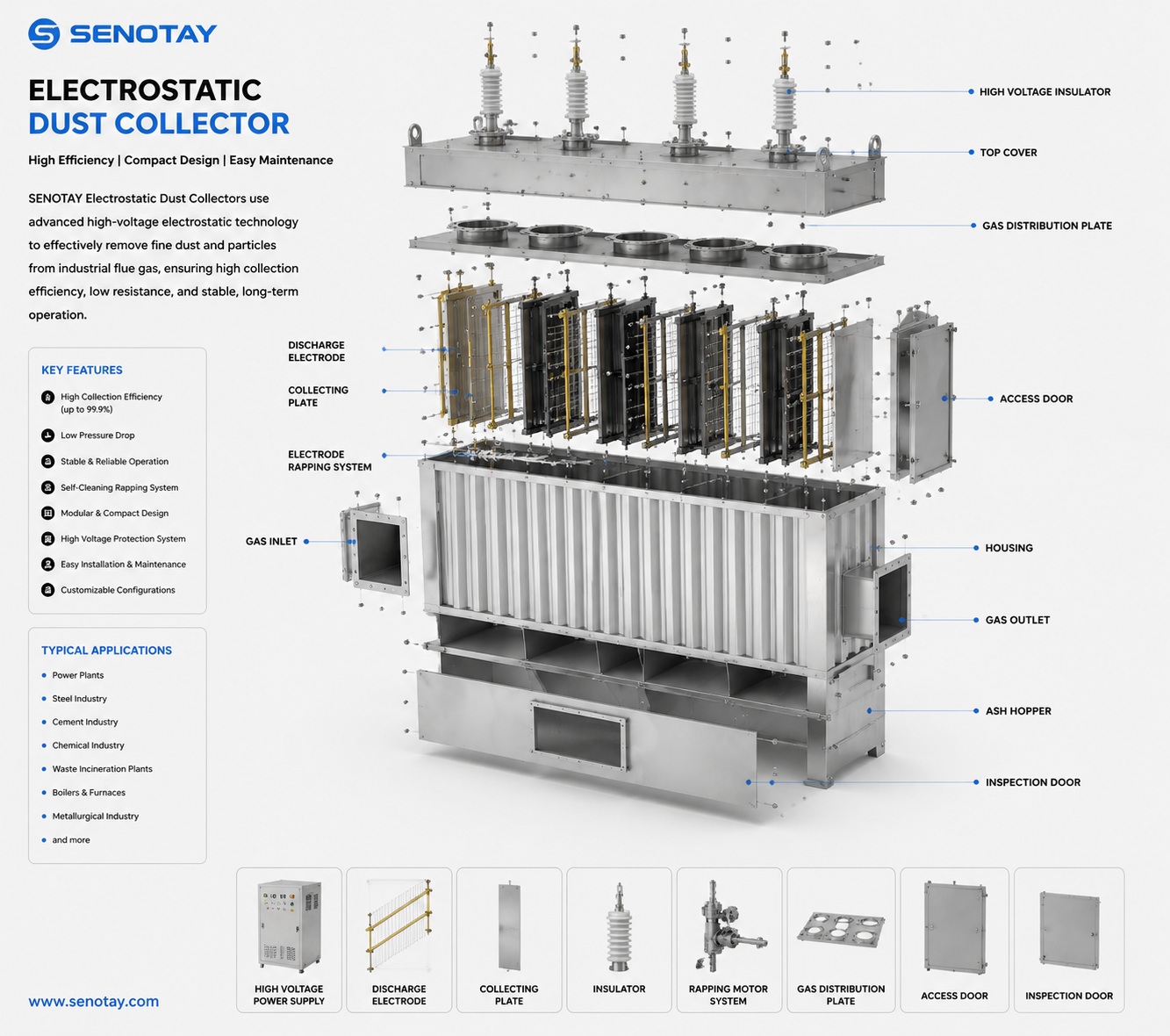
The performance of an electrostatic precipitator is governed by the Deutsch equation, which ties collection efficiency to three fundamental parameters:
η = 1 − e^(−ω × A / Q)
Where:
η = collection efficiency
ω = particle migration velocity (m/s)
A = total collection electrode surface area (m²)
Q = volumetric gas flow rate (m³/s)
The equation points to the three main levers for improving ESP dust collector efficiency:
Industry benchmarks show what a well-designed ESP system can do:
Typical new equipment design efficiencies: 99% to 99.9%
Dry and wet ESPs: 99% to greater than 99.9% PM removal
Submicron particle capture: 90% to 95% efficiency
Particles of 5 µm: efficiency increases linearly to 99.9%
PM₁ capture: efficiency greater than 96.5%
PM₁₀ capture: efficiency exceeding 99%
Senotay's HES and HWES Series consistently hit 99.7% to 99.9% collection efficiency, with outlet dust concentrations below 10 mg/Nm³, meeting even the strictest international emission standards.
Dust resistivity is among the most critical factors in ESP performance. An ESP works most efficiently when dust resistivity sits in the range of roughly 10⁷ to 10¹⁰ ohm·cm. Dry ESPs typically perform best between 5 × 10³ and 2 × 10¹⁰ ohm·cm.
Too low (<10⁴ Ω·cm): Particles lose charge too quickly, causing re-entrainment
Too high (>10¹¹ Ω·cm): Particles retain charge, creating back-corona that reduces efficiency
Senotay designs every ESP system around resistivity analysis, tailoring electrode spacing and voltage to the specific dust profile. For tough applications where resistivity can spike, such as cement kiln dust, Senotay's wet ESP (WESP) systems offer an alternative, using water flushing to keep resistivity problems in check.
Gas velocity through the ESP has a direct effect on particle collection. Push the velocity too high and residence time drops, letting particles slip through before they can be collected.
Optimal velocity: 3 to 5 ft/sec (approximately 1.0–1.5 m/s), allowing treatment time greater than 10 seconds
Collection zone velocity: 1.0–2.5 m/s; higher velocities risk particle re-entrainment
For each application, Senotay's engineering team works out the optimal specific collection area (SCA), typically 80–160 m²/(m³/s) for demanding sub-5 mg/Nm³ targets, so the gas spends enough time in the field to be collected effectively.
The geometry and configuration of the discharge and collection electrodes have a significant impact on efficiency. Research shows that:
Corrugated collecting plates enhance electric field strength, favoring particle charging and accelerating deposition
Hole-hole electrode structures exhibit higher peak currents at the same voltage
Optimized discharge electrode shapes can increase collection efficiency by approximately 20%
Senotay manufactures its high-performance ESP components in-house, including precision cathode wires that run at 20–70 kV DC for maximum particulate ionization, and durable dust collecting plates that act as the primary accumulation surface. That vertical integration keeps quality control in-house across every efficiency-critical component.
Temperature affects both the gas properties and dust resistivity. Senotay's HWES Series uses thermally engineered casing and high-tensile alloy electrodes that handle continuous flue gas temperatures up to 450°C (customizable to 650°C), so efficiency stays consistent even in demanding high-temperature applications.
The mechanical rapping system that periodically knocks accumulated dust off the collection plates has to be reliable and effective. Senotay manufactures ESP rapping hammers, also known as vibrating hammers, designed to remove the dust layers that cling to collecting electrodes and discharge wires, keeping the electrode surfaces clean and efficiency high over decades of operation.
Senotay, operating as Hebei OuTai Environmental Protection Equipment Co., Ltd., has been at the forefront of industrial dust collection since 2005. Its 15,000+ m² manufacturing facility produces the full range of dust removal equipment:
Electrostatic Precipitators (ESP) —dry and wet configurations, horizontal and vertical designs
Pulse Jet Bag Filters (standard, high-temperature, anti-static)
Cyclone Dust Collectors
Wet Dust Collectors (scrubbers)
Filter Cartridge Collectors
VOC Purifiers
ISO 9001:2015 — Quality Management System
ISO 14001 — Environmental Management
ISO 45001 — Occupational Health & Safety
CE Certified — European market compliance
Every Senotay ESP system goes through a rigorous engineering process. It starts with an analysis of the actual process conditions, gas volume, temperature, dust type, resistivity, and emission limits, and it ends with a documented pre-shipment test record. Senotay does not build generic catalogue units. Every system is custom-engineered for the conditions it will actually face.
Senotay serves 30+ industries across multiple continents:
Power Generation: Coal-fired and biomass boiler flue gas
Cement Manufacturing: Kiln dust, clinker coolers, raw mills
Steel & Iron Production: Sinter plants, blast furnaces, electric arc furnaces
Chemical & Petrochemical: Process off-gases, catalyst recovery
Waste Incineration: Municipal and hazardous waste flue gas
The ESP advantage is straightforward: lower energy consumption at 0.2–0.4 kWh per 1,000 m³, no filter bags to replace, continuous 24/7 operation, and 20+ years of service life.
Q: What is an electrostatic dust collector (ESP)?
An ESP is an air pollution control device that removes fine particulate from industrial exhaust with electrostatic forces. Dust particles get ionized by high-voltage discharge electrodes and then collect on grounded plates.
Q: What efficiency can Senotay ESP systems achieve?
Senotay's HES and HWES Series reach 99.7% to 99.9% collection efficiency, with outlet concentrations below 10 mg/Nm³.
Q: What factors most affect ESP dust collector efficiency?
Dust resistivity, gas velocity, electrode configuration, temperature, and rapping system performance are the primary factors.
Q: What is the difference between dry ESP and wet ESP?
Dry ESPs use mechanical rapping to knock collected dust off the plates. Wet ESPs (WESP) rely on continuous water flushing instead, which makes them ideal for sticky, corrosive, or saturated gas streams where a dry ESP would foul.
Q: What industries use Senotay ESP systems?
Power generation, cement manufacturing, steel production, chemical processing, and waste incineration.
Q: What certifications does Senotay hold?
ISO 9001:2015, ISO 14001, ISO 45001, and CE certification.
Q: How does ESP compare to baghouse filters?
ESPs operate at much lower pressure drop, 50–150 Pa versus 500–1500 Pa, have no bags to replace, and offer 20+ year service life. They are especially attractive for gas volumes above 500,000 m³/h and temperatures above 250°C.
ESP dust collector efficiency is not a fixed specification you can set and forget. It is the product of careful engineering, precise component manufacturing, and a real understanding of process conditions. From dust resistivity to electrode geometry, every variable has to be optimized to hit the 99.7% to 99.9% collection efficiencies that modern emission standards require.
Senotay brings two decades of manufacturing experience to this critical technology. From its ISO-certified facility in Botou, China, the company supplies electrostatic dust collectors that combine custom engineering, certified quality, and comprehensive after-sales support. Every Senotay ESP is sized for the specific process conditions it will face, because in industrial air pollution control, one size does not fit all.
Ready to talk about your ESP requirements?
Visit senotay.com or contact Senotay's engineering team for a customized solution built around your process conditions and emission targets.