
EN
What are you looking for?
Industrial dust is one of the quietest costs a factory ever pays. It gums up machinery, puts workers' health on the line, and—when the particles are combustible—can turn a routine shift into a serious incident. Yet plenty of facilities keep postponing air-filtration upgrades, because traditional setups like baghouses come across as big, pricey, one-off projects that demand acres of floor space and a complicated installation.
Tighter emission rules are compounding the problem. A baghouse filters through large fabric bags packed inside an enormous enclosure—it handles heavy dust loads well, but it swallows floor space and makes each filter change a slow, laborious job. For applications involving fine, toxic, or hazardous particulates—such as weld fume, pharmaceutical powders, or food-processing dust—a baghouse routinely falls short of the sub-micron capture levels that today's standards demand.
A mid-sized metal fabrication shop in Southeast Asia was living exactly these pressures. Its old baghouse ate up over 200 m² of floor space, and each filter swap cost 8 hours of downtime per filter change, yet it still couldn't reliably catch the sub-micron welding fume that was endangering workers and threatening regulatory compliance. What the plant really needed was a system that could deliver 99.9%+ filtration efficiency on fine dust, squeeze into about half the footprint, and cut maintenance downtime without sacrificing airflow capacity.
That's where Senotay came in.
Senotay (senotay.com) — a Chinese manufacturer of industrial dust collectors and air-filtration equipment that has been in business since 2005 — proposed a complete cartridge dust collector solution. Rather than the large fabric bags a baghouse depends on, a cartridge collector pulls the air through pleated filter cartridges made from cellulose, polyester, or nano-fiber media. The pleating packs a significant amount of surface area (up to 300 sq. ft. of media per cartridge) into a cartridge that stays compact, and that geometry is what gives cartridge systems their defining advantages: superior sub-micron capture, dramatically smaller footprint, and faster maintenance.
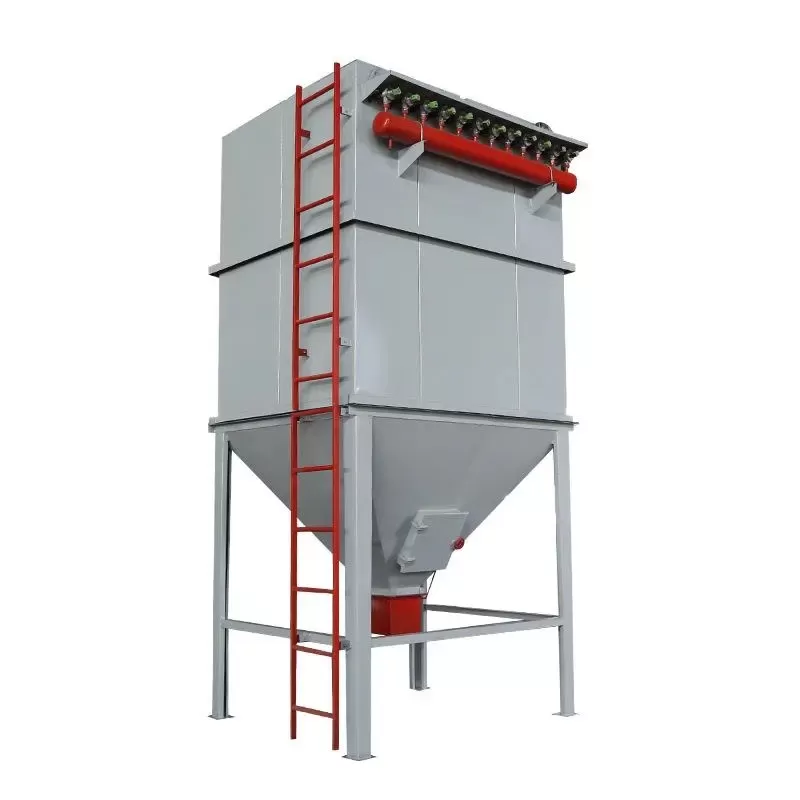
The basic concept is simple, but it's engineered for continuous, high-efficiency duty:
This self-cleaning process keeps airflow efficiency high and extends filter life without ever forcing a production shutdown. How well the pulse-jet cleaning performs, in turn, has an outsized effect on the unit's overall effectiveness, its energy use, and how long the filters hold up — which is why Senotay's engineering gives nozzle geometry close attention, working to keep residual pressure drop low, stretch the cleaning cycle, and lift overall collection efficiency.
Senotay's cartridge collectors start from modular configurations — standardized units that can be combined, expanded, and rearranged. Start with a base unit sized to today's airflow; when demand climbs, add matching filter modules rather than replacing the whole installation.
The table below lines up the two approaches on the metrics that matter most — performance and cost:
The cartridge advantage is clear: when a process demands fine and sub-micron dust control, space efficiency, or lower energy consumption, the cartridge collector wins on performance and keeps operating costs down.
Independent research backs this up. In a NIOSH study, nanofiber cartridge systems achieved 99.97% efficiency at 1 micron, while a standard pulse-jet baghouse managed only 98.7% at the same particle size. At heavier dust loads, the baghouse keeps an edge — but for most manufacturing jobs that involve fine dust, the cartridge collector is the stronger choice.
Senotay's pulse jet cartridge dust collectors can be found across 30+ industries wherever fine dust, fumes, or sub-micron particulate needs high-efficiency capture:
The system's ability to capture particles down to 0.3 microns with HEPA-grade media makes it especially well suited to applications where genuinely clean air and strict air-quality standards are non-negotiable.
Senotay builds its full range of cartridge dust collectors at its 15,000+ m² ISO 9001:2015, ISO 14001, and ISO 45001 certified facility in Botou, Hebei. Every unit is custom-engineered, in-house fabricated, and pre-shipment tested before it ever leaves the factory.
No middlemen, no markups. Senotay makes its cartridge dust collectors in-house, so the factory-direct pricing typically undercuts Western suppliers by 30–50%.
Senotay holds the ISO 9001:2015, ISO 14001, ISO 45001, and CE certifications. Every machine is built to international quality and safety standards and leaves with documented pre-shipment testing.
Standard configurations ship within 48 hours from regional distribution centers, with freight covered to qualifying destinations. Each module uses heavy-gauge welded construction, offers high-efficiency cartridge or bag filtration options, and runs an independent pulse-jet cleaning system in parallel.
Lifetime technical consultation
Replacement cartridges available with quick six-ear release mechanisms
PLC-based control with auto pulse-jet cleaning and real-time differential pressure monitoring
Remote diagnostics and troubleshooting
Senotay's catalog spans the whole spectrum of industrial dust removal and air purification:
Pulse Jet Bag Filters (standard, high-temperature, anti-static)
Electrostatic Precipitators (ESP)
Cyclone Dust Collectors
Filter Cartridge Collectors
Wet Dust Collectors (scrubbers)
VOC Purifiers
Q: What is a pulse jet cartridge dust collector?
It's a filtration system that captures fine dust and fumes through pleated filter cartridges. Short, high-velocity pulses of compressed air periodically clean the cartridges, so efficiency holds up without any production downtime.
Q: What efficiency can Senotay cartridge collectors achieve?
Senotay cartridge collectors deliver 99.9%+ filtration efficiency and can pull sub-micron particles down to 0.3 microns with HEPA-grade media.
Q: How does a cartridge collector compare to a baghouse?
Cartridge collectors bring up to 50% smaller footprint, 15–30% lower energy consumption, and superior fine-particle capture (99.97% vs. 98.7% at 1 micron). Baghouses are the better choice for very high dust loads and very large air volumes.
Q: What industries use Senotay cartridge collectors?
Metalworking (welding, grinding), pharmaceutical, food processing, woodworking, electronics, chemical processing, and automotive.
Q: What certifications does Senotay hold?
ISO 9001:2015, ISO 14001, ISO 45001, and CE certified.
Q: Can Senotay customize cartridge collectors for specific applications?
Yes — every Senotay unit is engineered around your actual gas volume, temperature, dust type, and emission limits. And because the designs are modular, capacity can grow right along with your production.
Q: How often do cartridges need replacement?
Filter life depends on the dust type, the loading, and how well the pulse cleaning works — usually 6–18 months. Senotay's pulse-jet cleaning helps cartridges last longer by keeping residual pressure drop low and cleaning more effectively.
For manufacturing operations that need fine and sub-micron dust control, space efficiency, and lower energy consumption, the pulse jet cartridge dust collector is the clear front-runner. With 99.9%+ filtration efficiency, up to 50% smaller footprint versus a baghouse, and 15–30% lower energy use, it delivers better performance at a lower operating cost.
Senotay brings two decades of manufacturing experience to this technology. From its ISO-certified plant in Botou, China, the company ships pulse jet cartridge dust collectors that bring together factory-direct pricing, certified quality, modular scalability, and comprehensive after-sales support. With airflow from 500 to 50,000 m³/h and filtration up to 99.9%+ at sub-micron levels, every Senotay system is tuned to the specific conditions it will face — because in industrial dust control, one size never fits all.
Ready to discuss your cartridge dust collector requirements?
Head to senotay.com or reach out to Senotay's engineering team and they'll build a solution tailored to your process conditions and emission targets.