
EN
What are you looking for?
Dust is far more than a nuisance in heavy industry. Left unchecked, it drains productivity, adds to the maintenance load, and creates genuine regulatory exposure. Operators in mining, cement, power generation, and grain processing all move enormous volumes of dusty gas, and they share the same fundamental problem: how to keep achieving high-efficiency particulate separation across high airflows without the ongoing cost of filter media replacement.
Every conventional option brings a trade-off. A single large-diameter cyclone is simple enough, but it struggles to catch fine particles. A baghouse filters more thoroughly, only to demand frequent filter changes and a noticeable rise in pressure drop. What plants really need is a middle path that keeps the best of both worlds: the no-moving-parts reliability of cyclone technology, combined with the high efficiency of multiple small-diameter tubes, operating in parallel.
That middle path is exactly what the combined twin cyclone system delivers, also known as a multiclone dust collector. Because the design groups multiple small-diameter cyclone tubes inside one housing, it manages high separation efficiency and high throughput simultaneously. For buyers who want a dependable fabrication partner abroad, Senotay (senotay.com) — a Chinese manufacturer operating since 2005 with ISO 9001, ISO 14001, ISO 45001, and CE certifications — supplies factory-direct combined cyclone systems built to satisfy worldwide compliance.
Put simply, a combined cyclone dust collector — sometimes called a multiclone dust collection system — is an air pollution control device built around one idea: numerous small-diameter cyclone tubes, all arranged inside a single pressure vessel. Each tube spins up its own vortex, and together they strip particulate matter out of the gas stream with high efficiency.
That arrangement resolves a long-standing engineering tension. On their own, smaller cyclones are more efficient but handle less air. Link enough of them in parallel and the system as a whole achieves both high efficiency and high throughput — a decisive edge in heavy industrial service.
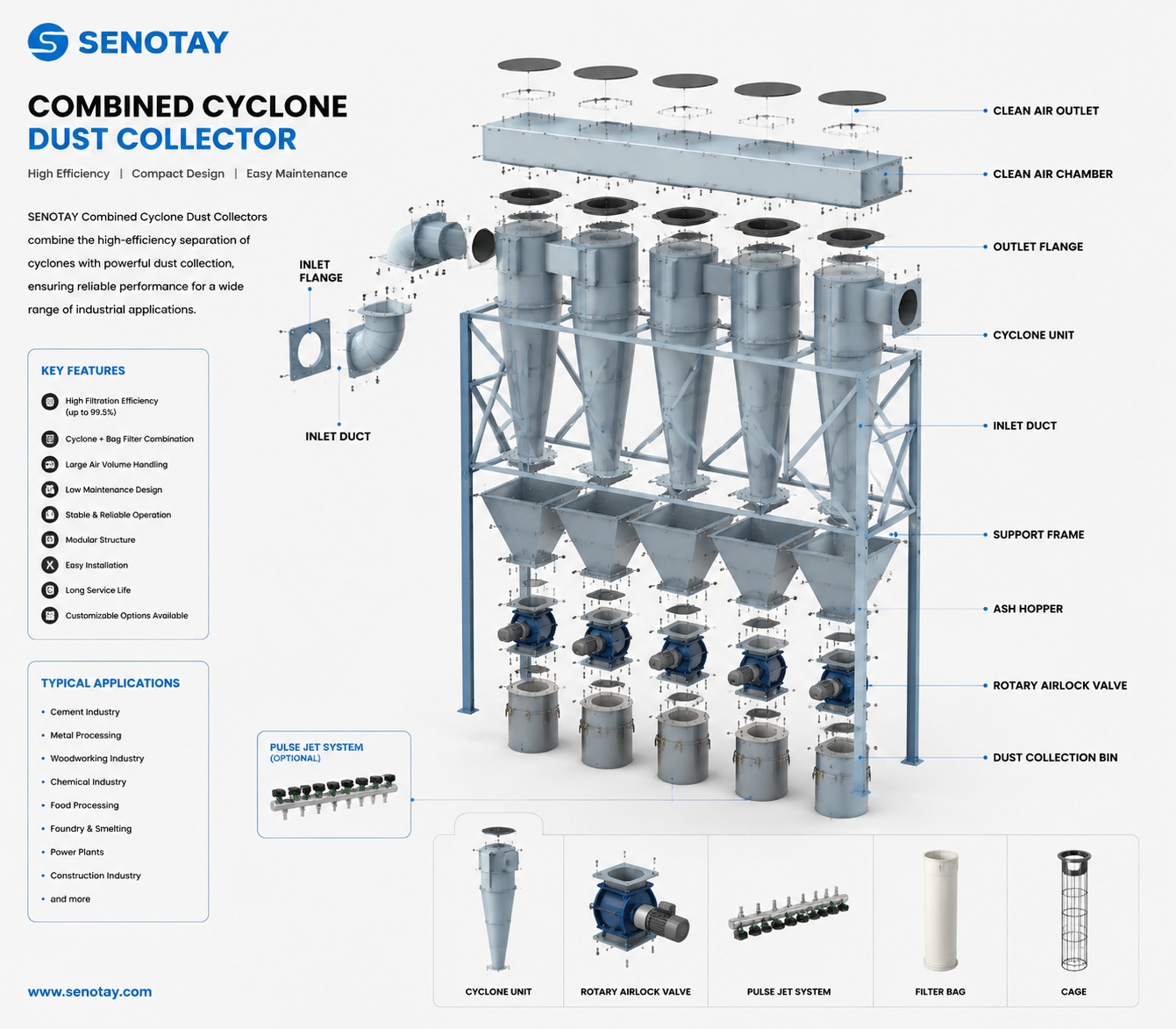
Combined twin cyclone systems sit at the most advanced end of this technology. They take the parallel arrangement of multiple tubes, which is what makes high throughput possible, and add the series staging of primary and secondary separation on top to capture fine particles more effectively.
The operating principle comes down to centrifugal separation:
This design uses no moving parts in the gas stream — no filters to replace and no motors beyond the system fan. In practice, that translates into exceptionally low ongoing maintenance relative to baghouses or cartridge filters.
Research consistently demonstrates the superiority of multi-cyclone arrangements:
The research keeps pointing the same way: multi-cyclone efficiency is superior when compared to the single cyclone. A dual cyclone configuration, for instance, has delivered higher collection efficiency and lower pressure drop than a single cyclone of the same volume. In one head-to-head study, the dual cyclone achieved collection efficiency greater than 95% on fibrous particles.
The combined cyclone advantage is clear: there is no filter media to replace, no moving parts to fail, pressure drop stays low enough to protect fan energy, and the unit handles high temperatures up to 450°C without complaint. Used in pre-filtration duty, a combined cyclone can extend bag or cartridge filter life by 2–3 times by removing the bulk of coarse particulate before it ever reaches the secondary filter.
These systems tend to be the specification of choice wherever large volumes of dusty gas need continuous, low-maintenance treatment:
Because the system has the ability to handle dust loadings exceeding 2 kg/m³ of air, it suits applications with heavy dust loads particularly well — the kind of duty that would otherwise send competing technologies back for maintenance over and over.
Senotay, officially Hebei OuTai Environmental Protection Equipment Co., Ltd., has manufactured industrial dust collectors and air filtration equipment since 2005, working out of its 15,000+ m² facility in Botou, Hebei. Its customer base now spans 30+ industries on several continents, all supported with factory-direct pricing and certified quality.
Senotay's answer is the HCY Series Combined Cyclone Dust Collector, which groups multiple cyclone elements in parallel and series configurations to sharpen both classification and collection performance:
1. Factory-Direct Pricing. No middlemen and no markups. Because Senotay manufactures combined cyclone systems in-house, factory-direct pricing typically lands 30–50% below comparable Western suppliers.
2. Certified Quality. ISO 9001, ISO 14001, ISO 45001, CE, and RoHS certifications back every system, so each unit is assured to meet international quality and safety standards.
3. Fast Global Delivery. Standard configurations ship within 48 hours from regional distribution centers, and qualified destinations receive complimentary freight.
4. Comprehensive After-Sales Support. The relationship does not end at delivery: you get lifetime technical consultation, OEM replacement wear parts, and remote diagnostics and troubleshooting.
5. Regional Fabrication Advantage. Being part of China's industrial equipment manufacturing ecosystem — particularly in Hebei Province — brings integrated design, fabrication, and assembly under one roof. And with major ports close by, the setup enables rapid export fulfillment.
Like any piece of process equipment, combined cyclone dust collectors have to comply with the applicable industry standards:
Performance benchmarks laid out in Chinese industry standards place single/twin-cylinder cyclones at ≥85% efficiency and multi-tube cyclones at ≥92%.
Senotay systems exceed these benchmarks by a comfortable margin: combined cyclone efficiency reaches 95–99%+ on particles above 10 µm and >95% on particles above 5 µm.
Q: What is a combined cyclone dust collector?
Put simply, a combined cyclone dust collector groups multiple small-diameter cyclone tubes inside one housing. Each tube develops its own vortex, and their combined action removes particulate matter from the gas stream with high efficiency.
Q: What is the difference between a twin cyclone and a combined cyclone?
A twin cyclone usually means two cyclone units running in parallel or in series. A combined cyclone — the multiclone — instead packs 4–48+ tubes into a single housing to push both throughput and efficiency higher.
Q: What efficiency can Senotay combined cyclone systems achieve?
The HCY Series delivers >95% efficiency on particles above 5 µm and 95–99%+ on particles above 10 µm. With fine filtration options, efficiency can reach up to 99.98%.
Q: What industries use combined cyclone dust collectors?
These collectors show up in mining, cement, power generation, chemical processing, grain processing, metalworking, woodworking, and pharmaceutical operations.
Q: What materials are used in Senotay combined cyclone systems?
The options are Q235 carbon steel, powder-coated steel, SS304, and SS316, and the right grade is selected according to the corrosion and abrasion resistance the application demands.
Q: What certifications does Senotay hold?
Senotay is certified to ISO 9001:2015, ISO 14001, ISO 45001, CE, and RoHS.
Q: How does a combined cyclone compare to a baghouse?
A combined cyclone needs no filter media to replace, runs at lower pressure drop — roughly 500–2,000 Pa versus 1,000–2,500+ Pa for a baghouse — and copes with higher temperatures, up to 450°C. Baghouses still come out ahead on sub-micron particles, but at a significantly higher maintenance cost.
For high-volume industrial dust control, combined twin cyclone systems strike the best balance of efficiency, reliability, and operating cost. By grouping multiple small-diameter cyclone tubes in parallel, these systems reach 95–99%+ separation efficiency on particles above 10 µm — and they get there with no filter media to replace, no moving parts in the gas stream, and exceptionally low maintenance requirements.
Senotay has spent two decades building fabrication expertise around exactly this kind of equipment. From its ISO-certified facility in Botou, China, the company supplies combined cyclone dust collectors that pair factory-direct pricing, certified quality (ISO 9001, ISO 14001, ISO 45001, CE, RoHS), and comprehensive after-sales support. Units span airflow capacities from 1,000 to 8,000+ m³/h and hold efficiency above 95% on particles over 5 µm, and because every process is different, each system is engineered for the conditions it will actually face.
Ready to discuss your combined cyclone requirements?
Head to senotay.com or get in touch with Senotay's engineering team for a customized combined twin cyclone solution matched to your process conditions and emission targets.