
EN
What are you looking for?
Boilers fired on coal or biomass push a hot, abrasive flue gas toward the chimney, and that stream is heavy with fly ash — the kind that chews through ordinary equipment and pushes operators up against ever-tightening emission limits. In practice, the pain points keep coming back to the same handful of problems:
Heat. By the time flue gas from a chain-grate or pulverized-coal boiler leaves the economizer, it can still be sitting above 200°C.
Abrasion. Fly ash is essentially finely ground rock, and it scours metal away at elbows and at every point where the flow impinges on a surface.
Spark risk. Unburned embers travel with the gas and can set filter bags alight further downstream.
Emission rules. As particulate limits tighten, letting coarse ash travel all the way to the stack simply is not an option.
Steel cyclones start to struggle once temperatures climb past a few hundred degrees, and abrasive fly ash wears them down quickly. Baghouses are efficient, but they mean a steady drumbeat of filter replacement costs plus an ongoing spark hazard. So for plant operators and OEM buyers, the question is not whether to pre-clean boiler flue gas — it is how to do it reliably and cost-effectively, with documented performance that keeps the regulators satisfied.
The answer is the ceramic multi-tube cyclone dust collector, a technology that pairs the physics of centrifugal separation with the staying power of high-temperature ceramics. And for buyers looking for a dependable OEM partner overseas, Senotay (senotay.com) — a Chinese manufacturer in business since 2005, with ISO 9001, ISO 14001, ISO 45001, and CE certifications — supplies factory-direct ceramic multi-tube separators engineered for the world's most demanding boiler applications.
A cyclone rests on one of the oldest ideas in industrial gas cleaning: spin dirty gas fast enough, and centrifugal force throws the heavier dust outward, where it drops into a hopper. There are no filters to clog and no moving parts — just physics.
The ceramic multi-tube version puts that idea to work in extreme conditions. Inside a steel housing, small ceramic tubes sit side by side in parallel. Dirty gas arrives through an inlet box, helical vanes steer it into each tube, and as it spins it sheds its particles into an ash hopper below. The cleaned gas then rises through a central outlet pipe and moves on to the next stage or straight to the stack.
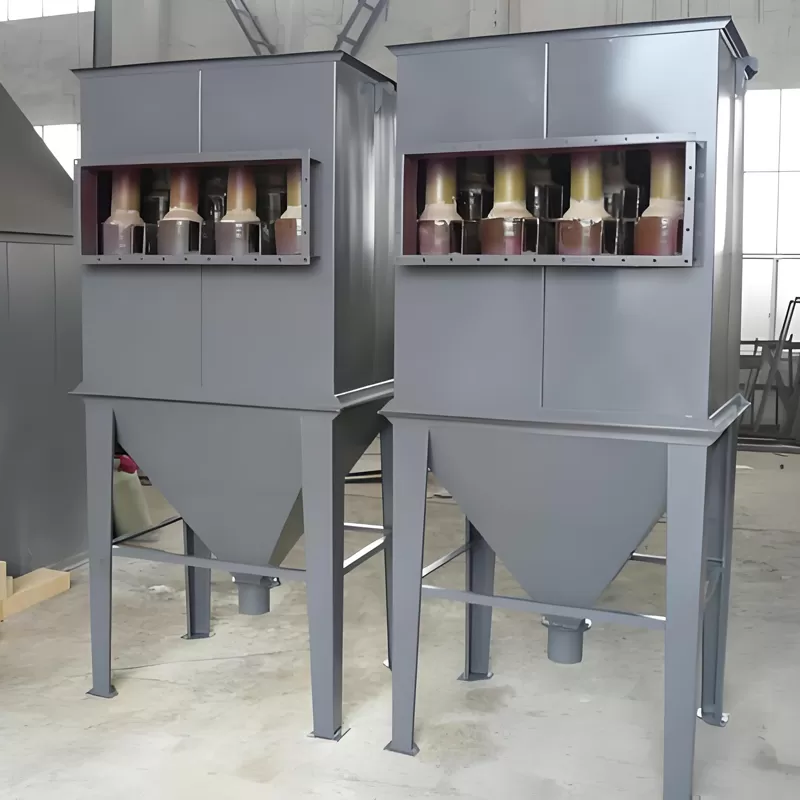
Collection efficiency improves as tube diameter shrinks. A bank of small cyclones separates fine dust more effectively than a single large cyclone, and it does so while keeping pressure drop low enough for the boiler fans already on site. Built right, a multi-tube cyclone can achieve 90% or even greater collection efficiency for fine particulates, with overall efficiency coming in at 90 to 95% on a weight basis.
In boiler duty, the tube material really is everything. Fired above 1,200°C from cordierite, alumina-silica fiber, and fire clay, ceramic tubes shrug off both heat and abrasion — they run dependably from about −20°C to 500°C, and special grades will go higher still. On top of that, ceramic stands up to abrasion and corrosion roughly three times better than stainless steel across a pH range of 2–12.
The XGD/W high-efficiency ceramic multi-tube dust collector gives a good sense of what this technology can really do. It was developed jointly by Senotay and the Tangshan Steel Design Institute and has passed technical appraisal by both the State Environmental Protection Administration and the Hebei Provincial Science and Technology Commission. The numbers speak for themselves:
For OEM buyers weighing pre-filtration options for boiler flue gas, the decision has real consequences for both cost and performance:
The ceramic multi-tube advantage is clear: it handles temperatures others cannot, resists abrasion and corrosion, needs no filter media to replace, and costs roughly half that of an electrostatic precipitator to install — all while returning 95% primary efficiency and acting as a natural spark arrester.
The operating principle is simple in concept, yet engineered with real care:
This design uses no moving parts in the gas stream — no filters to replace and no motors beyond the system fan. The payoff is a dust collector that needs exceptionally low ongoing maintenance compared with a baghouse or an electrostatic precipitator.
Studies have shown that when flow rate and pressure drop are held equal, the efficiency of multi-cyclone arrangements is superior when compared to single cyclones. One optimized design, for instance, reached a cut-off diameter of 5.87 µm with a pressure drop of only 349.6 N/m². For particles above 5 µm, multi-tube cyclone efficiency runs 80% and above — which makes this an ideal first-stage pre-cleaner ahead of a baghouse or an ESP.
Ceramic multi-tube cyclone dust collectors tend to be the go-to choice wherever high-temperature, abrasive, or corrosive flue gas needs dependable pre-cleaning:
The XGD/W ceramic multi-tube dust collector also fits various types of coal-fired heating furnaces, civil power plant boilers, and industrial boiler flue gas treatment. Because it handles hot, dusty gas while actually improving heat recovery, it earns its keep in energy-intensive industries where recovering waste heat is a priority.
Senotay, operating as Hebei OuTai Environmental Protection Equipment Co., Ltd., has been building industrial dust collectors and air filtration equipment out of its 15,000+ m² facility in Botou, Hebei since 2005. The company now serves 30+ industries across several continents, with factory-direct pricing and certified quality.
Senotay's XGD/W high-efficiency ceramic multi-tube dust collector was developed together with the Tangshan Steel Design Institute and has passed technical appraisal by the State Environmental Protection Administration and the Hebei Provincial Science and Technology Commission. The company has also worked alongside the Design Institute of Hebei Metallurgical Design Institute, Shougang, Anshan Iron and Steel, and Jinan Iron & Steel — which says a great deal about how it performs in the most demanding corners of heavy industry.
No middlemen, no markups — every unit is manufactured in-house.
Comparable quality to Western and Japanese suppliers at 30–50% lower cost
Standard configurations ship within 48 hours from regional distribution centers.
OEM replacement ceramic cyclones and guide vanes, available with a documented 6–8 year service life.
Lifetime technical consultation, with remote diagnostics included.
Ceramic multi-tube cyclone dust collectors have to meet the industry standards that apply to their application, including these:
Senotay systems exceed these benchmarks: primary efficiency reaches 95%, secondary efficiency 98%, and the result is compliance with even the most demanding particulate emission limits.
Q: What is a ceramic multi-tube cyclone dust collector?
In essence, a ceramic multi-tube cyclone dust collector runs many small-diameter ceramic cyclone tubes in parallel inside a steel housing. Dirty gas spins through each tube, and centrifugal force throws the particulate matter clear of the stream — no filters, no moving parts, and durability that holds up at high temperature.
Q: What temperatures can ceramic multi-tube cyclones handle?
The Senotay XGD/W series operates dependably right up to 700°C, without deformation or cracking even under sharp high-and-low temperature differentials. Steel cyclones, by contrast, usually give out above 350°C.
Q: What efficiency can Senotay ceramic multi-tube systems achieve?
At 800 Pa resistance, primary efficiency comes in at 95%; add a second stage and efficiency climbs to 98% at 1,200 Pa resistance. For particles above 5 µm, expect 80% and above.
Q: How long do ceramic components last?
Ceramic cyclones and guide vanes carry a documented service life of 6–8 years. They stay smooth, non-stick, and non-blocking, with strong resistance to corrosion and wear, and the equipment as a whole keeps going for more than 20 years.
Q: How does a ceramic multi-tube cyclone compare to an electrostatic precipitator?
Roughly speaking, the investment runs about half that of an electrostatic precipitator. A ceramic multi-tube cyclone also handles higher temperatures, needs no high-voltage equipment, and costs far less to keep running.
Q: What certifications does Senotay hold?
Senotay is ISO 9001:2015, ISO 14001, and ISO 45001 certified, and carries CE marking.
Q: What industries use Senotay ceramic multi-tube systems?
Senotay ceramic multi-tube systems are at work in power generation (coal and biomass boilers), cement, steel and iron production, mining, metallurgy, and incineration.
Q: Can Senotay customize ceramic multi-tube systems for specific applications?
Absolutely. Each system is engineered around the gas volume, temperature, dust type, and emission limits it will actually face. The XGD/W series, for example, was developed with the Tangshan Steel Design Institute specifically for hot, corrosive flue gas.
For pre-cleaning hot boiler flue gas, the ceramic multi-tube cyclone dust collector is about as good as it gets: it delivers 95% primary efficiency, 700°C temperature resistance, abrasion resistance three times that of stainless steel, and investment cost half that of electrostatic precipitators. When the gas leaving a boiler is hot, abrasive, and corrosive — and the emission rules demand performance you can prove — the ceramic multi-tube separator stops being optional and becomes essential.
Senotay has spent two decades getting good at this exact technology. From its ISO-certified plant in Botou, China, the company ships ceramic multi-tube cyclone dust collectors that combine certified quality, proven engineering partnerships (Tangshan Steel Design Institute, Shougang, Anshan Iron & Steel), factory-direct pricing, and comprehensive after-sales support. Every system Senotay builds is tailored to the process conditions it will actually face, because in industrial air pollution control, one size does not fit all.
Ready to discuss your ceramic multi-tube separator requirements?
Head over to senotay.com or get in touch with Senotay's engineering team, and they will put together a solution built around your process conditions and emission targets.