
EN
What are you looking for?
If your operation makes dust - and most industrial operations do - you already know it's not just a housekeeping problem. Uncontrolled dust damages equipment, slows production, and can put workers at risk. A baghouse dust collector is the workhorse that fixes this: a fabric filter system that pulls contaminated air through rows of filter bags, captures the dust, and returns clean air to the room or the atmosphere. In this article, we'll look at how baghouse systems work, which industries depend on them, and what to consider when you're sourcing one - including the practical details of buying from a manufacturer that ships worldwide. Whether you run a cement plant, a metal shop, or a food processing line, the principles here will help you ask the right questions.
Baghouse dust collectors capture dust with rows of fabric bags and clean themselves automatically.
Pulse-jet systems are the most common configuration and offer the lowest ongoing maintenance.
Right-sized filtration lowers energy use and keeps you in compliance with air-quality rules.
A manufacturer with global delivery simplifies sourcing, installation, and after-sales support.
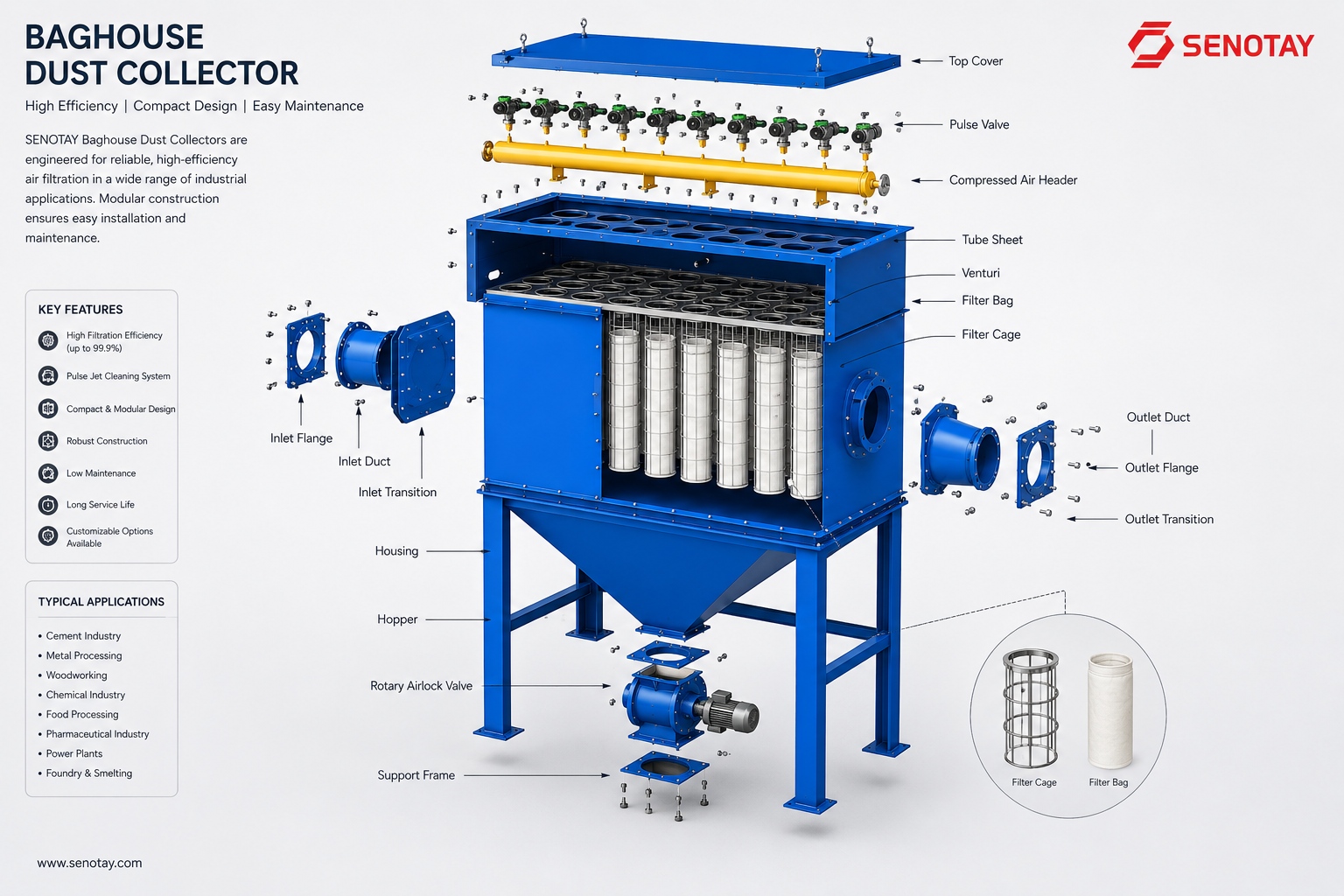
A baghouse dust collector, sometimes called a fabric filter or bag filter, is a large vessel filled with vertical filter bags. Dirty air enters from below, dust collects on the outside of each bag, and clean air passes through the fabric and out the top. Over time, a layer of dust builds up on the bags. That sounds like a problem, but it's actually part of the process - the accumulated dust cake does a surprising amount of the filtering itself.
Cyclones remove only the heaviest particles and are often used as pre-cleaners. Cartridge collectors handle lighter loads in a more compact footprint. A baghouse, by contrast, is built for heavy, abrasive, and high-temperature dust streams, which is why it remains the standard for cement, mining, metal processing, and similar demanding industries. If your facility produces a lot of fine, persistent dust, a baghouse is usually the most dependable answer you can buy.
In a pulse-jet bag filtration system, a short blast of compressed air is fired down into each bag from the top. The shock wave flexes the fabric, knocking the dust cake loose so it drops into the hopper below - and the system keeps filtering the whole time. Because cleaning never stops the unit, you get continuous operation and predictable performance, even in processes that run around the clock. The pulses fire in a sequence, usually one bag row at a time, so the airflow barely dips and the pressure drop stays steady from the first hour to the last.
Dirty air enters the hopper, where the heaviest particles settle out first.
Fine dust collects on the bag surfaces while clean air passes through the fabric.
Compressed-air pulses release the dust, which falls into the collection hopper.
A rotary valve or screw conveyor removes the collected dust continuously.
Reverse-air and shaker systems work, but they require the unit to go offline for cleaning. A pulse-jet collector cleans on the fly, which means higher throughput and steadier pressure drop. For continuous processes, that reliability is often the deciding factor.
Dust control is rarely optional in heavy industry. Workplace exposure limits and emissions regulations make filtration a legal requirement in most countries, and the costs of getting it wrong - fines, downtime, health claims - are far higher than the price of a well-designed baghouse dust collector.
Mining and aggregates: crushing, screening, and conveying create constant dust.
Metal and foundry work: grinding, welding, and shot blasting generate fine, abrasive particles.
Cement and building materials: high volumes of dry powder need serious filtration.
Food and feed: dust from grains and powders requires careful, hygienic handling.
Chemicals and pharmaceuticals: containment is critical for safety and product quality.
Beyond protecting workers, good filtration protects the process itself. Clean air keeps bearings, sensors, and control cabinets free of abrasive dust, which means fewer unplanned stops and longer equipment life. Viewed that way, a baghouse isn't a cost - it's a maintenance saving that pays for itself.
There is no single 'best' baghouse - the right choice depends on your dust, your space, and your process. Here's how the main options stack up, along with when each one earns its keep.
Bag material matters just as much as the housing. The right fabric has to cope with your operating temperature, the chemistry of your dust, and its abrasiveness - without wearing out long before its time. Choosing well here is the difference between a system that runs for years and one that eats replacement bags. When a supplier can match the fabric to your exact dust chemistry, you also reduce pressure drop, which translates directly into lower fan energy and quieter running.
An undersized system struggles from day one. A good supplier calculates airflow, dust load, and pressure drop before quoting, rather than selling you a standard unit and hoping it fits. Once installed, maintenance is simple but regular: watch the pressure differential, check for broken bags, and empty the hopper on schedule. Most manufacturers, Senotay included, supply spare bags and media so you're never stuck waiting for replacements.
Buying industrial equipment from another country can feel like a leap of faith. Senotay has been designing and shipping baghouse dust collectors and related air systems since 2005, and it built its reputation by making that leap straightforward: complete documentation, packaging engineered for long freight journeys, and support that continues after the equipment lands. Certifications to ISO 9001, ISO 14001, and ISO 45001 cover quality, environment, and occupational safety - so the system you receive matches the specification you approved.
Certified quality, environmental, and safety management since 2005.
Full technical documentation and drawings provided before shipment.
Export packaging that protects filters, fans, and housings in transit.
After-sales support for installation, commissioning, and spare parts.
Start with your airflow volume, the type of dust, and your available space. A reliable manufacturer will calculate the required filter area and pressure drop for your baghouse dust collector before you commit to anything.
Bag life depends on temperature, abrasiveness, and dust chemistry. Most systems run for two to five years between changes, and monitoring pressure differentials helps you catch problems early.
Yes, with the right fabric and design. PTFE and aramid media cope with high temperatures, while special coatings and pre-cleaners handle sticky or moist material.
Yes. Senotay ships worldwide with export-ready packaging and provides documentation and technical support for installation and operation.
Clean air is not a luxury in industrial work - it's the foundation of safe, efficient production. A well-designed baghouse dust collector protects your people, your equipment, and your compliance record all at once. If you're ready to upgrade an aging system or build from scratch, talk to Senotay. With two decades of experience and worldwide delivery, the right filtration system is closer than you think. Request a quote and a sizing recommendation today.