
EN
What are you looking for?
Dust in the air isn’t just a housekeeping problem — it’s a safety hazard, a maintenance burden, and a compliance risk. The single-cylinder cyclone dust collector has been separating solids from gas streams for more than a century, and it’s still one of the smartest, cheapest ways to protect downstream equipment and reclaim valuable material.
Senotay has designed and manufactured industrial dust collectors, cyclones, and conveying systems since 2005, shipping OEM cyclone systems to plants around the world. In this guide, we’ll break down how a single cyclone separator design works, which factors drive efficiency, and how to spec the right unit for your process.
Along the way we’ll also cover when a multi-cyclone layout makes sense and how to keep your unit running for years. If you’re sizing a new line or upgrading an old one, the context is worth the read.
Cyclones use centrifugal force, not filters, so there’s no media to clog or replace.
Geometry — body diameter, inlet shape, and cone angle — drives efficiency more than anything else.
A cyclone is the ideal pre-separator that extends the life of baghouses and cartridge filters.
An OEM partner sizes the unit around your dust, airflow, and temperature — not a guess.
Maintenance is minimal but non-negotiable: inspect the inlet and cone for erosion.
A single-cylinder cyclone dust collector is a mechanical separator that removes particulate from a gas stream using swirling airflow. Contaminated air enters the cyclone tangentially, spirals downward along the cylinder wall, and centrifugal force throws heavier particles outward. The particles slide into the collection hopper at the bottom, while clean gas exits through the vortex at the top.
There are no moving parts and no filter bags in the separation zone, which is why cyclones are cheap to run and dependable in harsh environments. The trade-off is that a basic cyclone won’t catch the finest dust — which is exactly why it’s usually paired with a baghouse or cartridge filter downstream.
In practice you’ll find single-cylinder cyclones handling everything from woodworking chips and plastic regrind to cement dust and metal shavings. Wherever the material is heavy enough to be thrown outward, a cyclone earns its keep.
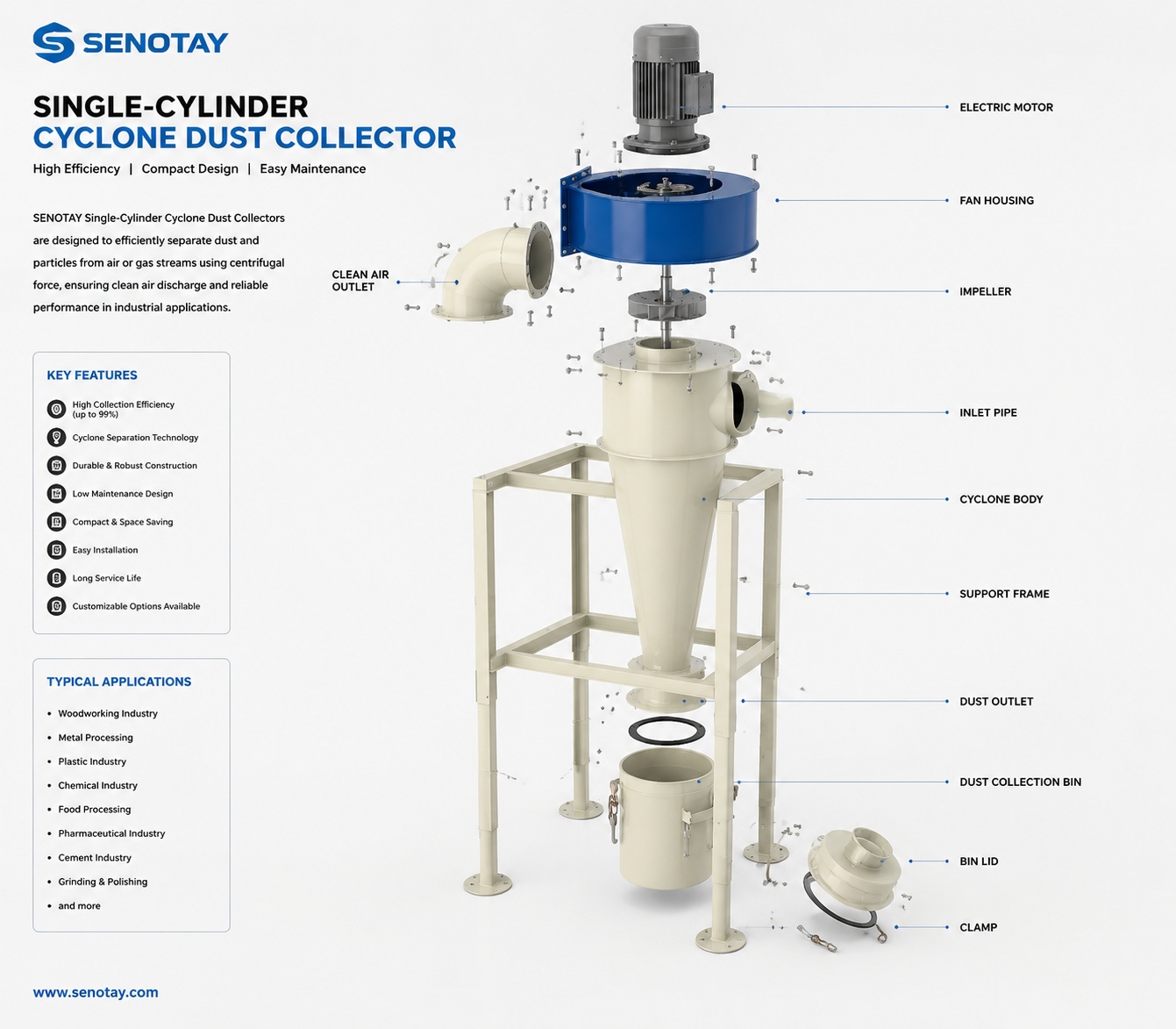
Separation happens because of a balance between two forces. Centrifugal force pushes particles outward toward the wall; drag from the inward-moving gas tries to carry them up and out. Larger and denser particles win easily. Smaller particles need a higher inlet velocity, a smaller cyclone body, or a second stage of filtration.
That physics sets the right expectations: a cyclone is a workhorse for coarse and medium dust, not a HEPA replacement. Used correctly, it takes the heavy load off your fine filters and lets them run far longer between cleanings.
A cyclone is almost never the whole story. In a typical dust-collection setup, it sits at the front of the line, removing the heavy, abrasive, or combustible fraction before the air reaches a baghouse or cartridge filter that handles the fine dust. The payoff is a filter that loads slower, pulses less often, and lasts years longer.
That upstream protection is worth real money. Fine filters are expensive to replace, and the compressed air used for pulse cleaning is a running cost you can’t ignore. Every kilogram of dust the cyclone takes out is a kilogram the filter doesn’t have to.
The beauty of a cyclone is how little it asks for. There are no bearings to grease and no bags to change. The maintenance routine boils down to a few checks:
Inspect the inlet scroll and inner wall for erosion, especially with abrasive dust.
Check the collection hopper and airlock for leaks or bridging.
Verify pressure drop across the unit — a sudden change signals a blockage or leak.
Confirm the vortex finder and outlet pipe are clean and aligned.
Keeping those four checks on a schedule prevents the two failures that actually happen: eroded metal from abrasive dust, and lost performance from a blocked or leaking discharge. Both are caught in minutes during a routine round.
Getting the geometry right is where experience shows. The checklist our engineers work from:
Inlet velocity — too low and particles never reach the wall; too high and pressure drop and erosion climb.
Cylinder diameter — smaller bodies generate stronger centrifugal force but handle less flow.
Cone angle and length — a longer cone gives particles more time to migrate outward.
Vortex finder — the inner tube that sets the clean-gas exit path; its length and diameter tune performance.
When throughput is large but individual cyclones get oversized and inefficient, engineers often use several smaller cyclones in parallel. Each unit then runs closer to its ideal operating point, which raises overall collection efficiency. That gain comes with added complexity — more inlets to wear and more cones to clean.
In most plants, a single well-sized cylinder is the right answer — it’s simpler, cheaper to maintain, and easier to troubleshoot. Multi-cyclone systems earn their complexity when the total flow is large and the dust load is high.
Buying a cyclone from a catalog is a gamble, because real-world performance depends on your material, particle size distribution, gas temperature, and moisture content. An OEM like Senotay designs around your actual process data: we size the unit, select the right plate thickness and wear lining, and specify the conveying and discharge system that fits your plant.
Process-based sizing from your dust analysis and airflow data
Material selection — carbon steel, stainless, or abrasion-resistant lining
ISO 9001, ISO 14001, and ISO 45001 certified manufacturing since 2005
Complete systems: cyclone, airlock, conveying, filtration, and controls
After-sales support, spare parts, and performance guidance
Beyond the hardware, there’s the design knowledge. A cyclone that’s wrong for your material isn’t just ineffective — it can erode quickly, plug, or even pass dust it should have caught. Twenty years of building these systems means we’ve seen the failure modes before, and we design them out rather than discovering them in your plant.
For particles above 10 microns, a well-designed cyclone typically captures 80–95%. Efficiency drops sharply below about 5 microns, which is why cyclones usually run ahead of a baghouse or cartridge filter.
No. Separation is purely mechanical, so there is no media to replace or plug. Any downstream filter handles the fine fraction.
High inlet velocity and abrasive dust gradually wear the inlet scroll and inner wall. Wear-resistant linings and correct velocity selection extend service life.
Yes. Cyclones operate well beyond the temperature limits of bag filters, provided the materials are selected for the operating temperature.
A well-designed single cyclone separator can cut your filtration load, recover usable material, and protect expensive downstream equipment for decades. Senotay’s engineers will size a single-cylinder cyclone dust collector around your actual process — not a guess. Send us your dust analysis and airflow data, and we’ll recommend the right configuration, quote it, and support you from installation to operation.