
EN
What are you looking for?
How a catalytic combustion dust collector and VOC catalytic oxidizer (CATOX) system scrub solvent fumes and odor from industrial air. Compare options.
If your plant paints, prints, coats, or handles solvents, you know the smell. VOC-laden exhaust carries hydrocarbons out of the building — into the air, and increasingly into the attention of regulators. The answer is combustion: burn the solvents before they leave the stack. A catalytic combustion dust collector — a system that pairs particle capture with a catalytic oxidizer — destroys the volatiles at far lower temperatures than a flame, which is why it is the workhorse of industrial VOC abatement.
In this guide you will learn what a catalytic combustion dust collector and a VOC catalytic oxidizer (CATOX) system are, how catalytic oxidation compares with thermal oxidation, where these systems earn their keep, and how to size, run, and maintain one.
Catalytic combustion destroys VOCs at roughly 300–400 °C instead of the 750 °C+ a thermal oxidizer needs, so fuel costs drop sharply.
A CATOX system passes solvent-laden air over a catalyst bed that oxidizes hydrocarbons into carbon dioxide and water.
Once up to temperature, the reaction is self-sustaining — the heat it releases keeps the system running.
Industrial VOC abatement is increasingly a regulatory requirement, not a choice.
A catalytic combustion dust collector handles dust and fumes in one line when paired with proper filtration.
Senotay has built air pollution control equipment since 2005, with ISO 9001/14001/45001 certifications.
Air loaded with solvent vapor is drawn in, preheated, and passed over a catalyst — usually a noble-metal-coated honeycomb or mesh. The catalyst lowers the activation energy of oxidation, so the hydrocarbons ignite and burn at temperatures far below a naked flame. The reaction converts the VOCs into carbon dioxide and water vapor, and the heat released is captured and reused to preheat the incoming air. That heat recovery is what makes catalytic oxidation economical to run.
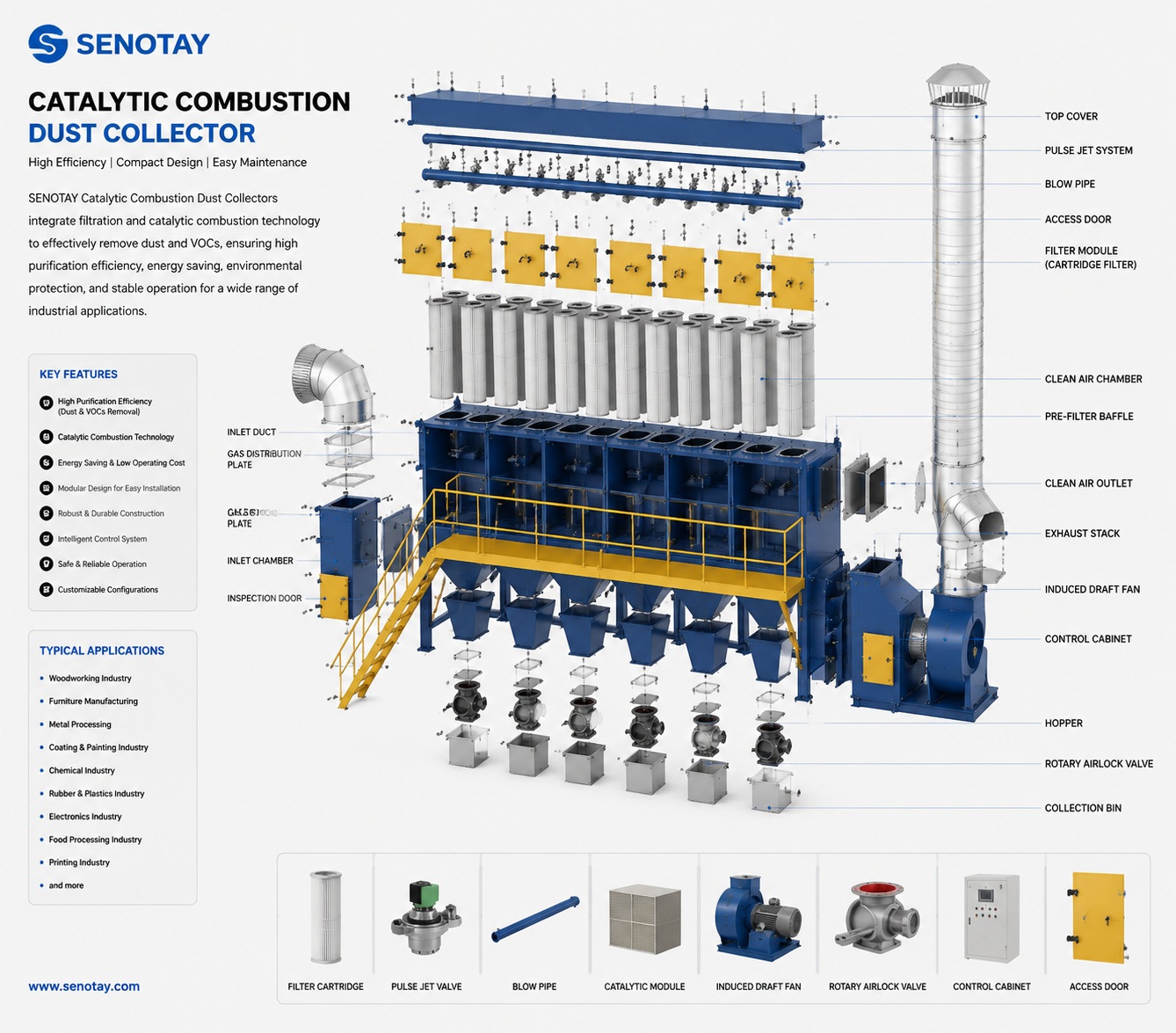
The name combines two jobs in one line. A catalytic combustion dust collector first removes particulates from the exhaust — with a filter or cyclone — then sends the cleaned, solvent-laden air through the catalytic oxidizer. Plants with both dust and fume problems get one system instead of two.
Thermal oxidation burns VOCs with a direct flame at high temperature. It is simple, robust, and nearly total in destruction efficiency, but it consumes a lot of fuel. Catalytic oxidation does the same chemistry at a lower temperature, so running cost is much lower. The trade-off is that the catalyst is sensitive — it can be poisoned or fouled by certain compounds, so the air stream needs care.
For a plant with a steady VOC load — a paint line, a print shop, a coating line — a catalytic combustion dust collector with CATOX technology is usually the better business case. For a dirty or highly variable stream, thermal may be the safer choice. Your supplier should model both before you commit.
Catalytic combustion shows up wherever solvents evaporate in volume:
Paint and powder-coating lines — booth exhaust loaded with solvents
Printing and packaging — inks, thinners, laminating adhesives
Coating and converting — solvent-based coatings on rolls and parts
Chemical and pharmaceutical — reactor and dryer off-gases
Plastics and rubber — curing and molding fumes
In each case the goal is the same: a catalytic combustion dust collector keeps hydrocarbons out of the atmosphere and off the plant's compliance record, without burning a fortune in fuel.
Particulates are the enemy of a catalyst. A good system removes dust before the oxidizer, which is where the dust-collection half of a catalytic combustion dust collector earns its place. High-efficiency filters or a cyclone protect the catalyst and keep destruction efficiency up.
The heart of the system is the catalyst bed. The air stream passes across it at a controlled temperature, and the oxidation reaction releases heat. A heat exchanger transfers that heat to the incoming cold air, so the system runs on a fraction of the fuel a straight thermal unit would need. Once stable, the reaction sustains itself with the burner used only for start-up.
Right-size the system to the real exhaust, not the sales brochure:
Measure airflow in cubic meters per hour — under-sizing a catalytic combustion dust collector causes odor breakthrough.
Know the VOC type and concentration; both drive temperature and heat-recovery design.
Check for catalyst poisons — sulfur, silicones, halogens — before specifying.
Plan the footprint, utilities, and ducting route in advance.
Ask for expected destruction efficiency and fuel cost per operating hour.
A catalytic combustion dust collector is only as good as its upkeep. These habits keep it running at spec:
Monitor catalyst bed temperature and pressure drop; a climbing differential means fouling.
Change pre-filters on schedule — they are cheap insurance for an expensive catalyst.
Log start-ups; burner duty tells you whether the reaction is self-sustaining.
Sample stack emissions periodically to confirm destruction efficiency.
Keep spares of the thermocouples and pressure sensors on the shelf.
Senotay has designed and built industrial dust collectors, air filtration, ventilation, purification, and conveying equipment since 2005, for plants that cannot afford downtime. Its range covers a catalytic combustion dust collector and VOC catalytic oxidizer (CATOX) systems alongside conventional dust and fume equipment, all backed by ISO 9001 quality, ISO 14001 environmental, and ISO 45001 occupational health and safety management. Talk to Senotay at senotay.com for a system matched to your solvent load and your budget.
Much less than a thermal oxidizer. Because the catalyst lets the reaction run at 300–400 °C, the system becomes self-sustaining once up to temperature, and the burner mostly handles start-up. Many plants see fuel use fall by 50–80% versus thermal.
Yes. A catalytic combustion dust collector pairs particulate filtration with a catalytic oxidizer in one line, so dust is removed before the air reaches the catalyst. That protects the catalyst and solves both problems together.
Sulfur, silicones, halogens, and heavy-metal compounds can deactivate a catalyst over time. Knowing the VOC chemistry before specifying, and removing particulates upstream, protects catalyst life.
It depends on the solvent load and local emission rules. Where regulations require VOC control, catalytic oxidation is often the most economical way to comply because of the low fuel consumption. Have your supplier model your numbers first.
Solvent fumes are expensive in two ways: what you pay to heat them out of the stack, and what you pay when the regulator counts them. A catalytic combustion dust collector and VOC catalytic oxidizer (CATOX) system turns that liability into a controlled, low-energy reaction — and often pays for itself in fuel and compliance savings. If you are planning a new line or facing an audit, talk to Senotay at senotay.com for a recommendation based on your actual exhaust, not a catalog.