
EN
What are you looking for?
Learn how a grinding table dust collector keeps metal dust and sparks under control. Compare downdraft tables, filters, sizing, and maintenance for your shop.
Grind a piece of steel and the air around you fills with metal dust, grinding sparks, and smoke you cannot see clearly but can definitely smell. Leave it in the air and it settles on machines, drifts into offices, and gets breathed in by the people doing the work. A grinding table dust collector pulls all of that away at the source, before it becomes a problem.
This guide walks you through how these systems work, the health and fire risks they solve, how to size and choose one for a fabrication shop, and the maintenance habits that keep them performing. If you are buying, upgrading, or just trying to get compliant, this is where to start.
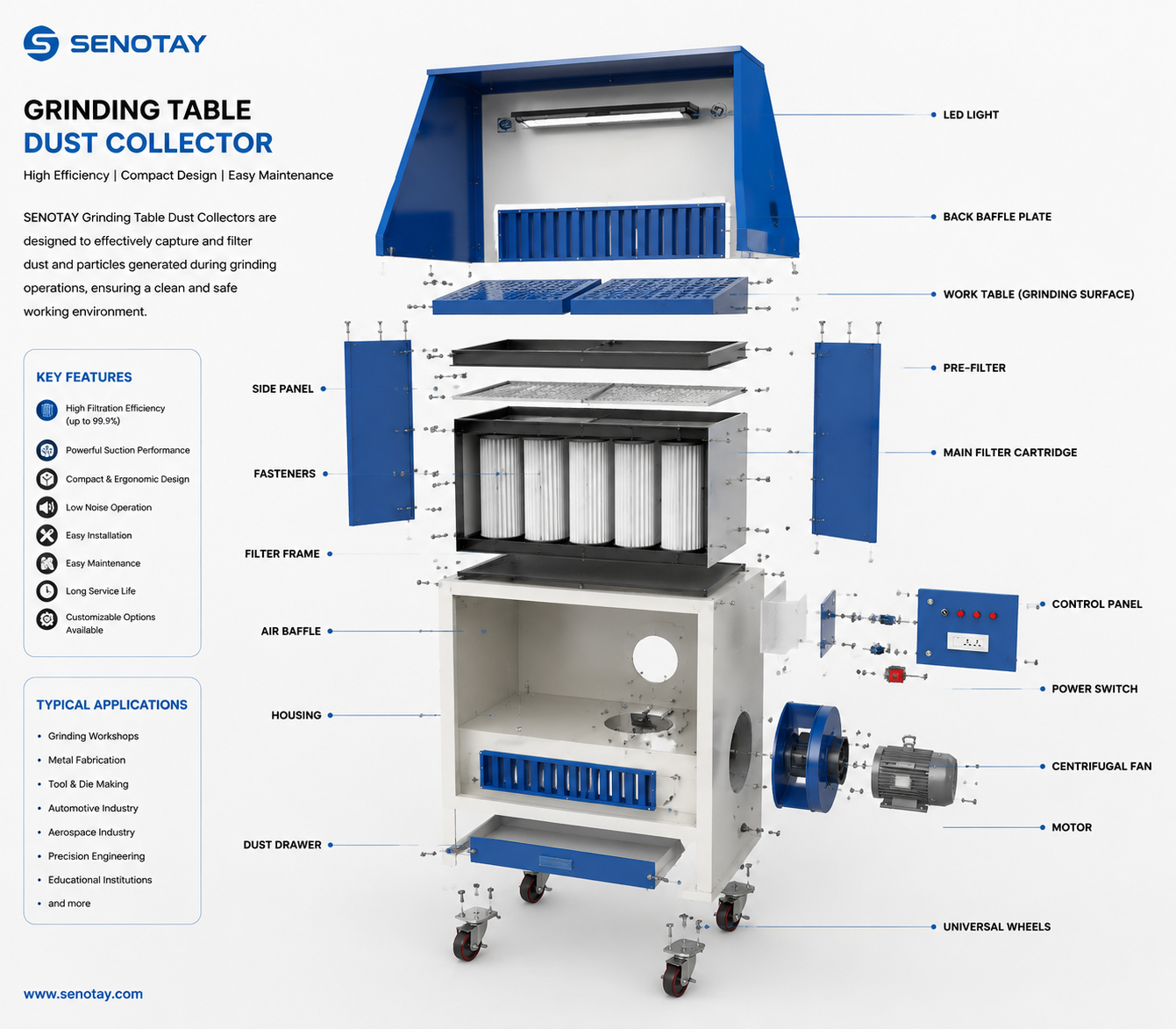
A grinding table dust collector captures dust and sparks right at the work surface, using a downdraft or backdraft airflow.
Grinding dust is not just a hygiene issue—it is a fire and explosion hazard, especially with aluminum and other combustible metals.
Cartridge filters with spark arrestors handle the hot, coarse load that standard vacuum filters cannot.
Sizing a grinding table dust collector matters more than brand: airflow, filter area, and capture velocity decide whether the system actually works.
Good systems are quiet, easy to clean, and simple to service—maintenance is where most systems fail.
Senotay has built industrial air filtration and conveying equipment since 2005, with ISO 9001/14001/45001 certifications.
Downdraft tables pull air straight down through the work surface, so dust falls away from your face and into the filter. Backdraft (or side-draft) benches pull across the work area into a rear slot—handy for tall parts or fixtures that would block a perforated tabletop. Both rely on the same idea: capture the contaminant at the source with enough velocity to beat the worker's breathing zone. That capture-at-source principle is the core of any effective grinding table dust collector.
At its simplest, it is a ventilated workbench with a powerful extraction fan underneath and a filter that cleans the air before it returns to the room. You work on top; the dust disappears below. Shops use them for bench grinding, deburring, blending, and weld cleanup.
Grinding produces fine metallic and abrasive particles. Breathed in repeatedly, that dust irritates lungs and has been linked to serious occupational disease. Regulators take it seriously: health and safety rules now require exposure limits and documented control measures for metalworking dust, and you can expect an inspector to ask what you are doing about it.
Steel sparks look dramatic, but aluminum and magnesium dust are the real danger. Finely divided metal dust can ignite or even explode when it accumulates and finds an ignition source—and grinding generates sparks constantly. A dust extraction bench system removes the fuel before it builds up, which is why any shop running non-ferrous grinding should treat extraction as a safety device, not a comfort feature.
Every system is a balance of air volume and face velocity. If the airflow is too weak, dust puffs up past the downdraft and back into your face; too strong, and fan cost and noise climb. A rule of thumb for a grinding table dust collector is roughly 60–80 m/min of face velocity across the work surface, with a spark arrestor and a heavy-duty cartridge filter handling the load.
Choosing a grinding table dust collector starts with your actual work, not the biggest option in the catalog. Walk through the checklist:
Workpiece size: the table should be bigger than your largest parts, or you will be working outside the capture zone.
Dust type: steel, aluminum, or abrasive dust each changes the filter and spark-protection requirement.
Duty cycle: a unit that runs all day needs more filter area and a bigger motor than one used for occasional cleanup.
Space and noise: check the footprint and the decibel rating—some units are built for shops, others for quiet corners.
Cleaning method: reverse-pulse self-cleaning filters beat manual shaking when the shop runs hot.
A system that is maintained quietly keeps protecting you; one that is ignored becomes a dust source itself.
Position your grinding table dust collector near the work, not across the shop—long duct runs kill airflow.
Keep ducting short, straight, and smooth; every bend steals velocity from your grinding table dust collector.
Change or clean filters on schedule, not when the airflow audibly drops.
Empty the dust drawer before it is full; compacted dust is harder to clear and smells.
Check the spark arrestor and drop-out chamber regularly—they are your first line of defense.
Senotay has designed and built industrial dust collectors, air filtration, ventilation, purification, and conveying equipment for manufacturers since 2005. The range covers a grinding table dust collector for the bench through full workshop systems, all backed by ISO 9001 quality, ISO 14001 environmental, and ISO 45001 occupational health and safety management. You get an equipment maker that has spent two decades on exactly these problems, not a generalist. Talk to them at senotay.com.
Aim for 60–80 m/min of face velocity across the work surface as a starting point. The correct volume depends on table size, dust type, and duct length—size it with your supplier, not by guesswork.
Yes, if it is specified for it: fit a spark arrestor, a properly grounded system, and a filter rated for combustible dust. Never run non-ferrous metals through a plain steel-only unit.
Only if the cleaned air returns to an occupied space and you need sub-micron control. For venting outside, a good cartridge filter is usually enough; check local rules.
Follow the manufacturer's schedule, and watch the pressure gauge—when differential pressure climbs, it is time to clean or replace. Heavy-duty shops often do it weekly.
A downdraft table captures heavy sparks and grinding dust at the work surface. A welding fume extractor is positioned at the weld pool to catch the fume plume. Many shops run both.
Grinding dust is one of the easiest shop hazards to control and one of the easiest to ignore—until it costs you a health inspection, a fire risk, or a good worker. A grinding table dust collector sized to your work and maintained on a schedule removes the hazard at the source, and it pays for itself in cleaner air, cleaner machines, and fewer arguments with auditors. If you are ready to put a system in place, talk to Senotay at senotay.com and get a recommendation based on your actual parts and metals, not a catalog page.