
EN
What are you looking for?
Modular dust collector systems scale with your facility. See how modular cartridge dust collectors and plug-and-play dust control simplify air filtration.
Dust is one of the quietest costs in a factory. It fouls machinery, threatens worker health, and — when the particles are combustible — can turn a routine shift into a serious incident. Yet many facilities put off upgrading their air filtration because traditional systems feel like a big, expensive, one-time project.
A modular dust collector changes that. Instead of a single fixed unit sized for a future you can only guess at, you start with the capacity you need now and add filter modules as production grows. This report explains how modular cartridge dust collectors work, where they deliver the most value, and how to choose the right system for your facility.
Modular systems expand as you grow — add filter modules without redesigning the plant
Cartridge filtration captures fine and combustible dust effectively in many applications
Plug-and-play installation shortens lead times and reduces downtime
Correct sizing, filter media, and maintenance protect your investment for years
A modular dust collector is an air filtration system built from standardised units that can be combined, expanded, and rearranged. A base unit handles a certain airflow; when demand grows, you add matching filter modules, fans, or hoppers instead of replacing the whole system.
The practical effect is flexibility. A workshop can install a modest system this year and double its capacity next year — or a large plant can connect several modular units to cover separate production cells, all sharing the same type of filter cartridges and controls. A typical system comprises:
Inlet section with optional spark or abrasion protection
Cartridge filter modules with pulse-jet cleaning
Fan and motor sized to the system’s airflow
Control panel with pressure-differential monitoring
Collection hopper and discharge valve
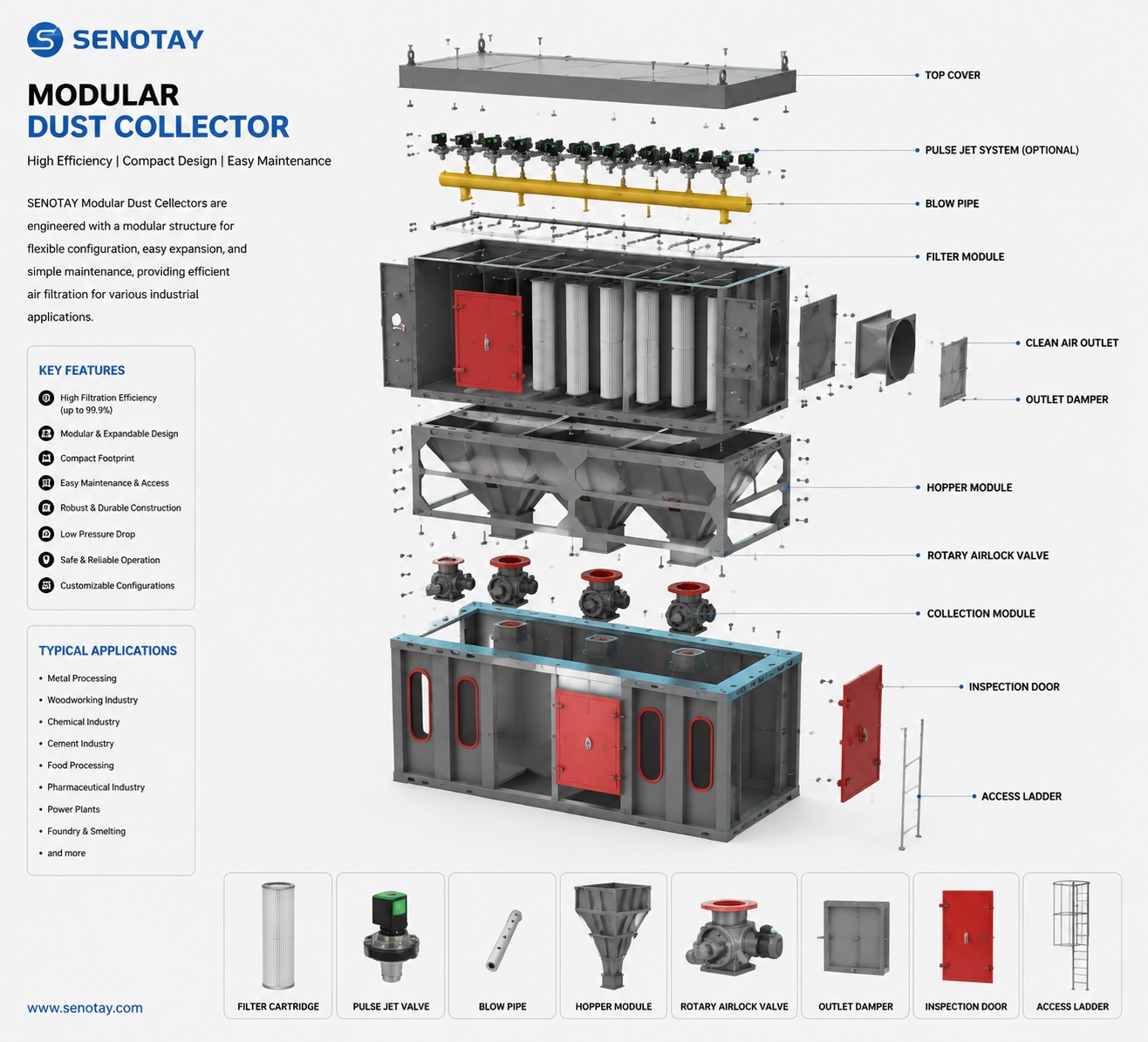
The working principle is straightforward. Contaminated air enters the unit, flows through the filter cartridges, and clean air passes back into the workspace or outside. As dust builds up on the cartridge surface, a pulse of compressed air shakes the cake loose, so the filter keeps working at full efficiency without frequent shutdowns.
In a modular design, each cartridge bank operates as an independent cleaning zone. That means you can service or expand one section while the rest of the system keeps running — a big advantage in facilities that cannot afford to stop production for maintenance.
Choosing between a modular and a fixed system comes down to how your needs are likely to change. The comparison below highlights the practical differences.
Very few factories know exactly what their airflow demand will be in five years. Scaling up, adding a second shift, or introducing a new process can suddenly double the amount of dust a line produces. Scalable filtration systems let you match capacity to reality rather than to a forecast.
Take a metal fabrication shop that adds a robotic welding cell. A fixed system would need to be re-engineered and reinstalled; a modular unit simply receives one more filter bank and a modest fan upgrade. The production line never stops, and the new cell is covered by the same compliance documentation as the rest of the plant. Modular designs shine when:
Production lines or shifts are expected to expand
Several collection points must feed one networked system
The facility rents its space or may relocate
Budget cycles favour staged, predictable spending
Dust control is not a one-size-fits-all problem. Woodworking produces coarse chips and fine sanding dust; metal fabrication generates grinding grit and welding fume; food and pharmaceutical plants handle fine powders that must never contaminate a product. A modular approach adapts to each of these.
Beyond housekeeping, industrial dust is a regulatory matter. Combustible dusts fall under safety codes such as NFPA 652 and ATEX in many regions, and airborne fine particles are limited by occupational exposure standards. Capturing dust at the source protects workers, keeps neighbours happy, and makes compliance audits far less stressful.
There is an operational payoff too. Cleaner air means fewer equipment breakdowns, less product contamination, and lower housekeeping costs — savings that quietly improve the bottom line every year.
The most obvious advantage of a modular dust collector is financial. You avoid the large one-time capital outlay of a custom system and instead invest in stages as your needs become clear. Energy-efficient motors, variable-speed drives, and good filter media also keep running costs down.
Add in longer filter life from effective pulse-jet cleaning, and a well-chosen modular system typically pays for itself through reduced downtime and better air quality. A reputable manufacturer will model these numbers with you before you commit to anything.
Servicing is part of the payback story. Standardised modules mean a technician carries one set of spare cartridges and understands every unit in the plant, so maintenance is fast and predictable. For multi-site companies, the same modular platform can be rolled out across locations, simplifying training, spares stocking, and annual budgeting.
Choosing well starts with understanding your dust. Characterise the particle type and size, determine the airflow you need at each collection point, and be honest about likely growth. Then match the filter media, capture efficiency, and controls to the application. A useful sequence is:
Sample and classify your dust (combustible, hygroscopic, fine, coarse)
Calculate total airflow and required capture velocity
Plan spare capacity for future modules
Select filter media suited to particle size and temperature
Consult a manufacturer — Senotay (senotay.com), for example, has built industrial dust collectors, filtration, ventilation, purification, and conveying equipment since 2005, with ISO 9001, 14001, and 45001 certification
A dust collector made from standardised filter modules that can be added or rearranged as air requirements change. You install what you need now and expand later without rebuilding the system.
It depends on the airflow required to capture your dust effectively. A manufacturer can size the base unit from your process details and show how many modules your growth plan will need.
Yes — that is the point. Most modular collectors are designed so additional filter modules, fans, and hoppers can be added without disrupting the existing installation.
Match the media to your particle size, temperature, and any regulatory requirements. Cartridge filters with different pleat counts and coatings cover most industrial dusts; food and pharmaceutical use may call for HEPA-rated options.
Contact a manufacturer with your dust type, airflow figures, and layout. Senotay’s engineers can recommend a modular configuration and quote both the initial install and future expansion paths.
Dust control should be an asset, not a headache. With a modular dust collector, you get clean air, safer working conditions, and a system that grows alongside your business — without a giant, disruptive project. Talk to the Senotay team, share your process details, and get a recommendation sized for today and ready for tomorrow.