
EN
What are you looking for?
In industrial air pollution control, few technologies are as trusted as the horizontal flow electrostatic precipitator (ESP). Power generation, cement production, steel manufacturing, and other heavy industries rely on it day in, day out. It is the workhorse that keeps particulate emissions within legal limits and protects public health.
Not all horizontal ESP systems are equal, though. A unit can look right on paper and still fall short in service. What separates a system that merely passes spec from one that runs 20+ years with little maintenance comes down to engineering, material quality, and how carefully it is built. That is the gap Senotay (senotay.com), a Chinese manufacturer with two decades in this field, has focused on closing.
Senotay has designed, built, and tested industrial dust collection equipment since 2005, from its 10-stage production facility in Botou, China. The company holds ISO 9001:2015, ISO 14001, and ISO 45001 certifications, and its horizontal ESP systems reach 99.9% filtration efficiency across 30+ industries worldwide. In this guide we look at why horizontal flow ESP technology matters, how it actually works, and what sets the HWES Series apart.
A horizontal electrostatic precipitator is a particulate control device that uses electrostatic forces to pull dust, smoke, and fine particles out of industrial exhaust gas. In a horizontal flow ESP, the gas stream travels horizontally between discharge and collecting electrodes. A high-voltage potential difference between the two creates a strong ionizing field, and that field is what charges and removes the particles.
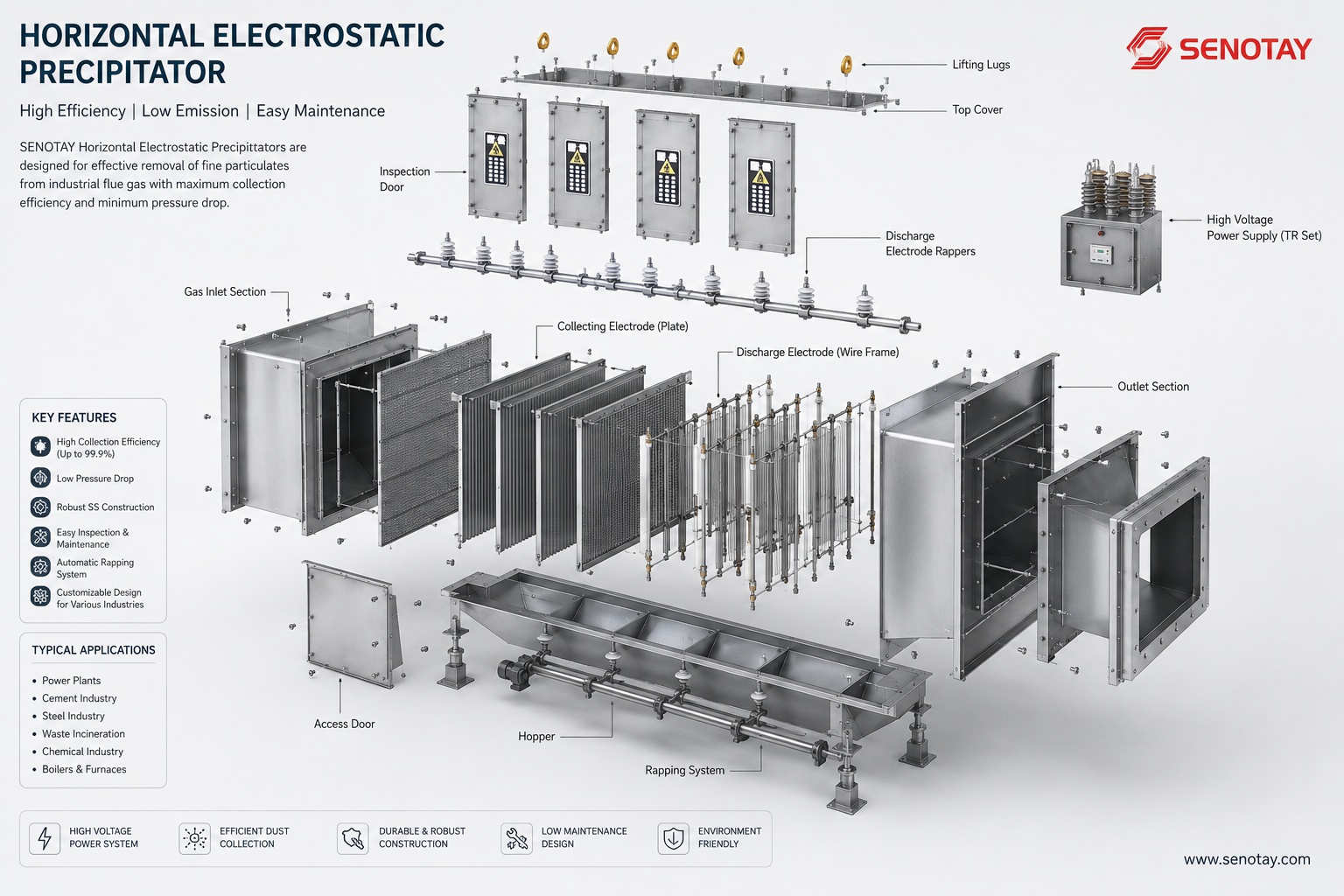
Charging – high-voltage electrodes release electrons into the gas stream and ionize the gas molecules. Those ions collide with dust particles and stick to them, giving each particle an electrical charge.
Collection – the now-charged particles are drawn toward the oppositely charged collecting plates (electrodes) and held there. Because the gas passages run parallel to the flow, treatment is continuous rather than batch by batch.
Removal – a mechanical rapping system periodically knocks the collected dust off the plates. Gravity drops it to the bottom of the casing, where it is collected for disposal.
Horizontal layouts have real advantages over vertical flow designs. Studies show that horizontally oriented electrode ESPs collect particles in the hard-to-catch 300–500 nm range noticeably better, and they hold more than 90% collection efficiency across all particle sizes. Vertical flow ESPs, by contrast, are limited here because they typically have just one electric field to work with.
Horizontal ESPs are also easier on floor space. The layout lets you install the unit with its longitudinal axis at right angles in the ground plan, so you get more capacity inside the same footprint. That makes them a natural fit for retrofit jobs where there simply isn’t room to spare.
Horizontal electrostatic precipitators are used across nearly every corner of heavy industry:
The horizontal flow ESP is especially good with fine fly ash, cement kiln dust, and high-volume power generation applications. Outlet concentrations stay consistently under 10 mg/Nm³, so these systems clear even the strictest emission limits in the world.
Senotay’s HWES Series Horizontal Electrostatic Precipitator is the result of two decades of building this kind of equipment. It is designed for high-volume industrial duty and copes with heavy dust loads and high-temperature gases with minimal pressure loss, holding up for years without fuss.
The HWES Series starts from high-grade raw materials and is built around state-of-the-art high-voltage technology:
Casing – mild steel or stainless steel (customizable)
Electrodes – high-tensile carbon steel or corrosion-resistant alloy
Insulators – ceramic or porcelain for high dielectric strength
Rapper system – mechanical/hammer/anvil type for reliable dust removal
Transformer-rectifier – steady high-voltage DC power supply
The numbers speak for themselves: energy consumption of 0.2–0.4 kWh per 1,000 m³, no filter bags to replace, continuous 24/7 operation, and a 20+ year service life. For high-volume, high-temperature streams full of fine particulates, no other technology matches that mix of efficiency and low lifetime cost.
Senotay, operating as Hebei OuTai Environmental Protection Equipment Co., Ltd., has been a major name in industrial air pollution control since 2005. Its 15,000+ m² manufacturing facility in Botou, Hebei Province, turns out the full range of dust removal equipment:
Pulse Jet Bag Filters (standard, high-temperature, anti-static)
Electrostatic Precipitators (ESP) —dry, wet, multi-field configurations
Cyclone Dust Collectors
Wet Dust Collectors (scrubbers)
Filter Cartridge Collectors
VOC Purifiers
ISO 9001:2015 — Quality Management System
ISO 14001 — Environmental Management
ISO 45001 — Occupational Health & Safety
CE Certified — European market compliance
Every Senotay dust collector goes through a rigorous 10-stage production process, starting with engineering analysis of the actual process conditions and ending with a documented pre-shipment test record. We do not build generic catalogue units. Each system is sized for the real gas volume, temperature, dust type, and emission limit of its intended application.
We serve 30+ industries across several continents, with a track record of 99.9% filtration efficiency and a habit of custom-engineering every unit. Whether the job is fine fly ash from a coal-fired boiler, cement kiln dust, or hot process gas, our engineering team delivers systems that meet the regulations and usually beat them.
Horizontal ESP systems have to satisfy emission limits that keep getting tighter, both globally and regionally. In China, cement kilns must meet GB 4915-2013, which caps emissions at 30 mg/Nm³. For aluminum processing, GB 25465-2013 tightened the limit from 100 mg/m³ down to 10 mg/m³. Senotay’s HWES Series holds outlet concentrations below 30 mg/Nm³ as standard, and optional configurations reach 10 mg/Nm³ or less.
Internationally, Senotay equipment is built to meet EU emission standards and ISO 9001:2015 quality requirements. CE certification confirms it complies with European health, safety, and environmental protection rules.
Q: What is a horizontal electrostatic precipitator (ESP)?
It’s a device that removes fine particulates from industrial exhaust using electrostatic forces. Gas flows horizontally through ionizing electrodes, charged particles are caught on grounded plates, and a rapping system periodically knocks the accumulated dust loose.
Q: What industries use horizontal ESP systems?
Power generation, cement manufacturing, steel production, chemical processing, and waste incineration.
Q: What efficiency can Senotay’s HWES Series achieve?
Up to 99.9% dust removal efficiency, with outlet concentrations below 30 mg/Nm³ and an optional configuration that reaches under 10 mg/Nm³.
Q: How does a horizontal ESP compare with a baghouse?
An ESP runs at 50–150 Pa pressure drop, against 500–1500 Pa for a baghouse, so the fan uses a lot less energy. There are no bags to replace, and service life runs 20–25 years.
Q: What certifications does Senotay hold?
ISO 9001:2015, ISO 14001, ISO 45001, and CE certified.
Q: Can Senotay customize ESP systems for specific applications?
Yes. Every system is engineered around the actual gas volume, temperature, dust type, and emission limits of the application.
For high-volume, high-temperature particulate control, the horizontal flow electrostatic precipitator is still the go-to technology. Its efficiency, low running cost, and long service life make it hard to replace for power plants, cement kilns, and steel mills.
Senotay has spent two decades getting this technology right. From its ISO-certified plant in Botou, China, we ship horizontal ESP systems that pair factory-direct pricing with certified quality and comprehensive after-sales support. Every HWES Series unit is engineered for the specific demands of its application, because in air pollution control, one size never fits all.
Ready to talk through your particulate control requirements?
Visit senotay.com or get in touch with Senotay’s engineering team for a solution tailored to your process conditions.