
EN
What are you looking for?
Welding fumes is easy to ignore and hard to defend. The smoke drifting off a bead contains metals that, inhaled over years, do real damage, and the rules around it keep tightening in almost every market. That is why welding fume extraction technology has quietly become one of the fastest-growing purchases in fabrication shops worldwide. The question is no longer whether to control the fume, but which system to choose, and that answer varies a lot by region, industry and process. This guide compares the main approaches side by side, maps how different parts of the world buy them, and helps you match a Welding Fume Purifier to your shop.
Capture the fume at the arc and you solve most of the problem cheaply.
Ambient and portable purifiers have a role, but they are complements, not substitutes, for source capture.
Compliance drives the market: regional rules shape what shops install first.
Filter media and airflow matter more than brand names.
A supplier with worldwide distribution experience simplifies certification and spare parts.
The science has been settled for years. Stainless and coated steels release hexavalent chromium, and manganese fumes from ordinary welding affect the nervous system at doses regulators once considered safe. Combined with tightening exposure limits, that has turned fume control from a nice-to-have into a legal and commercial requirement for any shop that wants long-term workers, clean audits and export business.
Deferring fume control rarely saves money. Regulatory fines and stop-work orders are the visible cost, but the quieter ones are larger: compensation and insurance claims that surface years later, skilled welders who leave for cleaner shops, and buyers who drop suppliers that fail a ventilation check. For the price of a single workstation's welding fume purifier, a shop removes the whole category of risk.
Worker protection: respiratory harm compounds over years and is largely preventable at the source.
Compliance: exposure limits for welding fume are tightening in North America, Europe and Asia.
Export requirements: buyers increasingly audit supplier ventilation as part of qualification.
Productivity: clean air means less downtime for fatigue and fewer rejects on sensitive parts.
Different jobs need different tools. The comparison below covers the four approaches that dominate the market, and the honest trade-offs of each.
Each of these can be built around a welding fume purifier with the right filter media and airflow. The technology choice is really about where the contaminant is captured, and that single decision drives most of the cost and effectiveness.
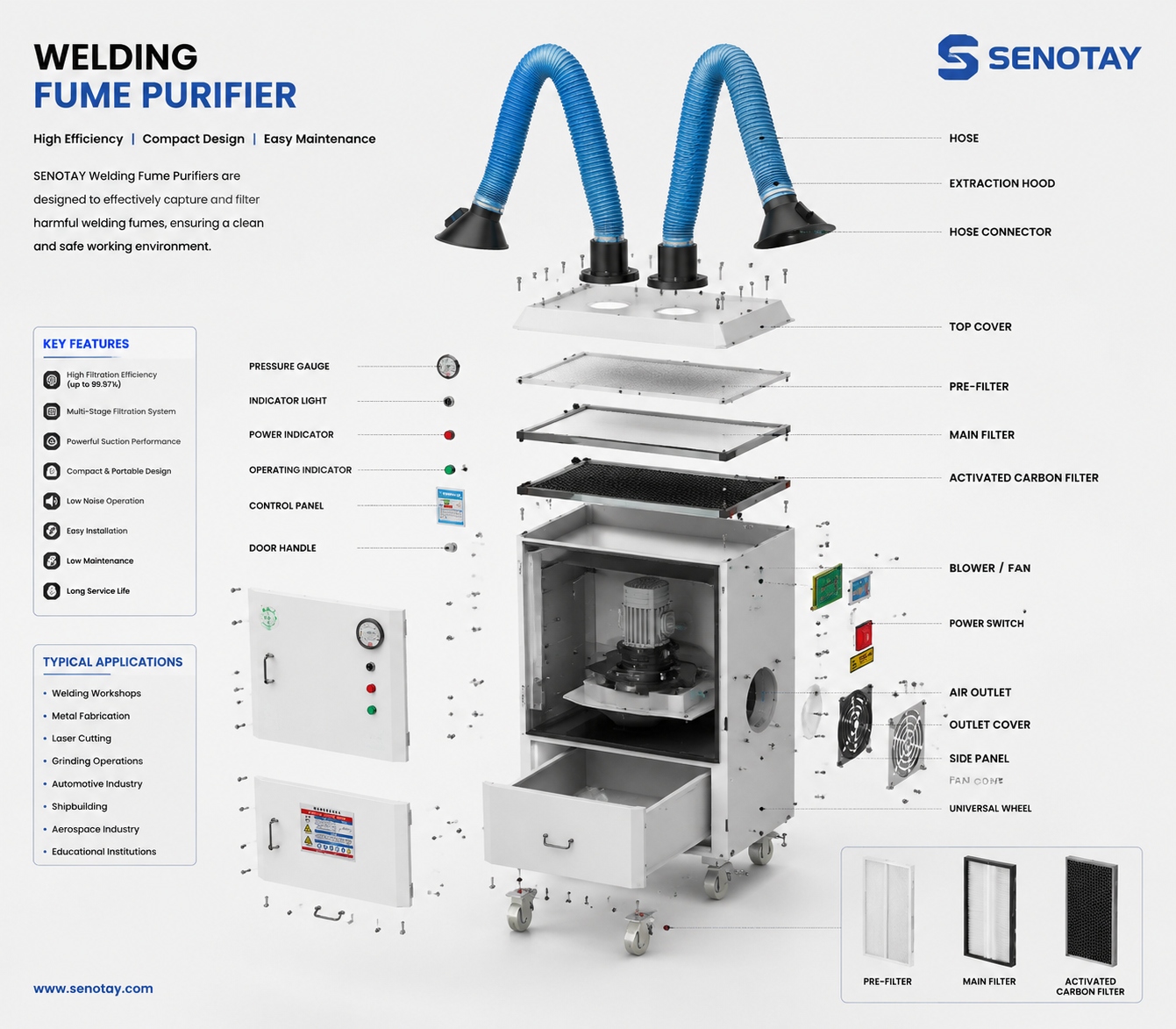
Whatever the capture point, the cleaning core looks similar. Fume is drawn into a spark trap that catches the embers and large particles that would otherwise damage the media. A pre-filter collects the coarse dust, then the fine fume reaches the main filter, typically HEPA or fine-pleat polyester media capable of trapping sub-micron particles. A fan on the clean side pulls the air through and returns it to the shop, while a control panel tracks the pressure drop and signals when the filter is full. Each component is replaceable, which is why filter and parts availability matters as much as the initial price.
The strongest finding across every market study is consistent: capture the fume at the arc and you solve most of the problem cheaply. Ambient cleaning has a role, but it is a complement, not a substitute.
Source capture removes fumes before it reaches the breathing zone, which is the point of exposure limits.
Ambient units clean the whole hall, but the welder still breathes a plume on the way to the filter.
The best layouts combine both: source capture for the worker and ambient units for background air.
Portable purifiers earn their keep on mobile crews and in the field where ducting is impossible.
A useful mental model is that source capture controls the worker, and ambient cleaning controls the room. Most serious installations start with the first and add the second as budgets allow. Asking which one to buy is really asking about the exposure problem you are solving today, and most shops should start at the arc.
Adoption patterns look different across the world because the drivers differ: regulation in Europe, liability in North America, and export pressure with rising standards in Asia. Mapping them shows where the market is heading.
A few industries shape most of the market. Robotic welding cells run nearly continuously, which drives demand for durable industrial welding smoke extraction systems with long filter life. Shipyards and heavy fabrication work in large open spaces where ambient and mobile units dominate. Battery and EV production adds a new layer, because joining battery components introduces metals with tighter limits on weld smoke control. Wherever these sectors cluster, local suppliers and standards tend to follow, which is why distribution patterns mirror industrial geography.
Matching the unit to the workload is where most buying mistakes happen. The good news is that the calculation is straightforward if you feed the supplier honest numbers.
Airflow: the purifier needs enough flow to move fume at the capture point, typically 500–1,000 m³/h per arm.
Filter class: HEPA or fine-pleat media for fine fume; coarse sparks need a spark trap first.
Metal type: stainless and coated steels demand stronger filtration than mild steel.
Duty cycle: continuous robotic welding needs a more robust design than occasional bench work.
Local service: confirm filter availability and support in your region before you buy.
A quick example keeps the math concrete. Sizing a welding fume purifier for four MIG stations, each drawing 800 m³/h at the nozzle, needs a system rated for roughly 3,200 m³/h plus duct losses. Choosing a unit for one station and sharing it across four is the classic sizing error: every station ends up under-powered and fume escapes. Slightly oversizing, within reason, costs little at purchase and keeps capture strong as the shop grows.
Filter class is the other number worth understanding. Fine weld fume sits in the sub-micron range, so a basic dust filter catches the mass but lets the health-critical fraction escape. HEPA or high-efficiency fine-pleat media is the standard for industrial air purification in welding shops, and some suppliers offer flame-retardant options for higher-risk processes. Match the class to the metal you weld, not to the lowest price.
A unit that captures welding smoke at or near the arc and passes it through filter media before returning clean air to the shop. It can be a portable unit, an arm system or a source-capture nozzle.
Source capture first, always. Ambient cleaning is a complement for background air, not a replacement for capturing fumes at the breathing zone.
It depends on duty and metal type. Monitor the pressure drop across the filter and replace when it climbs past the manufacturer's limit, rather than on a fixed calendar.
Yes, with the right airflow rating and ducting. Each arm needs its minimum flow, so add up the stations and size the unit from the total.
Usually not, but sparks and embers require a spark trap before the filter. Confirm the setup with your supplier and local regulations.
Welding fume systems are an investment in people, compliance and the future of the business. The worldwide trend is one-way: tighter limits, better capture, cleaner shops. Senotay has designed and built industrial dust collectors, air filtration, ventilation, purification and conveying equipment since 2005, with ISO 9001, ISO 14001 and ISO 45001 systems and installations shipped worldwide. Send your process data, including welding type, metals, station count and airflow, and get a recommendation built around your shop rather than a catalog page.
Whichever path your shop takes, start with the fundamentals: capture at the source, size the airflow honestly, and buy from a supplier that stands behind the filter, the fan and the warranty. The systems that win worldwide are the ones that keep working in year two, not just the ones that look good in year one.
Ready to match the right purifier to your facility? Send your welding data to Senotay at senotay.com for a free sizing recommendation and quote.