
EN
What are you looking for?
When dust gets into the air of a facility, it eventually gets into everything else: lungs, machines, finished goods and inspection reports. Industrial dust is more than a housekeeping nuisance. It is a fire risk, a product-quality risk and a compliance risk. That is why the DMC Pulse Jet Baghouse Dust Collector is one of the most common pieces of equipment in factories, mills and processing plants worldwide. It captures dust at the source, cleans itself automatically and returns clean air to the work area or the atmosphere. In this guide we'll explain how pulse jet baghouse filtration works, where a DMC single pulse dust collector earns its keep, and what you actually need to verify when sourcing one globally.
A DMC baghouse cleans itself with short bursts of compressed air while the main fan keeps running.
It handles high dust loads and continuous operation far better than cartridge-style collectors.
Correct sizing air volume, air-to-cloth ratio and temperature matters more than brand.
Buying from a Chinese manufacturer can cut cost by 30 to 50 percent if you verify certifications, testing and support.
Maintenance is simple but non-negotiable: bags, pulse valves, controller and hopper discharge.
A baghouse is essentially a large metal box filled with cylindrical filter bags, arranged in rows and mounted on a tube sheet. Dust-laden air is pulled in through the inlet, passes over the bags, and clean air exits the top while the collected dust drops into a hopper below. The DMC single pulse design stands out because of how it cleans. Instead of shaking the bags or stopping the airflow, it fires a short blast of compressed air down each bag, flexing the fabric so the dust cake falls away. Because cleaning happens in rows while the rest of the collector keeps filtering, the system runs continuously, which makes it ideal for round-the-clock production.
Filter bags and cages: the fabric sleeves that capture dust and the wire frames that hold them open.
Pulse valves and header: the solenoids and air manifold that deliver the cleaning bursts.
Control panel: the programmable controller that cycles rows on a timer or pressure signal.
Hopper and rotary valve: where the dust collects and is discharged continuously or in batches.
Fan and ducting: the air mover and piping that keep the system under the right negative pressure.
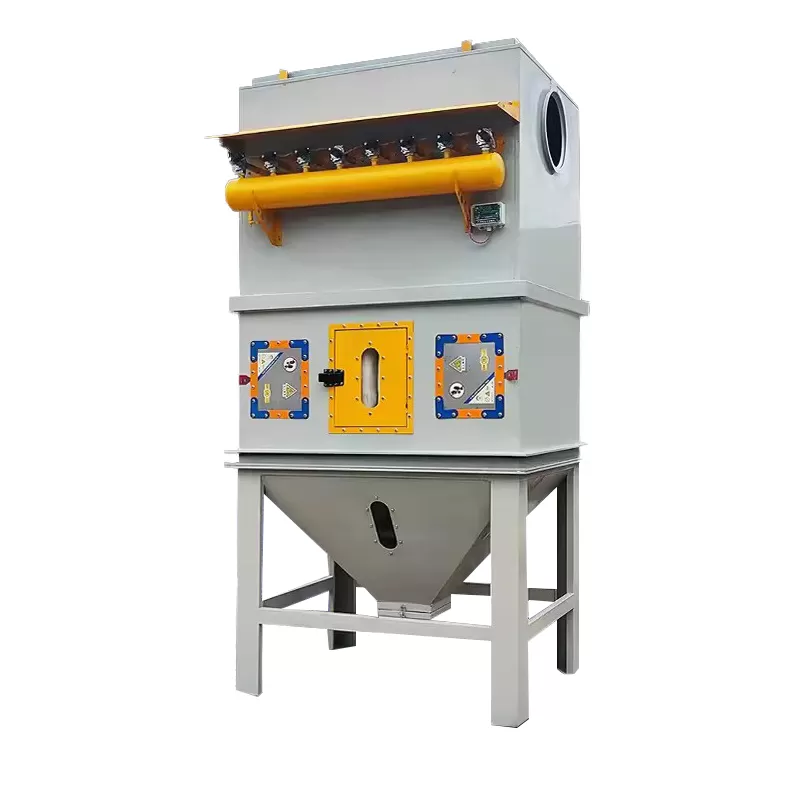
Follow one particle and the whole system becomes clear. Dusty air enters the inlet and slows down inside the housing, so the heaviest particles fall straight into the hopper. The fine dust keeps moving and settles onto the outside of the filter bags, where it builds into a porous cake. That cake is actually part of the filter; it captures even finer particles than the fabric alone. Clean air passes through the fabric and out the clean-air plenum. Meanwhile, the controller opens the pulse valve for one row of bags, sending a 0.1-second burst of compressed air down each bag from the inside. The bag flexes, the cake releases and drops into the hopper. The row goes back to filtering, and the next row takes its turn. No shutdown, no interruption, no loss of suction.
The pressure differential across the bags is the heartbeat of the whole system. A clean set of bags reads only a few hundred pascals; as the cake builds, the number climbs. The controller can trigger cleaning on a timer or on a differential-pressure signal, and well-run installations trigger on pressure so they clean only as often as needed. Cleaning more aggressively than required wastes compressed air, which is often the largest running cost after the fan itself.
If your process generates fine, dry dust continuously, a DMC single pulse dust collector is usually the right answer. It is a proven workhorse across dozens of industries.
Cement, concrete and mineral processing where dust loads are heavy and constant.
Grain, feed and food handling where product purity and fire safety both matter.
Woodworking and MDF lines with fine sanding and sawing dust.
Welding and metal fabrication where fume capture protects operators.
Chemical and pharmaceutical powder handling with strict emission limits.
Plastics and recycling plants handling abrasive regrind material.
Bag media selection deserves its own decision. Polyester handles most normal-temperature dust at low cost. Nomex and similar aramid media extend the range for hot process gas, while PTFE and coated glass media cope with aggressive chemicals and very high temperatures. For conductive or potentially explosive dust, anti-static bags with carbon-impregnated fibers and proper earthing are the rule, not the exception. A good supplier recommends media from your dust data rather than from a price list.
Sourcing filtration equipment from China has become standard practice for good reasons: mature supply chains, strong engineering talent and genuinely competitive pricing. The discipline is in the verification, not the decision. A reputable supplier welcomes the questions below because they separate serious buyers from price shoppers.
Confirm the supplier holds real third-party ISO certifications, and check the certificate scope covers what you are buying.
Ask for a detailed datasheet: air volume, filtration area, bag count, material and expected pressure drop.
Request test records or a factory acceptance test (FAT) before shipment, especially for custom builds.
Verify the fan and motor brands, and confirm the electrical build matches your local voltage and standards.
Clarify shipping terms, lead time, spare-bag availability and how quickly they respond to technical questions.
Get the warranty and commissioning support in writing before you pay a deposit.
Working with a supplier many time zones away is manageable when communication is structured. Look for a contact who answers in clear English within a business day, sends written minutes of technical calls and shares progress photos or videos during manufacturing. These habits feel minor until a problem appears and you need an answer at nine in the morning.
Senotay has designed and built industrial dust collectors, air filtration, ventilation, purification and conveying equipment since 2005, holding ISO 9001, ISO 14001 and ISO 45001 management systems that cover quality, environment and occupational health and safety. That combination is exactly what a global buyer should look for: a supplier that documents its own performance instead of asking you to take it on trust.
Most baghouse problems are sized on paper before they ever reach the shop floor. Give the supplier your process data and let them size the system, but keep these five numbers in view so you can sanity-check the proposal.
A baghouse is forgiving right up until it is not. The pressure differential across the bags is the single best early-warning signal: a sudden jump usually means blocked bags or a dead pulse valve, and a slow climb means the cake is not releasing. Build the maintenance routine below into the site schedule.
Typically every two to five years depending on dust load and abrasiveness. Track the pressure differential so you catch a failing bag before it becomes a compliance problem.
Yes, with the right design. Specify your dust class so the unit can be fitted with explosion venting or suppression, anti-static bags and proper earthing.
A pulse jet cleans with short compressed-air bursts while the fan keeps running. A shaker unit stops the airflow and physically shakes the bags, which suits lower-duty, batch processes.
For heavy coarse dust loads, a cyclone pre-separator removes the bulk of the material first and extends bag life. For fine dust it is usually unnecessary.
Buying dust collection is really buying clean, compliant and safe operation. A DMC pulse jet baghouse dust collector delivers that in a proven, low-maintenance package, and sourcing it well means verifying more than a price. Senotay has built dust collectors, air filtration, ventilation, purification and conveying equipment since 2005, with ISO 9001, 14001 and 45001 systems and installations shipped worldwide. Send your dust data, including material, particle size, airflow and temperature, and get a sizing recommendation and quote for a DMC system built around your process, not a catalog copy.
Ready to size the right system? Send your process data to Senotay at senotay.com for a free sizing recommendation and quote.