
EN
What are you looking for?
Walk into any welding bay, powder line, or grinding cell and the problem is the same: airborne dust that hangs in the air, settles on machines, and finds its way into lungs. An industrial cartridge dust collector is the modern answer, but choosing one is not simple — efficiency, airflow, energy, filter life, and total cost all compete. This report benchmarks cartridge dust collection systems against the alternatives, compares filtration media side by side, and gives you a practical framework for picking the right system for your plant.
Cartridge collectors typically capture 99%+ of fine and respirable dust.
Pleated filter cartridges beat bags and cyclones on efficiency, footprint, and maintenance.
Filter media choice drives both performance and running cost.
Energy, downtime, and filter replacement often outweigh the purchase price over a system's life.
Compliance with workplace exposure limits starts with correct sizing and filtration class.
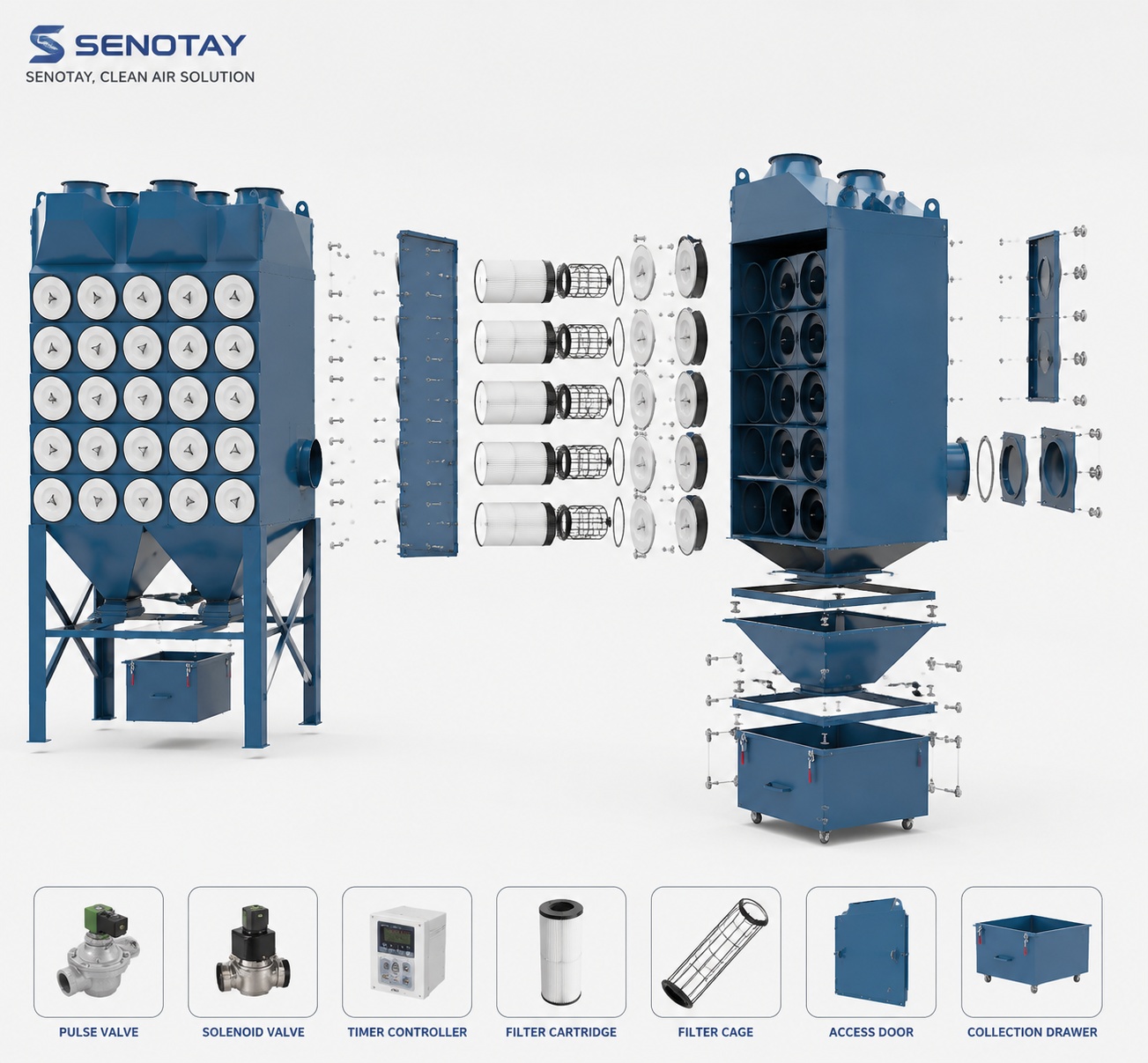
At its core, a cartridge dust collector moves dust-laden air through a set of pleated filter cartridges. Particles collect on the media surface while clean air passes through to the fan and out the stack. When the layer of dust thickens, a pulse-jet system blasts compressed air through each cartridge in sequence, knocking the cake loose so it drops into the hopper below. The pleats are the trick: they pack a lot of filter area into a small footprint, which is why cartridge systems can be so compact compared with older technologies.
Dust-laden air enters the inlet; heavy particles drop into the hopper first.
Pleated cartridges capture fine and respirable dust on the media surface.
Reverse pulse cleaning keeps filters from blinding while the fan keeps running.
Clean air exits the outlet — often clean enough to return to the workspace.
To see where cartridge filtration technology earns its place, it helps to benchmark it against the two common alternatives: the baghouse, which uses long fabric bags, and the cyclone, which separates dust by spinning it out of the airstream. Each has strengths; the table below compares them across the decisions that actually matter to a plant.
Table 1. Cartridge collectors benchmarked against bags and cyclones
The pattern is clear. Cyclones are cheap but only catch coarse dust, so most modern plants use them for pre-separation. Baghouses handle enormous volumes and high temperatures, but they are large and their bags leak at the seams. Cartridge collectors sit in the middle: high efficiency on fine dust, compact, and quick to maintain.
The cartridge is where performance lives, and not all cartridges are equal. Media choice determines what particle size you capture, how often you replace filters, and how much energy the fan needs. The table below benchmarks the main media families used in industrial cartridge dust collection systems.
Table 2. Cartridge media compared for a pleated filter dust collector
Two numbers matter more than most: airflow, measured in cubic feet per minute (CFM), and pressure drop. CFM decides how much dust you can pull from how many capture points. Pressure drop decides how hard the fan has to work — and the fan is usually the biggest energy cost in the system. A collector running at 3 kPa instead of 1.5 kPa can burn noticeably more electricity every shift, so well-sized systems with a sensible filter-to-air ratio keep pressure drop low and stable.
Worth knowing: face velocity — the air speed across the cartridge face — should stay within a recommended range for your dust type. Too fast and fine particles punch straight through the media; too slow and you are hauling more steel than you need. A reputable supplier calculates the filter-to-air ratio for your application rather than guessing at a fan size, and that single number separates a system that stays clean for years from one that blinds in months.
Purchase price is the smallest part of owning a dust collector. Over five years, energy, filter replacements, and downtime typically dwarf the initial equipment cost. That is why a cheap unit with poor media can end up costing more than a well-built system within the first year.
Energy: every kilopascal of extra pressure drop increases fan power — and it compounds hourly.
Filters: replacement cartridges are a recurring cost; media quality sets their lifespan.
Downtime: filter changes and bag failures stop production; simpler changes win.
Compliance: failed emissions or exposure tests can mean fines and shutdowns.
Workplace exposure limits set by regulators — and increasingly strict local emissions rules — define the bar your collector has to clear. For fine, hazardous, or combustible dust, that bar is high, and a pleated filter dust collector with the right media is often the practical way to meet it. Ask your supplier for test data and standard compliance documentation up front, not after installation.
And remember: the collector is only part of the system. Regulators look at the whole path from source to stack, so capture efficiency at the hood matters as much as the filter class on paper. A system that is well-sealed and properly balanced is the one that passes an inspection on the first visit.
Get the selection steps right and the system pays for itself; get them wrong and you are buying filters twice. Walk through this list before you call suppliers.
Identify the dust: type, particle size, combustibility, moisture, and temperature.
Count the capture points and estimate the total airflow (CFM) you need.
Decide the target filtration class — from general process dust up to HEPA-class fine dust.
Factor in safety: explosion vents, spark arrestors, and grounding for combustible dust.
Compare lifetime cost, not just sticker price — including filter life and energy.
Choose a supplier with a real track record and local service and spare parts.
A cartridge collector uses pleated filter cartridges that pack more filter area into less space, capture finer dust, and are quicker to replace. Baghouses handle very large volumes and high temperatures but take up more room and are more prone to leaks at the bag seams.
It depends on the dust load, media quality, and cleaning system — typically anywhere from six months to two years. Good pulse-jet cleaning and a properly sized system extend cartridge life considerably.
Yes, if it is built for it. Combustible dust requires explosion venting or suppression, proper grounding, and often a safety monitoring filter. Confirm your supplier's equipment meets the relevant standards for your specific dust.
Add up the airflow required at each capture point — hoods, ducts, machines — with a safety margin, then match that to the collector's rating. A professional sizing visit is worth it; undersized systems underperform and blind filters fast.
A cartridge dust collector is a long-term investment in air quality, compliance, and plant uptime. Benchmarking the options by efficiency, energy, and lifetime cost — rather than sticker price — is the way to choose well. That is exactly how Senotay has built industrial air cleaning systems since 2005, with ISO 9001, 14001, and 45001 certifications backing our quality and environmental practice. Tell us about your dust and your process, and we will help you size the right system for the job.
Contact Senotay at senotay.com for a free sizing consultation on cartridge dust collectors and industrial air cleaning.