
EN
What are you looking for?
Plants don’t hold still for long. A fabrication shop bolts on another welding cell. A woodworking operation doubles its router line. A pharma company outgrows pilot batches and moves into full commercial runs. Every one of those moves pushes more dust and fumes into the air, and every one of them runs into the same wall: the dust collector you installed three years ago is now undersized.
A single-unit collector corners you the moment you outgrow it. The options are all bad. Run the system past its design limits and you’re gambling on emissions violations and filter failure. Rip the whole unit out for a bigger one and you’re facing serious capital plus weeks of downtime. Or bolt on a second collector and duplicate the ductwork, the controls, and every maintenance headache that follows.
There’s a better answer: an expandable industrial dust collector that sits on a modular platform. You don’t buy a new system. You add to the one you already own, one module at a time, whenever throughput climbs. That idea is what drives the Modular Dust Collector — standard, pre-built units that bolt together, expand, and get reconfigured without bringing the plant down.
Senotay (senotay.com) has been manufacturing industrial dust collectors and air filtration equipment in China since 2005, and it holds ISO 9001, ISO 14001, ISO 45001, and CE certifications. Its HMD Series Modular Dust Collector covers airflow requirements from 5,000 to 200,000 CFM, all through standardized modules, and does it with 99.9% filtration efficiency and factory-direct pricing.
A modular collector works differently from a conventional single-unit system — the difference sits in how it scales. The underlying idea is simple enough: filtration capacity is additive.
Industrial air management has been drifting this way for years. The traditional setup runs one high-rated power unit serving the whole facility through long, complicated duct runs. Smaller standardized collectors working side by side change the math. They give you zone control, incremental expansion, and fault tolerance — lose a single module and the rest of the factory keeps producing.
Senotay’s HMD Series Modular Dust Collector is where twenty years of manufacturing experience settles into a product. Each module uses heavy-gauge welded construction and offers high-efficiency cartridge or bag filtration options, with independent pulse-jet cleaning systems running in parallel.
1. Scalable and Adaptable Design. A single module moves 5,000–20,000 m³/h airflow, and the array can scale to 100,000+ m³/h, so capacity keeps pace as your output climbs.
2. Regulatory Compliance. Each unit ships with CE, ISO 9001:2015, EN ISO 16890, and ATEX Zone 22, which keeps installations inside both EU and OSHA requirements.
3. High-Efficiency Filtration. PTFE and polyester media hold 99.9% filtration efficiency under real operating conditions.
4. Energy Efficiency. Airflow paths are laid out to cut power draw by 20–40% against a conventional system.
5. Maintenance-Friendly Construction. Filters swap out fast, pulse-jet cleaning runs on its own, and live differential pressure readings flag problems before uptime suffers.
6. Future-Proofing. Need more air volume down the road? Add filter modules to the unit you already own instead of starting over.
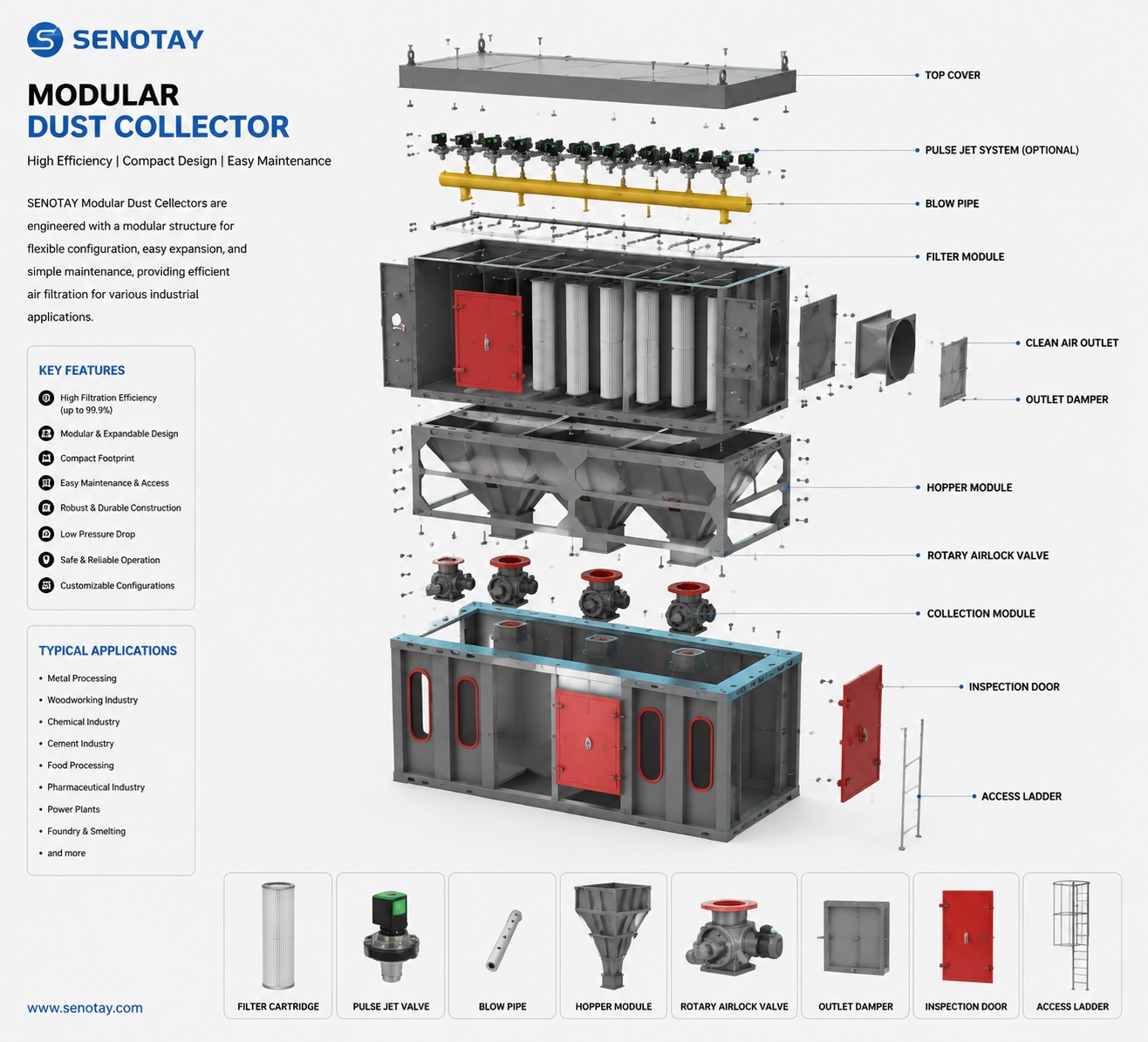
Each module in a Senotay modular system is a complete filtration unit on its own. Here’s what goes into one:
Filter Housing: A welded heavy-gauge steel enclosure, with optional coating for corrosive air
Filtration Element: Your pick of cartridge (pleated media) or bag (woven fabric)
Pulse-Jet Cleaning System: Solenoid valve, compressed-air manifold, and venturi nozzles
Differential Pressure Sensor: Tracks how loaded the filter is, continuously
Access Door: Quick-release, so filter changes take minutes rather than hours
Inlet and Outlet Ducts: Standard flanges, so one module bolts straight onto the next
Common Header: A shared inlet manifold spreads dust-laden air evenly across every module
Parallel Operation: Each module handles its own airstream, start to finish
Independent Cleaning: Pulse-jet timing is set per module, so cleaning one never disturbs its neighbors
Central Control Panel: A PLC watches every module and reports alarms with diagnostics
Running in parallel buys something a single large unit can’t offer: if one module requires service, the remaining modules continue filtering. Output keeps moving. Put that beside a monolithic baghouse or cartridge collector, where one torn filter or a stuck cleaning cycle can take the whole system down.
Senotay modular collectors are at work in 30+ industries around the world — anywhere a plant needs room to grow and tight capture of fine particulate:
With the ability to capture particles down to 0.3 microns with HEPA-grade media, the system suits processes where the air has to be genuinely clean and the standards are strict.
Senotay runs a 15,000+ m² ISO 9001:2015, ISO 14001, and ISO 45001 certified facility in Botou, Hebei. Nothing leaves the factory without being custom-engineered, in-house fabricated, and pre-shipment tested first.
Senotay sells factory-direct procurement, which strips out design fees and middleman costs. You’re buying modular filtration at wholesale numbers.
1. Fast, Free Shipping. Components leave regional distribution centers within 48 hours, and freight is covered for qualifying destinations.
2. Comprehensive After-Sales Support. Technical consultation for as long as you own the equipment, OEM filters and parts, and remote troubleshooting when something looks wrong.
3. Staged Investment. A monolithic system wants one enormous check up front. Modular lets you expand step-by-step expansion and match spending to the growth you’ve actually seen.
Q: What is a modular dust collector?
It’s a filtration system assembled from standardized, pre-engineered modules. As airflow demand climbs, you combine more of them. Where a monolithic collector forces a full replacement, a modular one simply takes another module.
Q: What is an expandable industrial dust collector?
It’s a collector built to gain filtration capacity over time rather than at the drawing board. Senotay’s HMD Series does it with parallel modules — each handling 5,000–20,000 m³/h — that link together to reach 100,000+ m³/h.
Q: What airflow capacity can Senotay modular collectors achieve?
Senotay HMD Series handles 5,000 to 200,000 CFM — roughly 100,000+ m³/h total — by stacking standardized modules.
Q: What filtration efficiency do Senotay modular collectors achieve?
Senotay modular collectors hold 99.9% filtration efficiency at 0.5 µm. Move up to the higher-efficiency media and that figure reaches 99.95% at 0.1 µm.
Q: How does a modular collector reduce energy consumption?
Senotay’s airflow design drops energy use by 20–40% against conventional systems. Modules only run when there’s air to move, and per-module pulse-jet cleaning keeps them from over-cleaning.
Q: What certifications does Senotay hold for modular dust collectors?
Senotay carries ISO 9001:2015, ISO 14001, ISO 45001, CE, EN ISO 16890, and ATEX Zone 22, covering the major global industrial standards.
Q: Can Senotay customize modular collectors for specific applications?
Yes. Nothing is built to a generic spec — actual gas volume, temperature, dust type, and emission limits drive the design. And because the platform is modular, capacity can still grow later.
Dust control shouldn’t be a decision you make once and regret the first time production grows. The Modular Dust Collector and the Expandable industrial dust collector mark a real shift in how plants handle air filtration — away from fixed monolithic equipment and toward scalable, future-proof platforms that expand alongside the business.
Senotay has been building this equipment for twenty years, and the product shows it. From an ISO-certified plant in Botou, China, the company ships HMD Series Modular Dust Collectors that pair factory-direct pricing with certified quality (ISO 9001, ISO 14001, ISO 45001, CE, ATEX), 99.9% filtration efficiency, and 20–40% energy savings. Capacities run from 5,000 to 200,000 CFM, and the modular layout means a system can grow without a shutdown. Every Senotay unit is specified around the process it will actually serve — because in industrial dust control, one size does not fit all.
Ready to discuss your modular dust collector requirements?
Visit senotay.com or talk to Senotay’s engineering team about a solution built around your process conditions and emission targets.